
Ancient Egyptian Astronomy
How Egyptians tracked stars to measure time, align temples, and map the afterlife. Grounded in Pyramid Texts and astronomical ceilings.
Contents
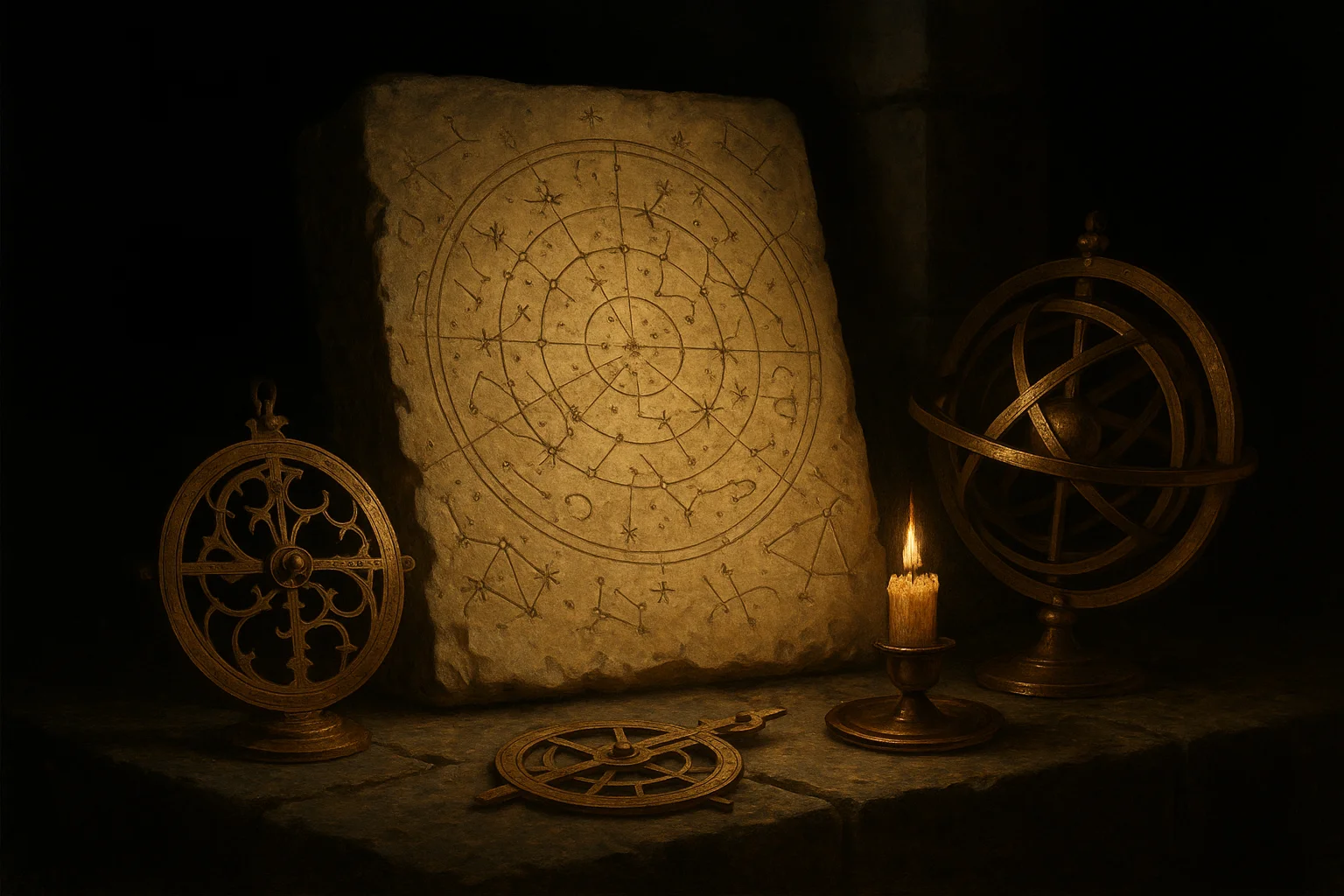
Ancient Egyptian astronomy was a sacred science that unified celestial observation with divine cosmology, using stellar cycles to regulate temple rituals, construct calendars, and map the afterlife. The Egyptians identified 36 decans, star groups that rose at ten-day intervals, and aligned monumental architecture to solar and stellar events recorded in the Pyramid Texts and on tomb ceilings. This knowledge shaped religious practice, agricultural cycles, and the architecture of eternity itself.
Modern accounts often strip Egyptian astronomy of its theological context, treating it as proto-science divorced from belief. Yet every star chart painted on a coffin lid and every temple axis aligned to the solstice was an act of worship. The sky was not merely observed. It was inhabited by Egyptian gods, and its movements dictated the rhythm of creation.
The Sky as Sacred Architecture
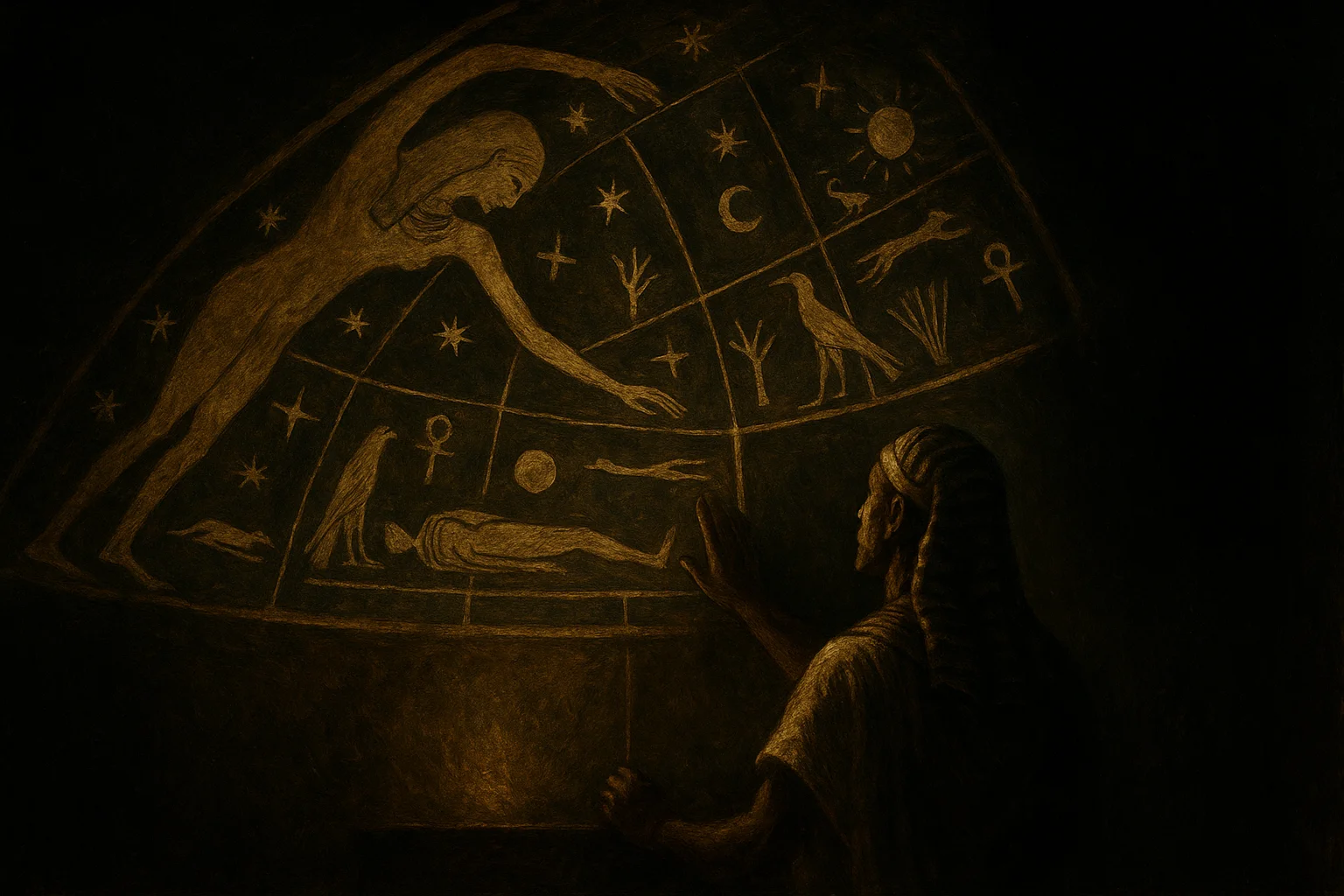
The Egyptians conceived the cosmos as a structure. Nut, goddess of the sky, arched over the earth, her body spangled with stars. Geb, the earth god, lay beneath her. Between them, Shu held the heavens aloft. This was not metaphor. It was cosmology rendered in stone and paint.
Pyramid Texts, Utterance 251, describe the deceased king ascending to join the imperishable stars, the circumpolar constellations that never set. These stars were eternal, immune to the cycle of death that governed the rest of creation. The southern sky, by contrast, held the decans, stars that rose and set in predictable sequence. The two zones mapped different destinies: permanence above, cyclical renewal below.
Observation was ritual. Priests tracked the heliacal rising of Sirius, the moment the star reappeared on the eastern horizon just before dawn after weeks of invisibility. This event, called peret Sopdet, signaled the annual Nile flood and the start of the new year. The star was Sopdet, divine herald of fertility. Her rising was not merely noted. It was celebrated, anticipated, woven into the calendar that governed planting and festival alike.
Decans and the Division of Night
The 36 Decans
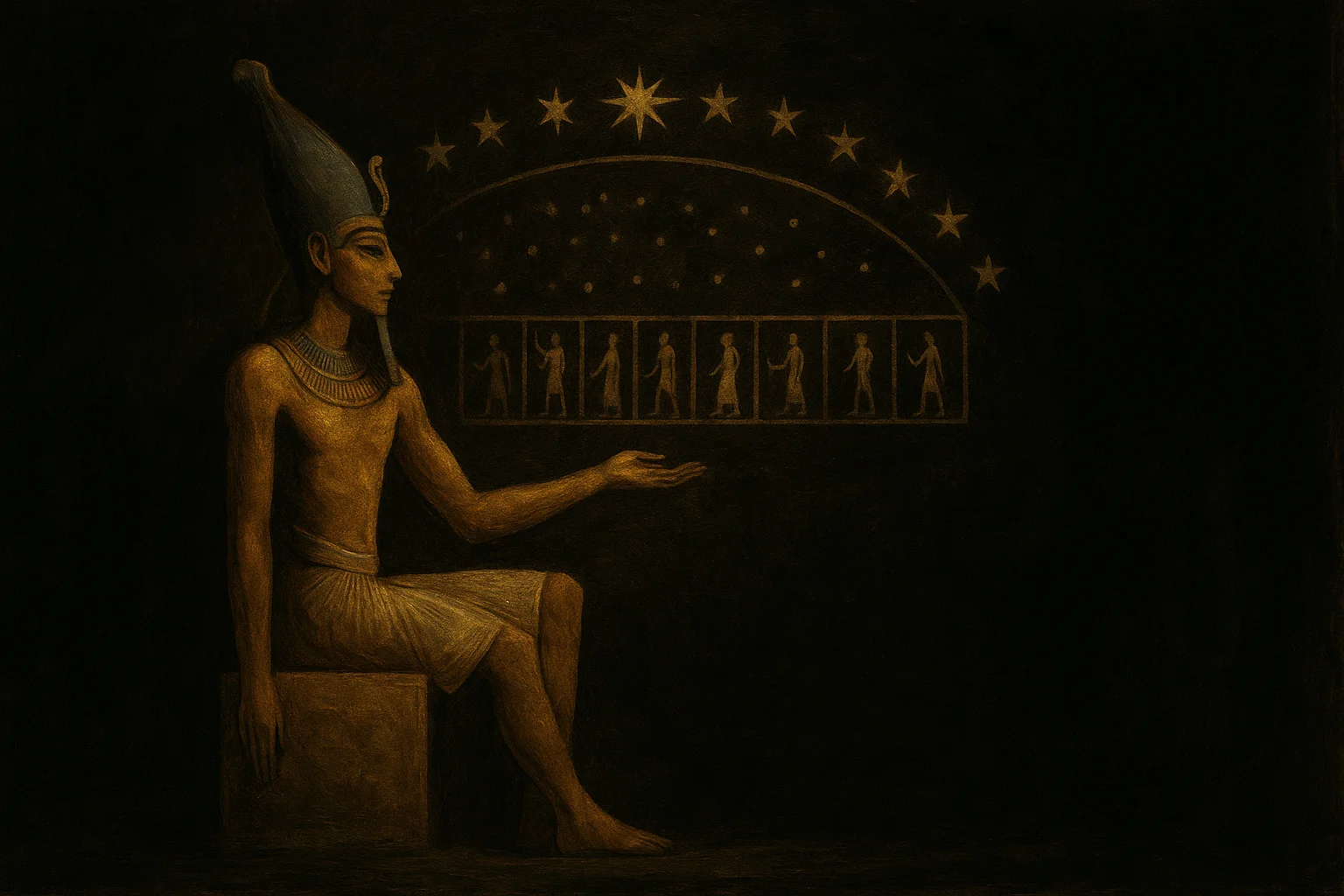
Decans were groups of stars or single bright stars that rose above the eastern horizon at intervals of roughly ten days. Thirty-six decans covered the full Egyptian year of 360 days, with five epagomenal days added to reconcile the calendar. Each decan presided over ten degrees of the zodiacal belt, though the Egyptian system predated Greek zodiacal thought.
The Carlsberg Papyrus I, a Demotic text from the Roman period, preserves a decanal list with names like Knemu and Khentet-Heru. These names appear centuries earlier on Middle Kingdom coffin lids. The decans were not abstract coordinates. They were divine beings, each with a name, a place in the procession of night, and a role in guiding the dead through the hours of darkness.
Coffin Lids and Star Clocks
Middle Kingdom coffins bear diagonal star tables on their inner lids, directly above the mummified head. These star clocks listed decans in columns, each column representing a ten-day week. Twelve rows marked the twelve hours of night. As each decan rose, it signaled a new hour.
Coffin Texts, Spell 335, instruct the deceased to "know the bas of the East," the souls who are the stars. The star clock was both timepiece and guide, enabling the dead to navigate the nocturnal journey through the underworld. The system was not perfectly accurate. Precession and the irregular spacing of bright stars introduced drift. But precision was secondary to function: the dead needed orientation, not ephemerides.
Solar Observation and the Civil Calendar
The Sothic Cycle
The heliacal rising of Sirius, Sopdet in Egyptian, occurred roughly every 365.25 days. The Egyptian civil calendar, however, used a fixed 365-day year with no leap day. Over time, the calendar drifted relative to the solar year. After 1,460 years, the calendar and the Sothic rising realigned. This period is called the Sothic cycle.
The Ebers Papyrus, a medical text from circa 1550 BCE, records a Sothic rising on the ninth day of the third month of summer, year nine of Amenhotep I. This notation allows modern scholars to anchor Egyptian history to absolute dates, though debate persists over which cycle is referenced and whether the observation was made at Memphis or Thebes.
Three Seasons, 365 Days
The civil calendar divided the year into three seasons of four months each: Akhet (inundation), Peret (emergence), and Shemu (harvest). Each month had 30 days. Five epagomenal days, the birthdays of Osiris, Horus, Seth, Isis, and Nephthys, completed the year. This structure appears fully formed in texts from the Old Kingdom onward.
The calendar served administrative and agricultural needs. Tax collection, labor conscription, and temple offerings all followed its rhythm. Religious festivals, however, were often tied to lunar months or seasonal markers like the Sothic rising, creating a dual timekeeping system. Scribes trained in mathematical astronomy reconciled the two, calculating feast days decades in advance.
Temple Alignment and Celestial Events
Egyptian temples were not arbitrarily oriented. The axis of a temple often aligned with the rising or setting sun on a significant date: the winter solstice, the summer solstice, or the heliacal rising of a star associated with the temple's deity. The temple of Karnak, dedicated to Amun-Re, aligns with the winter solstice sunrise, flooding the sanctuary with light on the shortest day of the year.
At Abu Simbel, the great temple of Ramesses II is oriented so that twice a year, on dates near the king's birthday and coronation, sunlight penetrates the inner sanctuary and illuminates statues of the deified Ramesses and the gods Amun, Re-Horakhty, and Ptah. The alignment is precise, the result of deliberate calculation and surveying.
The shift to solar monotheism under Akhenaten brought new temple orientation practices. Temples to the Aten were open-air structures, their altars exposed to the sun's rays. The emphasis was on direct solar worship, unmediated by the darkness of traditional sanctuaries. This architectural theology did not survive Akhenaten's death, but it demonstrates how cosmology shaped stone.
Astronomical Ceilings: Maps of the Afterlife
Senenmut's Tomb
The tomb of Senenmut, architect and steward under Hatshepsut, contains the earliest known depiction of the northern constellations. The ceiling of chamber TT353 shows the circumpolar stars, the decans, and the planets. The layout is not a literal star map but a theological diagram, arranging celestial bodies according to their religious significance.
The northern sky includes recognizable figures: the Bull's Foreleg (our Ursa Major), the Hippopotamus (Draco), and the Crocodile. These were not neutral asterisms. They were divine actors in the nightly drama of cosmic order. The Bull's Foreleg, for instance, was associated with Seth and the violent energy that threatened but also sustained creation.
Ramesses VI and the Book of Day
The ceiling of the burial chamber of Ramesses VI in the Valley of the Kings is covered with excerpts from the Book of Nut and the Book of Day. The goddess Nut stretches across the vault, her body tracing the path of the sun. The text describes the sun's journey: swallowed by Nut at dusk, traveling through her body at night, reborn from her womb at dawn.
"The majesty of this god enters her mouth at the place where the sun sets in the western horizon of the sky. Then this land is in darkness, in the manner of death." Book of Nut, tomb of Ramesses VI
The astronomical ceiling is a manual for resurrection. The king, like the sun, must traverse the body of night to be reborn. The stars mark the hours, the decans the stages, and the gods the perils and protections encountered along the way. The ceiling at Nefertari's tomb offers a parallel vision, her journey mapped in gold and lapis.
Instruments and Methods
The Merkhet and Plumb Line
The merkhet, a sighting tool made from a palm rib with a notched end, was used in conjunction with a plumb line to establish true north and measure the transit of stars. Two observers aligned the merkhet with a circumpolar star, using the plumb line as a vertical reference. This method allowed priests to orient temples and tombs with mathematical precision.
The merkhet appears in tomb paintings and reliefs, often held by priests labeled as "hour watchers." The title is literal. These men measured time by tracking stellar transits, calling out the hours for temple rituals performed in darkness. The tool was simple, the principle geometric, the application sacred.
Water Clocks and Shadow Reckoning
Water clocks, or clepsydrae, measured time by the regulated flow of water from a vessel marked with hour lines. Examples survive from the reign of Amenhotep III onward. The interior walls of these vessels often bear decanal figures and hieroglyphic inscriptions invoking the gods of time.
Daytime hours were reckoned by shadow length. The Rhind Mathematical Papyrus, Problem 79, describes a method for calculating the height of a structure using the ratio of shadow to vertical gnomon. This technique, applied in reverse, allowed observers to estimate the hour by measuring the shadow cast by an obelisk or sundial.
Decanal hours (night)
Variable length, tied to stellar risings, twelve per night regardless of season. Each decan marked one hour as it crossed the meridian.
Shadow hours (day)
Variable length, measured by gnomon shadow. Twelve daylight hours expanded in summer, contracted in winter, never equal to night hours.
Astronomy in Religious Texts
The Pyramid Texts and Coffin Texts are dense with astronomical references. The deceased king is called an imperishable star, a morning star, a companion of Orion. Orion, identified with Osiris, strides across the southern sky. Sirius, his consort Isis, follows behind. The Milky Way is the Winding Waterway, the celestial Nile along which the solar barque travels.
These are not poetic flourishes. They are instructions. The dead must know the stars to navigate the Duat, the realm between death and rebirth. Utterance 251 commands: "The sky is clear, Sopdet lives, for I am a living one, the son of Sopdet." Identity and destiny are stellar.
Later texts, such as the Book of the Dead, continue this tradition but with less astronomical specificity. The focus shifts from star knowledge to moral judgment and magical protection. The sky remains present, but as backdrop rather than map. The shift reflects changing funerary theology, not a decline in astronomical knowledge.
Legacy and Limits
Egyptian astronomy was not theoretical in the Greek sense. There is no surviving Egyptian treatise on planetary motion, no geometric model of the cosmos. Observation served ritual and calendar, not abstract inquiry. Yet the precision of temple alignments and the consistency of decanal lists across centuries demonstrate systematic, transmitted knowledge.
Hellenistic astronomers, working in Alexandria, inherited Egyptian star lists and decanal divisions. Ptolemy's Almagest cites Egyptian observations, though often dismissively. The Egyptians had data. The Greeks built models. Both approaches were astronomy, but with different ends.
The limits are real. Precession was not understood, though its effects were observed. Planetary retrograde motion was noted but not explained. The five-day drift of the civil calendar was never corrected by a leap year, despite awareness of the discrepancy. These were not failures of intellect but choices of priority. The calendar served the state and the cult. Perfection was unnecessary.
The symbolic weight of the Eye of Horus, often associated with lunar phases and fractions, hints at the interplay between observation and myth. The eye was both a mathematical tool and a divine emblem, its parts corresponding to fractional measures used in grain distribution. Astronomy, theology, and administration were not separate disciplines.
Frequently asked questions
How did ancient Egyptians measure time using the stars?
Ancient Egyptians measured nighttime hours using decans, 36 groups of stars that rose at ten-day intervals, with twelve decans marking the twelve hours of night as each crossed the meridian. Star clocks painted on Middle Kingdom coffin lids listed decans in diagonal tables, allowing priests and the dead to track the passage of hours by observing which decan was visible. During the day, shadow length from a gnomon or obelisk indicated the hour, though both day and night hours varied in length with the seasons.
What role did astronomy play in Egyptian temple construction?
Egyptian temples were deliberately aligned to celestial events such as solstices, equinoxes, or the heliacal rising of stars associated with the temple's deity, ensuring that sunlight would illuminate the sanctuary on religiously significant dates. The temple of Karnak aligns with the winter solstice sunrise, while the Abu Simbel temple of Ramesses II is oriented so sunlight reaches the inner sanctuary twice a year. These alignments required precise surveying using tools like the merkhet and plumb line, demonstrating that temple architecture was both cosmological statement and ritual instrument.
What are decans and how were they used in Egyptian star clocks?
Decans were 36 groups of stars or individual bright stars that rose above the eastern horizon at ten-day intervals, dividing the Egyptian year into 36 periods and the night sky into twelve hourly segments. Star clocks on coffin lids listed decans in diagonal columns, each column representing a ten-day week and each row an hour of night, allowing observers to determine the time by noting which decan was rising or crossing the meridian. The system was used both for timekeeping in temple rituals and as a guide for the deceased navigating the nocturnal underworld.
How accurate was the ancient Egyptian calendar?
The Egyptian civil calendar was a fixed 365-day year divided into twelve 30-day months plus five epagomenal days, but it lacked a leap year and thus drifted relative to the solar year by one day every four years. Over 1,460 years, the calendar completed a full cycle and realigned with the heliacal rising of Sirius, an event known as the Sothic cycle. While this drift was recognized, it was never corrected, likely because the calendar served administrative and ritual functions that did not require perfect solar synchronization.
What astronomical knowledge is preserved in tomb ceilings?
Tomb ceilings preserve star maps, decanal lists, and excerpts from religious texts like the Book of Nut, depicting the goddess Nut arching over the earth with stars marking the hours of night and the sun's journey through her body. The ceiling of Senenmut's tomb shows the earliest known representation of northern constellations, while the burial chamber of Ramesses VI includes detailed astronomical diagrams linking stellar cycles to the king's resurrection. These ceilings functioned as both cosmological diagrams and practical guides for the dead, mapping the path through the underworld using celestial landmarks.
What tools did Egyptian astronomers use to observe the sky?
Egyptian astronomers used the merkhet, a palm-rib sighting tool with a notched end, paired with a plumb line to establish true north and measure stellar transits for temple alignment and timekeeping. Water clocks, or clepsydrae, measured nighttime hours by the regulated flow of water through marked vessels, while gnomons and obelisks cast shadows used to reckon daytime hours based on shadow length. These instruments, though simple, enabled precise observations that informed calendar regulation, ritual timing, and monumental architecture.
Further reading on Mythologis
Free 25-page sample
Want the whole story?
Take the first 25 pages free. If it pulls you in, the full edition is yours as an instant PDF download, with a paperback on Amazon for selected titles.
Egyptian
The Egyptian Mythology Book: Ra, Osiris, Isis, Anubis, and the Sacred Stories of the Pharaohs
Ra, Osiris, Isis, Anubis, and the Sacred Stories of the Pharaohs
Three thousand years of Egyptian sacred stories. The Duat, the weighing of the heart, the cult of Osiris, and the daily voyage of the sun.
More from Egyptian
All articles
Egyptian
The Book of the Dead: Egypt's Guide to Eternity
Ancient Egypt's most sacred funerary text was not a single book but a living archive of spells, maps, and prayers that guided the dead through the perils between death and eternal life.
Egyptian
Eye of Horus: The Protective Amulet That Watched Over the Living and the Dead
Worn by pharaohs and fishermen alike, the Eye of Horus is one of antiquity's most potent protective symbols, carrying the weight of cosmic battle, divine healing, and eternal vigilance.
Egyptian
Ra the Sun God: Egypt's Supreme Ruler of Light and Creation
Ra, the ancient Egyptian sun god, blazed at the very heart of a civilization that worshipped light as the pulse of creation itself. Discover his origins, his many forms, and the sacred journey he took across the sky and through the underworld every single day.
Egyptian
The Ankh: Egypt's Eternal Symbol of Life
The ankh is ancient Egypt's most recognizable hieroglyph, a looped cross carried by gods and pharaohs alike as the very key to immortal life. Discover its origins, meanings, and sacred legacy.