

The Solomonic Dynasty Myth: Divine Right and Covenant
Ethiopia's Solomonic kings traced their bloodline to Solomon and Makeda, the Queen of Sheba. That lineage claim was not mere politics. It was a sacred covenant, written in blood, fire, and the Ark itself.
Contents
The boy born in the highlands of Aksum carried a secret in his body. His mother was Makeda, queen of a kingdom so wealthy that her camels arrived in Jerusalem laden with spices, gold, and precious stones. His father was Solomon, king of Israel, builder of the Temple, and vessel of divine wisdom. When the child grew up, he walked back into his father's court, and something far older than any throne shifted. A covenant, already ancient, found a new container.
The Solomonic Dynasty Myth is not simply a royal legend. It is the theological skeleton of an entire civilization. For roughly two thousand years, Ethiopian emperors legitimized their authority through a single, unbroken claim: descent from the union of Solomon and the Queen of Sheba, sealed by God's own transfer of the sacred Ark of the Covenant from Jerusalem to Aksum. The myth wove together genealogy, scripture, liturgy, and law into something that functioned simultaneously as foundation charter, national epic, and living religious doctrine.
Nowhere is that weaving more visible than in the Kebra Nagast, the "Glory of Kings," a fourteenth-century Ge'ez compilation that gathered older oral traditions, Coptic manuscripts, Arabic sources, and Axumite priestly memory into a single monumental text. That text did not merely record the myth. It performed it, generation after generation, at the center of Ethiopian imperial identity.
Makeda, Queen of Sheba: The Woman Who Triggers the Covenant
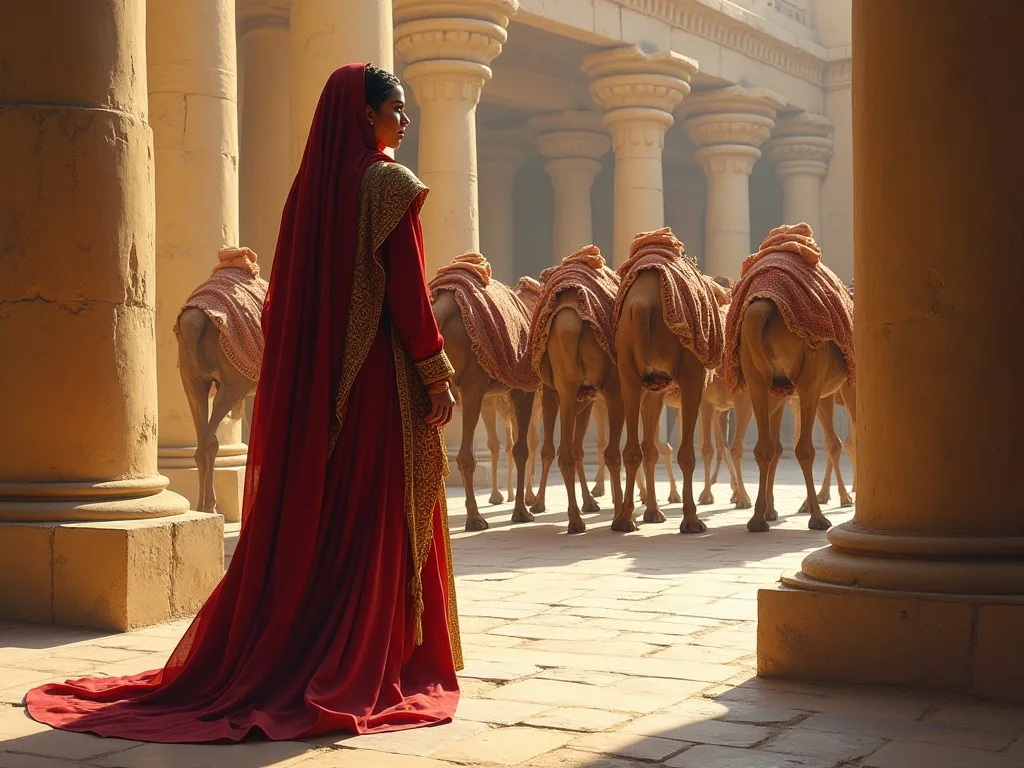
The narrative opens not with a king but with a queen. Makeda (called Bilqis in Arabic tradition and simply the Queen of Sheba in the Hebrew Bible's 1 Kings 10) rules a southern kingdom of immense abundance. The Kebra Nagast gives her a richer biography than the biblical text: she is a sovereign who has renounced idol worship after hearing the merchant Tamrin describe Solomon's wisdom and the God who granted it.
She travels north, a journey the text renders in quasi-liturgical terms: her caravan crosses deserts and rivers as though geography itself is preparing to yield something. In Jerusalem, Solomon entertains her, answering every riddle she poses. The Kebra Nagast records one famous bargain: Solomon asks that she take nothing from his house without permission. She agrees. At a banquet that night, he serves her heavily spiced food. Thirsty in the small hours, she reaches for a jar of water. Solomon holds her to her oath, and demands a price: she will share his bed. From that night, the lineage begins.
The encounter is theologically loaded. Makeda arrives worshipping natural forces; she departs as a monotheist. The text frames her conversion as the precondition for the covenant. God does not simply bestow divine right on any royal line. The mother must first turn toward the true sovereign of the cosmos. Her renunciation of the sun and stars for the God of Israel is the spiritual currency that purchases the covenant for her descendants.
This matters because it separates the Solomonic Dynasty Myth from simple dynastic propaganda. The claim is not merely "we come from a powerful king." It is "we come from the moment Ethiopia entered into relationship with the divine." Makeda's conversion is Ethiopia's covenant moment, and her son is its embodiment.
Menelik and the Transfer of the Ark
Makeda returns home pregnant. She gives birth to a son named Menelik (from the Hebrew ben-melek, "son of the king," though the Kebra Nagast preserves Bayna-Lehkem as his throne name). She raises him in her kingdom, teaching him the faith she has adopted. When the boy reaches adulthood, she sends him to Jerusalem to receive his father's blessing.
Solomon recognizes Menelik immediately. The text says the old king wept, because the boy's face was David's face, his own grandfather's face, the face of the covenant lineage. Solomon attempts to keep Menelik in Jerusalem, even orchestrating a public ceremony in which the young man is anointed as Solomon's heir to the throne of Israel. Menelik refuses. His kingdom, he says, is in the south.
Here the myth pivots from family drama to sacred heist. Menelik's companions, sons of the Jerusalem priesthood traveling with him back to Ethiopia, grow restless. They cannot bear to leave the holiest object in their world behind. Guided by a vision that reframes their act as divine will rather than theft, Menelik's companion Azariah enters the Temple and removes the Ark of the Covenant, replacing it with a replica. The original travels south, hidden in Menelik's caravan, surrounded by a miraculous luminosity the Kebra Nagast describes as the Shekinah, the dwelling-presence of God.
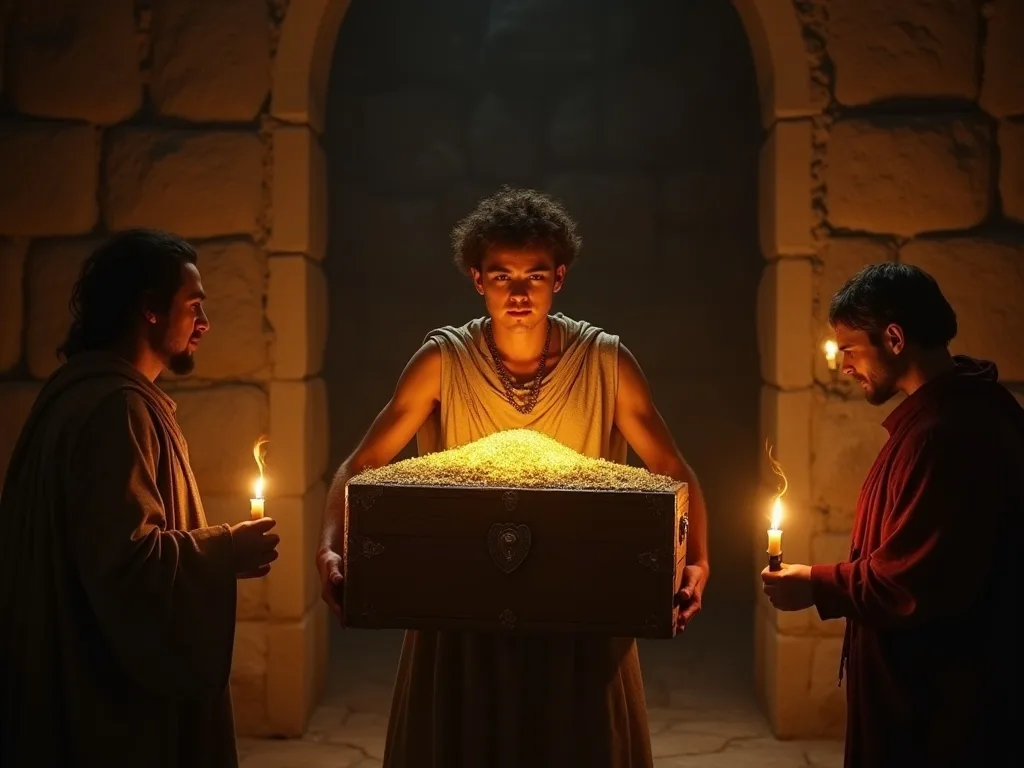
Solomon discovers the substitution. His grief, in the text, is immediately tempered by a dream in which God tells him the Ark's removal was willed: Israel failed to keep the covenant fully, and God's presence must seek a new home. The transfer is not a crime. It is a translation of sacred center. Ethiopia becomes the new Zion.
This is the mythological hinge on which the entire imperial ideology turns. By possessing the Ark, Aksum does not merely inherit Solomon's bloodline. It inherits his covenant with God. The Ethiopian emperor is not just a king descended from a famous ancestor. He is the guardian of the most charged object in Abrahamic religious imagination, which places his kingdom at the literal center of salvation history.
Divine Right in the Ethiopian Frame: Not a European Concept
European medieval theology articulated divine right through concepts like the rex dei gratia, the king by grace of God, developed from Pauline theology and Augustinian political thought. The Ethiopian frame is older, more specific, and more materially grounded.
In the Kebra Nagast model, the emperor's right to rule is not a general divine approval of monarchy as an institution. It is a specific relational claim: this bloodline was chosen, this ark was transferred, this covenant was ratified by God's own act of relocating his presence. The legitimacy is almost contractual. God is a party to it, not merely an endorser.
This produced a distinctly Ethiopian form of sacral kingship. The emperor bore the title Negusa Nagast, "King of Kings," a phrase that echoes both Solomon's biblical epithets and the Christological title Lord of Lords. He was also called the Lion of Judah, a messianic designation connecting him directly to the Davidic prophecies in the Hebrew Bible. Ethiopian royal traditions layered Christian theology over this Hebraic substrate after the Christianization of Aksum in the fourth century CE, producing a synthesis found nowhere else on earth.
It is worth pausing to compare this model with two parallel traditions of divine kingship. In Yoruba sacred political thought, the oba (king) derives authority not from a single founding covenant but from lineage continuity with the primordial orisha, particularly Odudua, the divine ancestor who descended from the heavens to found Ile-Ife. The king's body becomes a ritual vessel renewed at each enthronement; divinity is enacted rather than inherited by blood document. In the Byzantine tradition, the basileus ruled as God's vicegerent on earth, appointed by divine providence but accountable to an ecclesiastical body that could, in theory, withdraw legitimacy. The Ethiopian model is more specific and more contractual than either: the covenant is textually encoded in the Kebra Nagast, its object physically present in Aksum, its genealogical chain unbroken. Where the Yoruba king enacts divinity through ritual and the Byzantine emperor claims providential appointment, the Negusa Nagast possesses a written deed, a sacred relic, and an unbroken bloodline simultaneously. That triple grounding made the Ethiopian claim uniquely resistant to challenge.
The physical geography of Aksum reinforced the claim. The Cathedral of St. Mary of Zion, rebuilt multiple times but rooted in fourth-century foundations, is said to house the Ark to this day in a treasury chapel guarded by a single monk who never leaves. That monk is appointed for life. No outsider, Ethiopian or foreign, has been permitted inside within living memory. The myth does not belong only to the past; it is actively administered in the present.
The Kebra Nagast as Living Document
The Kebra Nagast was compiled in its current form around 1322 CE under the reign of Wedem Arad, when the Solomonic line had just been restored to the throne of Ethiopia after the Zagwe dynasty's century-long interruption. The text's timing was political in the most precise sense: it served as a legitimating document for the returning Solomonic claimants.
But calling it political propaganda undersells it. The text draws on multiple layers of source material. Its compilers cite a Coptic manuscript found in Alexandria, Arabic versions of the Queen of Sheba story circulating in the Islamic world, and oral traditions of the Ethiopian priestly class. The Kebra Nagast is genuinely syncretic: it quotes the New Testament and the Hebrew prophets alongside passages that read like ancient Near Eastern royal ritual, and it frames the whole within Ethiopian Orthodox Christian theology, specifically the Miaphysite Christology adopted at the Council of Chalcedon's aftermath.
Critically, the text was not shelved after the dynasty was secure. Ethiopian emperors continued to invoke it formally until the twentieth century. Haile Selassie, who ruled from 1930 to 1974, had it translated into English by Sir E. A. Wallis Budge in 1922 (prior to his full enthronement) specifically to make the claim legible to an international audience as Ethiopia faced Italian aggression. A myth about divine covenant became a diplomatic instrument.
The Kebra Nagast's 117 chapters cover not just the Solomonic lineage but also angelology, the pre-existence of Christ in Solomonic prophecy, the nature of wisdom, and the metaphysics of the Ark's power. It reads less like a chronicle and more like a systematic theology that happens to be structured around a royal genealogy.
Symbolism of the Ark in Ethiopian Sacred Geography
The Ark functions in this myth-system as more than a relic. It is a locus of divine presence, a portable Sinai, and a marker of covenantal geography. Wherever it rests, that place becomes the center of the world.
Ethiopian Orthodox Christianity institutionalized this theology through the concept of the tabot. Every consecrated Ethiopian church contains a tabot (plural ataboti): a wooden or stone tablet inscribed with the name of the saint to whom the church is dedicated, kept in the inner sanctuary and treated as the functional equivalent of the Ark's tablets. Churches without a tabot are not considered consecrated. The tabot is what makes a church a church.
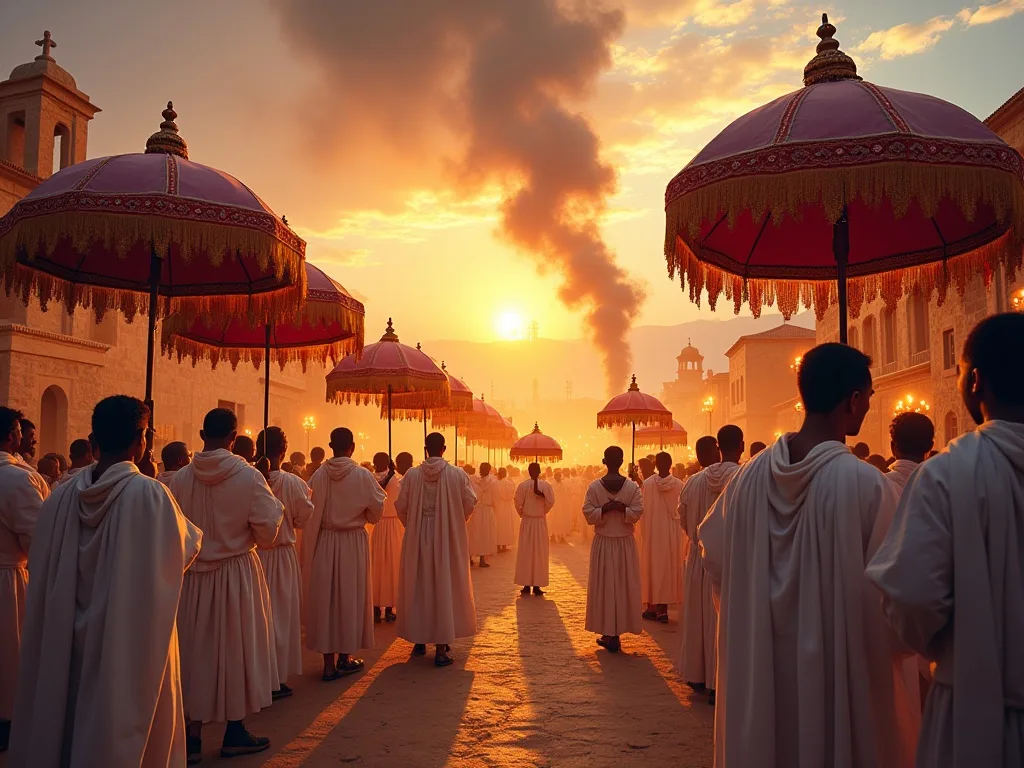
On major feast days, the tabot is carried in procession, wrapped in brocade, shaded by embroidered umbrellas called tilts, accompanied by priests chanting and deacons dancing, in a deliberate reenactment of the biblical procession when David brought the Ark to Jerusalem (2 Samuel 6). The myth is not commemorated. It is enacted, bodily, annually, in every region of the country. This liturgical performance is why the Solomonic Dynasty Myth has remained alive for two millennia rather than calcifying into historical memory.
The Ark of the Covenant in Ethiopian tradition is one of those rare mythological objects that generates parallel traditions across multiple cultures simultaneously. Jewish Falasha (Beta Israel) communities in Ethiopia, who predate the Christianization of Aksum and may represent the oldest continuous Jewish community outside Israel, also revere Aksum as the Ark's resting place, arriving at the same conclusion through a different scriptural lineage.
The Zagwe Interruption and the Myth's Political Elasticity
No myth of divine dynastic right survives without a stress test. The Solomonic line's came in the twelfth century, when the Zagwe dynasty took power. The Zagwe were not Solomonic descendants, a fact that both their critics and their own court recognized. Their response is mythologically instructive.
Rather than rejecting the Solomonic framework, the Zagwe worked within it. They built the extraordinary rock-hewn churches of Lalibela, named after their greatest king, carving eleven interconnected churches from living volcanic rock at elevations above 2,600 meters. King Lalibela himself was presented through retrospective hagiography, principally the Gadla Lalibala (the Acts of Lalibela, the primary Ge'ez hagiographic source compiled by Ethiopian Orthodox clergy in the centuries after his death), as a Christian king whose legitimacy derived from direct divine commission rather than Solomonic blood. An angel, in the Gadla Lalibala's account, transported him to heaven and showed him a heavenly Jerusalem; he returned to Ethiopia with instructions to build its earthly counterpart in stone.
The Zagwe did not claim the Ark. They claimed the New Jerusalem. It is a parallel move within the same mythological logic: if the Solomonic kings possessed the old covenant's center, the Zagwe possessed the new covenant's. When the Solomonic line reasserted control in 1270 under Yekuno Amlak, the Kebra Nagast's subsequent compilation half a century later was partly a rebuttal to Zagwe counter-mythology. Two competing sacred geographies, one Aksumite and Ark-centered, one Lalibelan and Christ-centered, had to be reconciled. The Kebra Nagast reconciles them by making Lalibelan devotion continuous with, rather than competitive to, the Solomonic covenant.
Menelik as Messianic Figure: The Typological Readings
Ethiopian theologians did not read Menelik merely as a historical prince. They read him typologically, the way Christian exegetes read Old Testament figures as types (prefigurations) of Christ. Menelik is simultaneously the son who leaves home and returns, the carrier of the divine presence from one people to another, and the king who refuses worldly power (the throne of Israel) in favor of his true mission.
The Queen of Sheba in Ethiopian tradition herself was given typological weight. Early Ethiopian and Syriac Christian commentaries read her visit to Solomon as an allegorical foreshadowing of the Gentiles' reception of the Gospel: she comes from the ends of the earth, she tests wisdom, she is converted, she carries the light home. Matthew 12:42 and Luke 11:31 explicitly invoke her as a witness against those who reject true wisdom, giving Ethiopian theologians a New Testament anchor for their national myth.
Menelik's movement from Jerusalem to Aksum maps onto the spread of divine election from a narrow ethnic covenant to a universal one. Ethiopia, in this reading, is not a latecomer to sacred history. It is the place where sacred history arrives fully formed, bearing everything that Jerusalem originally contained, and continuing forward into the eschatological future.
This typological density is one reason the myth proved so portable. When Jamaican Rastafarians encountered the Kebra Nagast through Marcus Garvey's Pan-Africanist movement and Leonard Howell's 1935 text The Promised Key, they were not misreading the Ethiopian original. They were following its own typological logic to its next iteration: if Ethiopia is Zion, and the Ark is there, then Haile Selassie, the last Solomonic emperor, is the living embodiment of the covenant, and his suffering and survival are eschatologically meaningful.
The Lion of Judah and Ethiopian Imperial Iconography
The title Lion of Judah (Embiaba Yihuda) was not decorative. It appears in Genesis 49:9 as Jacob's blessing over Judah, and in Revelation 5:5 as a Christological title for the one worthy to open the seven seals. By adopting it, Ethiopian emperors claimed a position inside both the Davidic messianic prophecy and the Christian apocalyptic narrative simultaneously.
Imperial regalia reinforced this at every scale. The Ethiopian imperial flag, used from Menelik II's consolidation of the modern empire in the 1880s through Haile Selassie's reign, bore a crowned lion holding a cross-topped scepter, directly visualizing the title. Throne rooms contained sculpted lions. The emperor's formal oath of office invoked "the God of Abraham, the God of Isaac, the God of Jacob" without any intermediary Christian saints, placing the inauguration explicitly within the Hebrew covenant structure.
The Ethiopian Orthodox Church's liturgical calendar was saturated with feasts connected to the Ark, to Solomon, and to Menelik. Timkat (Epiphany), the most visually spectacular festival of the Ethiopian year, involves a full immersion in water blessed by the tabot's presence, reenacting simultaneously Christ's baptism and Israel's crossing of the Jordan. The Timkat festival and its Ark theology runs on a Coptic foundation, and its lectionary cycle moves through the Kebra Nagast's themes annually, ensuring that every generation of Ethiopian Christians inhabits the myth as lived experience rather than distant history.
The Covenant's Collapse and Survival: 1974 and After
The myth faced its most severe political rupture in 1974, when Haile Selassie was deposed by the Derg, a Marxist military committee, and died under house arrest in 1975. With him, the Solomonic dynasty formally ended. A regime that was explicitly anti-monarchist, anti-clerical, and anti-mythological took power.
The Derg suppressed the Ethiopian Orthodox Church's public role, nationalized church properties, and persecuted clergy. The Kebra Nagast was not banned outright, but its public ceremonial function was severed from state power for the first time in centuries.
What the Derg discovered, and what every myth-breaker discovers eventually, is that the myth did not need the state to survive. In the diaspora, among Ethiopian Christian communities in the United States, Israel, and Europe, the Kebra Nagast continued to be read liturgically. Among Rastafarians in Jamaica, Trinidad, and increasingly Africa itself, the myth gained new adherents every year. Among scholars, translations by Budge, by Ephraim Isaac, and by more recent Ethiopian linguists kept the text in academic circulation.
After the fall of the Derg in 1991, the Ethiopian Orthodox Church reasserted its institutional presence. The tabot processions resumed publicly. The Cathedral of St. Mary of Zion was restored. The monk guarding the Ark's treasury chapel continues his solitary vigil. The covenant, whatever its ultimate historical status, has outlasted the regime that tried to make it irrelevant.
Frequently Asked Questions About the Solomonic Dynasty Myth
Frequently asked questions
Is there any historical evidence for Solomon and the Queen of Sheba's relationship?
The biblical account in 1 Kings 10 records the Queen of Sheba's visit to Solomon but describes no romantic relationship. The romantic and genealogical elements appear in later traditions: the Ethiopian Kebra Nagast, Arabic sources including the Quran's Surah 27 (which names her Bilqis), and the Babylonian Talmud's tractate Bava Batra. Archaeologists have not found direct evidence of a historical queen ruling a southern Arabian or Ethiopian kingdom with the specific biography the Kebra Nagast describes, but Sabaean inscriptions confirm that powerful queenly figures ruled in the South Arabian region. The mythological tradition is rich and internally consistent, even where the historical documentation is sparse.
Does Ethiopia really claim to possess the Ark of the Covenant?
Yes, and the claim is actively maintained. The Ethiopian Orthodox Church holds that the original Ark of the Covenant rests in the Chapel of the Tablet, a purpose-built treasury adjacent to the Cathedral of Our Lady of Zion in Aksum. The guardian monk has never permitted outside inspection. Graham Hancock's 1992 book The Sign and the Seal investigated the claim at length and found the tradition internally coherent and of great antiquity, though he could not confirm the Ark's physical presence. Most archaeologists and biblical scholars treat the claim as mythologically significant but archaeologically unverifiable.
What is the relationship between the Solomonic myth and Rastafarianism?
Rastafarian theology adopted the Kebra Nagast directly, largely through Marcus Garvey's Pan-Africanist promotion of Ethiopia as the symbolic homeland of African peoples and Leonard Howell's subsequent identification of Haile Selassie as the returned messiah. The Kebra Nagast's claim that Ethiopia is the new Zion, that the Ark rests there, and that the Solomonic bloodline carries divine authority mapped onto Rastafarian readings of biblical prophecy with near-perfect fit. Haile Selassie himself was a devout Ethiopian Orthodox Christian who never endorsed the Rastafarian interpretation of his person, but the mythological logic connecting the two movements is not arbitrary. It follows the typological method of the Kebra Nagast itself.
Who compiled the Kebra Nagast and when?
Ethiopian tradition attributes the compilation to the scribe Yeshaq of Aksum, working under the patronage of the restored Solomonic king Wedem Arad around 1322 CE. The text itself claims to have been translated from a Coptic original held in Alexandria, which was itself translated from a Greek source. Modern scholarship suggests the Kebra Nagast is a genuine synthesis of older materials: Aksumite priestly oral traditions, Ethiopian Christian homiletic literature, Coptic apocalyptic texts, and Arab versions of the Sheba legend. The fourteenth-century compilation served an immediate political purpose in legitimizing the restored Solomonic line, but its source material appears substantially older, possibly reaching back to the sixth or seventh centuries CE.
How did the Solomonic myth shape Ethiopian resistance to colonialism?
The myth provided a theological basis for viewing Ethiopia as divinely protected and covenantally elect, which directly shaped Ethiopian resistance to European colonialism. When Italy invaded in 1895-96, Emperor Menelik II mobilized the population partly through the language of the covenant: the Lion of Judah's kingdom could not fall to foreign dominion. The victory at the Battle of Adwa (1896) was interpreted through this mythological lens and became the first major African military defeat of a European colonial power. When Italy invaded again in 1935, Haile Selassie's League of Nations speech invoked the covenant framework implicitly, positioning Ethiopia's survival as a matter of divine right before an international audience. The myth was not merely symbolic; it functioned as political theology in direct contact with historical events.
The Covenant's Persistence Across Scholarly and Spiritual Frontiers
Academic scholarship has, for most of the twentieth century, treated the Kebra Nagast as a document of ideological construction rather than historical record, which is accurate but insufficient. Edward Ullendorff, one of the foremost Ethiopianists of the last century, argued that the text reveals more about fourteenth-century Ethiopian political theology than about the historical tenth century BCE. Getatchew Haile, the Ethiopian manuscript scholar whose work at the Hill Museum and Manuscript Library produced the most rigorous catalog of Ge'ez texts, has read the Kebra Nagast as a synthetic achievement of genuine theological sophistication, not a forgery dressed as scripture.
The more interesting scholarly debate now concerns transmission: how did the Queen of Sheba narrative travel between Ethiopian, Yemeni, Hebrew, Arabic, and Syriac traditions, each version sharing core elements while differing in emphasis? The Sabaean hypothesis, which locates the Queen of Sheba's kingdom in South Arabia (modern Yemen) rather than Ethiopia, and the Ethiopian hypothesis, which places her in Aksum, have generated a century of productive argument. The Aksumite kingdom had deep economic and cultural ties with South Arabia, so the choice between these two locations may itself be anachronistic: the ancient world in question did not draw that border the way we do.
What persists, regardless of where the historiography settles, is the myth's structural resilience. A story that began as a royal genealogy became a national theology, then a diaspora identity marker, then an international political argument, then a global religious movement. The Solomonic Dynasty Myth has proved capable of absorbing every historical trauma thrown at it and emerging with its central claim intact: that a particular bloodline, a particular ark, and a particular covenant placed Ethiopia at the center of sacred time.
That is not the behavior of propaganda. That is the behavior of myth in its deepest sense: a story so internally coherent, so responsive to the questions people actually carry, that every generation finds itself addressed by it. The monk in Aksum still keeps his vigil. The tabot still processes through the streets at Timkat. The Kebra Nagast is still read aloud in Ethiopian Orthodox churches. The covenant, whatever its origins, is still being kept.
Read the full book
Want the whole story?
The complete edition is an instant PDF download here, with a paperback on Amazon for selected titles.
Ethiopian
The Ethiopian Mythology Book: The Queen of Sheba, the Ark of the Covenant, and the Sacred Legends of Aksum
The Queen of Sheba, the Ark of the Covenant, and the Kingdom of Aksum
The sacred legends of Ethiopia, the one African kingdom never conquered: the Queen of Sheba and her journey to King Solomon, the Ark of the Covenant said to rest at Aksum, Waaqa the sky-god of the Oromo, and the saint-kings who carved the churches of Lalibela. Drawn from the Kebra Nagast and the living oral tradition.
More from Ethiopian
All articles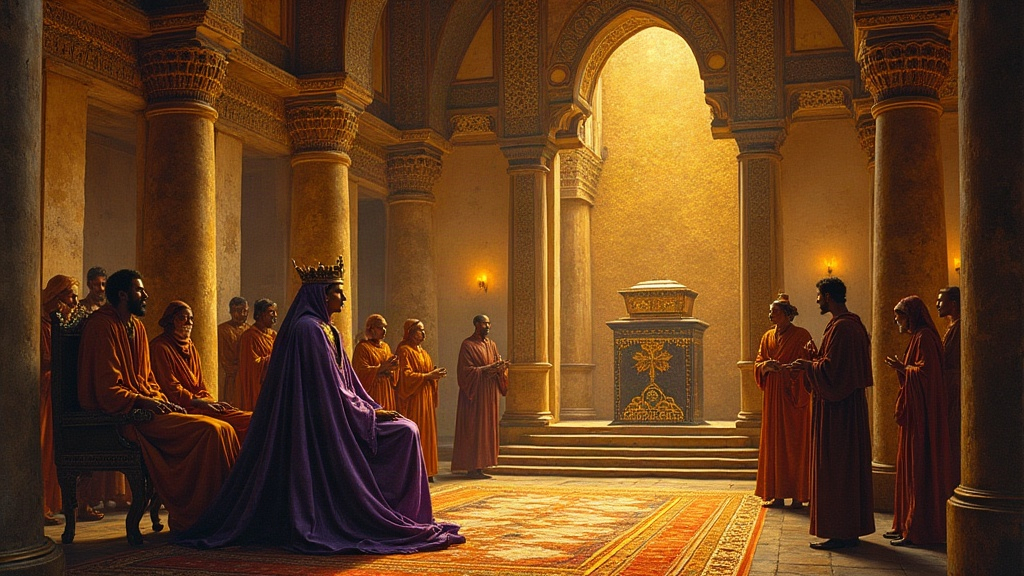
Ethiopian
The Kebra Nagast: Ethiopia's Sacred National Epic
The Kebra Nagast, Ethiopia's greatest literary and spiritual treasure, tells how the Queen of Sheba bore Solomon's son and founded a dynasty that would claim descent from Israel's king. Discover the epic that shaped an empire's identity and survives as living scripture today.
Ethiopian
Lalibela: The Rock-Hewn Churches and King's Vision
Discover how King Lalibela carved twelve churches from solid rock in Ethiopia's highlands, creating a sacred landscape that blends ancient Christian devotion with legendary ambition. A journey to Jerusalem without leaving home.

Ethiopian
Atete: Oromo Goddess of Fertility and Femininity
Atete embodies the generative power at the heart of Oromo spirituality. This goddess shapes the cycles of birth, growth, and renewal across the Ethiopian highlands and pastoralist cultures of the Horn of Africa.

Ethiopian
The Nine Saints: Founders of Ethiopian Monasticism
Nine Syrian monks arrived in Ethiopia in the 5th century and transformed its spiritual landscape. Discover how the Nine Saints founded Ethiopian monasticism, shaping the Tewahedo Church and a monastic tradition that endures today.