
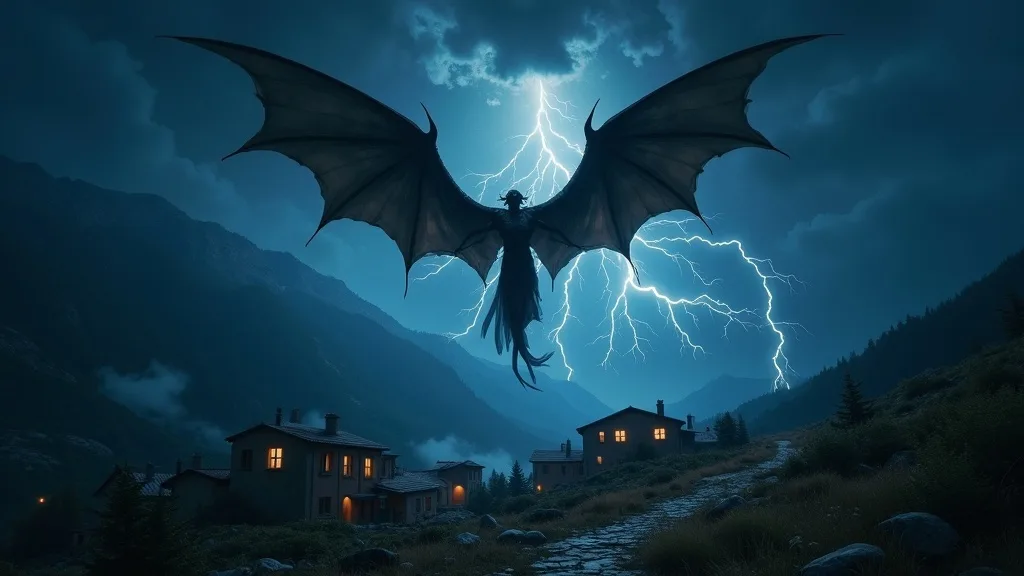
The Drangue: Storm-Warrior Protector Against Evil
Born with wings hidden beneath his arms, the Drangue is Albanian mythology's supreme hero: a half-human warrior who battles the chaos-serpent Kulshedra across storm-torn skies to keep the living world safe.
Contents
The sky above the Albanian highlands does not merely rain. It fights. When thunder splits the summer air and hail hammers the grain fields, the old villages knew exactly what was happening: the Drangue and the Kulshedra were locked in battle again, and the fate of every harvest, every child, every well in the valley swayed on the outcome.
This is not a myth in the distant, archived sense. As late as the early twentieth century, Albanian shepherds pointed at storm clouds and named the combatants. The tradition carried in living voices long after literacy arrived. That continuity is partly what makes the Drangue so arresting: he is not a god enthroned on a mountain, issuing decrees. He is born among humans, lives as one of them, and fights on their behalf at the cost of his own sleep and blood.
His story runs through the kanun (customary law) cultures of northern Albania, through Gheg oral ballads, through the records that folklorists like Maximilian Lambertz and Stavro Skendi compiled in the late nineteenth and early twentieth centuries. Piece those sources together, and what emerges is a portrait of heroism that is neither Olympian nor biblical. It is something older and stranger, rooted in storm-worship and the Iron Age frontier between the human world and the sky.
Origins in Albanian Oral Tradition
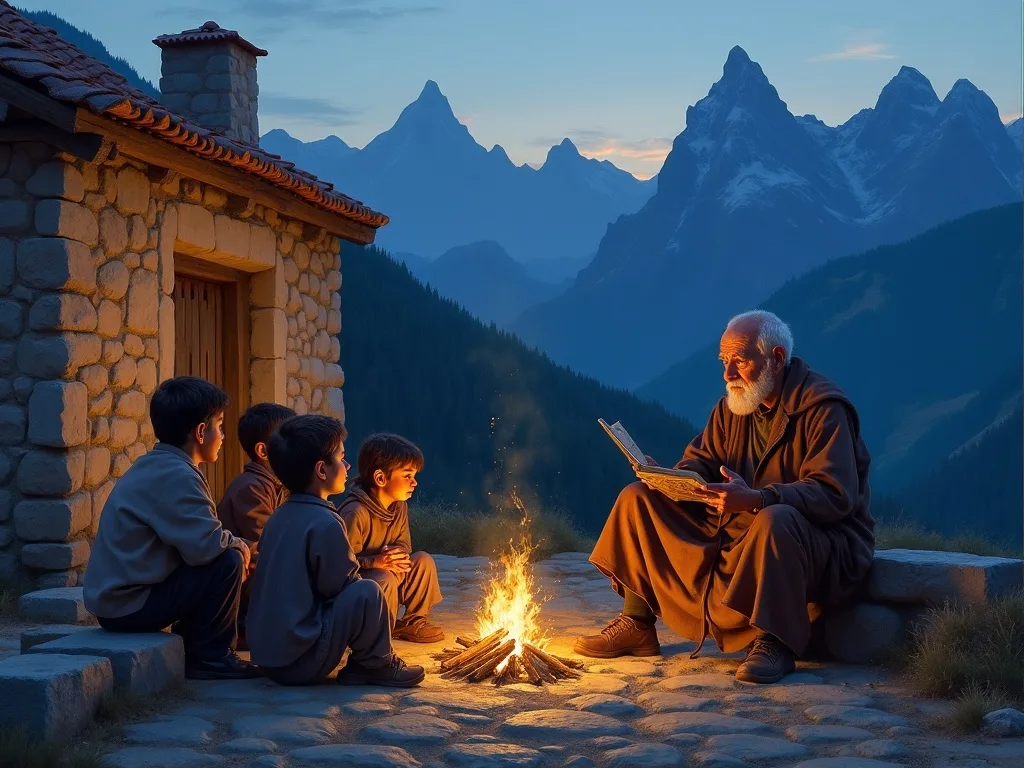
Albanian mythology preserved its core material not in written scripture but in oral poetry, riddles, and the elaborate legal-cultural system called the Kanun of Lekë Dukagjini. The Drangue belongs to this living archive. The word itself is believed to derive from a Proto-Albanian root connected to the concept of "dragon" or "serpent-power," though the Drangue himself is emphatically the enemy of serpentine chaos rather than its embodiment.
Early written references come from Ottoman-era sources and from the fieldwork of nineteenth-century European ethnographers who traveled through Shkodër, the Mat region, and the Dukagjin highlands. Johann Georg von Hahn, the Austrian consul and Albanologist who published Albanesische Studien in 1854, recorded versions of the Drangue figure alongside the Kulshedra as a structuring pair in Albanian belief. Maximilian Lambertz's later collections of Albanian epic songs (Volksepik der Albaner, 1917) filled in the narrative detail, showing the Drangue not as a single named individual but as a recurring type of hero, a category of being who appears in each generation when the threat is great enough.
That last point matters. The Drangue is not one man. He is a condition of birth. Any male child born with a caul and the telltale vestigial wings (described in sources as "small fin-like growths" under the upper arms, hidden under clothing for most of his mortal life) qualifies. He grows up ordinary in most visible respects, stronger than other men, prone to restless dreams, but otherwise unremarkable to outsiders. Only in battle, and especially in the aerial combat of storms, does his full nature express itself.
The Mark of the Drangue: Birth Signs and Hidden Nature
The birth of a Drangue is attended by specific omens. The caul, a membrane covering the head and sometimes the full body of the newborn, was read across many European traditions as a sign of second sight and protection from drowning. Albanian belief went further: the caul on a Drangue child marked him as already armored, already set apart for conflict.
The wings are the more singular feature. They are not the grand, feathered expanses of an angel. They are small, almost vestigial, concealed under clothing, mentioned in folk accounts as being like a "bat's membrane folded tight against the ribs." The Drangue himself may not know their full power until the first storm calls him. At that moment, the wings unfold, he rises into the sky, and the mortal farmhand or shepherd becomes what he was always meant to be.
This concealment is narratively significant. The Drangue lives among people as a person. He eats bread, feels cold, loves, and grieves. The hiddenness of his nature is not deception but a kind of dispensation: he is allowed a human life right up until the sky requires him. In this way he differs sharply from divine champions like Zeus who rule from above. He differs equally from a figure like Thor, whose divine identity is public and central to his social role. The Drangue's power is private until it becomes necessary.
The Kulshedra: The Adversary Across the Storm
No understanding of the Drangue is complete without her. The Kulshedra (also spelled Kuçedra in some dialects) is a monstrous female serpent, multi-headed in many versions, who grows more powerful with each year she lives. She originates as a water-snake (bolla) that survives through many cycles of transformation: after seven years the bolla becomes a kulshedra, after further years she grows additional heads and wings. She breathes fire, causes drought, poisons wells, and demands human tribute.
The Kulshedra is explicitly a force of cosmic disorder. She hoards water, causing rivers to dry up and crops to fail. She generates storms not as weather but as violence, hurling hail on fields and flooding lowlands. In some accounts she is also associated with sexual threat and the corruption of lineages, which places her in the broader category of Indo-European chaos-monsters that scholars like Jaan Puhvel and Calvert Watkins connected to the primordial serpent figure across Greek, Vedic, and Germanic traditions.
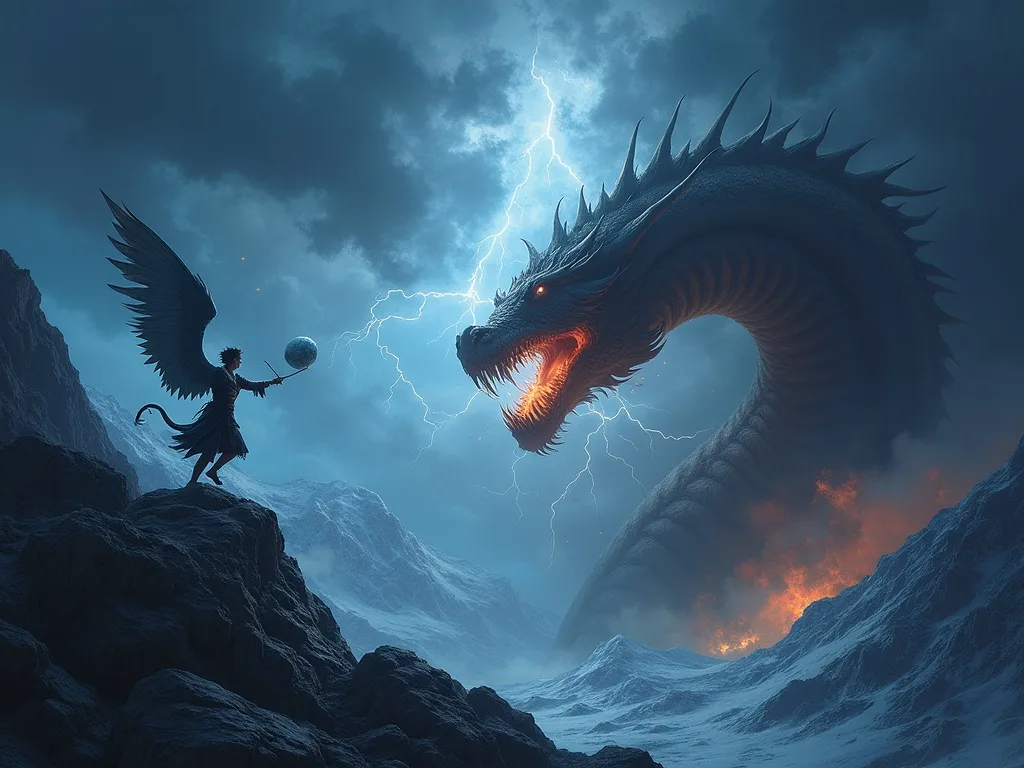
The match between Drangue and Kulshedra is the central event of Albanian sky mythology. It takes place in the clouds, invisible to most humans below, who perceive it only as a storm. The Drangue fights with rocks (hailstones, in some accounts), with fire, and with sheer physical force. If the Drangue wins, the storm passes, rain falls benevolently on the fields, and the people survive. If the Kulshedra drives him back, hail destroys the harvest and drought lingers.
The asymmetry of the fight is important. The Kulshedra grows stronger with age. Each transformation adds heads, power, and malice. The Drangue does not accumulate power in the same way. He fights on roughly human terms, amplified by his birth-gifts. This means each storm is genuinely uncertain. The heroism is real because the risk is real.
Drangue
- Born among humans with hidden wings and a caul
- Grows up in a village, conceals his nature
- Fights to protect water, harvests, and human life
- Uses rocks, fire, and physical strength
- Represents ordered sky, fertile rain, and cosmic boundary-keeping
- Does not accumulate power through age; remains mortal in frame
Kulshedra
- Begins as a water-snake, transforms over decades into a multi-headed monster
- Lives in caves, rivers, and storm-clouds
- Drains water, causes drought and destructive hail
- Breathes fire, floods valleys
- Represents uncontrolled chaos, sterility, and cosmic transgression
- Grows more powerful with each passing year and transformation cycle
How the Battle Unfolds: Myth as Meteorology
Albanian oral accounts describe the storm-battle in physical, almost tactical terms. The Drangue rises from wherever he happens to be sleeping, his wings unfolding as he clears the treetops. He carries stones pulled from riverbeds or peaks. The Kulshedra comes from her lair, churning the clouds, blotting the sun. The two meet somewhere above the mountains.
The fight is loud. Thunder is the impact of their bodies or weapons. Lightning is the Kulshedra's fire or the Drangue's retaliatory strike. Hail is the Drangue throwing stones; in some accounts it is also debris from the Kulshedra's own body when struck hard enough. Rain following the end of the storm marks the Drangue's victory: the Kulshedra retreats, the hoarded water releases, the fields drink.
This is mythology functioning as a total explanatory system for weather. It assigns every meteorological event to an agent with a motive. Rain is not chemistry; it is consequence. A hailstorm that destroys a field is not bad luck; it is the partial victory of a monster who was not defeated in time. The cosmological stakes of each thunderstorm are fully dramatized, which is precisely why the belief persisted so long in a culture where weather determined survival.
Comparative mythologists have noted strong structural parallels here. The Vedic god Indra battles the drought-demon Vritra in a storm-fight that releases the world's hoarded waters. The Norse Thor hunts the Jormungandr (the Midgard Serpent) whose stirring causes sea-storms. The Hittite storm-god Tarhunna defeats the serpent Illuyanka in a myth that structural anthropologist Calvert Watkins analyzed as part of an original Indo-European "dragon-slaying formula." The Drangue-Kulshedra pair fits this pattern almost perfectly, suggesting the Albanian tradition preserves an extraordinarily old stratum of proto-Indo-European sky-mythology.
The Drangue's Human Life: A Hero Who Does Not Live Apart
What distinguishes the Drangue from the storm-gods he resembles is the ground beneath his feet. He is not a deity. He lives in a village. He tends animals or farms land. He sleeps in a bed. He may marry. The folk records collected by Lambertz and others describe the Drangue going about daily life with no particular sign of his nature, except that other men sense something in him: he is calmer, stronger, harder to provoke, and he often knows when a storm is coming before the sky shows a cloud.
This ordinariness is not incidental. It is theologically pointed. The Drangue is proof that protection of the community does not require distance or divinity. The champion is already among you. He eats at your table. He owes his existence to the same village soil. His fight in the sky is an extension of the same loyalty that keeps a man at his neighbor's side during a blood feud or a harvest crisis. The aerial combat is simply the largest possible expression of an ethic the culture already honored at ground level.
When the Drangue dies, the manner of his death often carries narrative weight. Some accounts describe him falling from the sky after a losing battle and being found in a field, his wings finally visible in death, his body unmarked except for exhaustion. Others describe him dying of old age like any man, the storms perhaps growing worse in the years after his passing until a new one is born. The cycle is not tragic in the Greek sense. It is biological. It is how the sky stays safe.
Oral Transmission and the Surviving Ballads
The primary vehicle for Drangue mythology in Albanian culture was the oral epic, specifically the cycle known as kënget e kreshnikëve ("songs of the frontier warriors"), which form one of the most complete oral heroic traditions in Europe outside the South Slavic guslar cycle. These songs were performed by lahutarë (players of the single-string lahuta fiddle) at village gatherings, weddings, and wakes throughout northern Albania and Kosovo.
The Drangue appears in several of these songs, sometimes as the explicit subject, more often as a supporting fact of the cosmological backdrop against which human heroes operate. A hero facing an impossible enemy may be described as "fighting like a Drangue." A stormy night preceding a battle is read as omen and as cosmic parallel: the sky is fighting, and so are we.
Maximilian Lambertz's collections, along with later work by Albanian folklorists Gjergj Fishta and Zef Jubani, preserved hundreds of these variants. Fishta's monumental epic Lahuta e Malcís ("The Lute of the Highlands," 1937) draws on the same tradition, though it works within a Christian and nationalist framework that somewhat muted the pre-Christian cosmological layer. The purely mythological Drangue is more visible in the shorter lyric ballads and in the proverb layer, the untranslatable everyday sayings that encode belief without narrative.
Cross-Cultural Echoes and Scholarly Debates
The question of how old the Drangue tradition is remains genuinely open. Albanian belongs to its own branch of Indo-European, with no close living relatives. The language and its associated mythological vocabulary appear to preserve features that left no trace in the better-documented traditions: Greek, Latin, Germanic, Slavic. This makes Albanian a key comparative data point for reconstructing proto-Indo-European mythology, but it also means the evidence is sparse and hotly contested.
Some scholars, including Eric Hamp in his analyses of Albanian etymology, argued that terms like bolla (the original serpent), kulshedra, and elements associated with the Drangue reflect pre-Indo-European Balkan strata absorbed into an Indo-European grammatical framework. Others, following Watkins's dragon-slaying formula model, read the Drangue-Kulshedra pair as a straightforwardly Indo-European survival. The truth may involve both: a pre-existing Balkan serpent-cult reshaped by an incoming storm-warrior ideology.
What is not disputed is the function. Every culture along this Indo-European chain, from the Vedic Indra to the Norse Odin (whose battles with giants parallel this structure), assigns a champion the task of keeping chaos outside the boundary of the ordered world. The Drangue is Albania's contribution to that universal conversation, carrying it in a language that survived Ottoman domination, forced conversion, communist cultural suppression, and the erasure of four decades of totalitarian rule under Enver Hoxha. The fact that Albanian-American communities in Michigan and Connecticut were still telling Drangue stories in the 1980s is itself a form of mythological heroism.
The Drangue in Modern Albanian Culture and Identity
The post-communist reconstruction of Albanian cultural identity after 1991 returned the Drangue to public awareness. Scholars at the University of Tirana began systematic documentation of oral traditions that had been suppressed or classified as "backward folklore" under Hoxha's regime. The figure appeared in poetry, in painting, and eventually in early digital culture as a symbol of protective national identity.
The storm-warrior who fights invisibly, in the sky, keeping the living world safe while going unrewarded and unrecognized, proved to be a powerful metaphor for Albanian experience under occupation and dictatorship. The Drangue does not ask to be thanked. He does not hold public office. He fights because that is his nature. That quality resonated deeply in a culture that had survived precisely by internalizing resistance rather than displaying it.
Contemporary Albanian children's literature has introduced the Drangue to younger readers in illustrated formats, though the tendency is to anthropomorphize and soften the figure: wings become more angelic, the storm-battle more spectacular and less ambiguous. The folk tradition's insistence on ordinariness, on the Drangue as the man next door whose wings no one can see, is harder to render in a children's picture book. That tension between popular accessibility and mythological integrity is one the Albanian scholarly community continues to navigate.
For readers outside the Balkans, the storm-warrior protector against evil offers something that the more famous mythological traditions do not: a hero built entirely on concealment and proximity. He is not Achilles, burning bright and known to everyone. He is not Heracles, whose labors are numbered and celebrated. He is the man in the field who looks up at the sky and knows, without telling anyone, that tonight he will have to fight.
Frequently Asked Questions About the Drangue
Frequently asked questions
Is the Drangue a god or a human hero in Albanian mythology?
The Drangue occupies a category between the two. He is born of human parents and lives a human life, but he carries innate supernatural attributes (wings, a caul, extraordinary strength) that mark him as a being of special cosmic function. Albanian tradition does not grant him divine status or worship in the religious sense. He is closer to a demigod or a champion-spirit, a figure whose role is defined by protective combat rather than by cult or prayer.
What is the connection between the Drangue and the Kulshedra?
The Kulshedra is the Drangue's permanent adversary, a multi-headed fire-breathing serpent that causes drought, hail, and destructive flooding. Every storm in traditional Albanian belief reflects an ongoing battle between the two: the Drangue fights to release water benevolently and protect human settlements; the Kulshedra fights to hoard water and destroy crops. Their combat is the cosmological engine behind all severe weather events.
Where are the primary sources for Drangue mythology?
The main sources are the nineteenth and early twentieth-century ethnographic collections of Johann Georg von Hahn (Albanesische Studien, 1854), Maximilian Lambertz (Volksepik der Albaner, 1917), and Zef Jubani's earlier oral collections. The Albanian epic cycle kënget e kreshnikëve (songs of the frontier warriors) provides narrative context, and Gjergj Fishta's epic Lahuta e Malcís (1937) draws on the same tradition. Post-communist Albanian scholarship has added substantially to this base.
How does the Drangue compare to similar figures in other Indo-European mythologies?
The Drangue-Kulshedra pair closely parallels the Vedic Indra-Vritra pair, the Norse Thor-Jormungandr opposition, and the Hittite Tarhunna-Illuyanka myth. Calvert Watkins, in How to Kill a Dragon (1995), identified a reconstructed proto-Indo-European dragon-slaying formula that fits all of these. What makes the Drangue distinct is his human birth and social embeddedness: unlike Indra or Thor, he holds no divine office and is unknown to most of the community he protects.
Did belief in the Drangue survive into the twentieth century?
Yes. Ethnographic records from the early 1900s document active belief in northern Albania and Kosovo. Communities interpreted actual thunderstorms as Drangue-Kulshedra battles. The belief persisted in attenuated form through the Ottoman and interwar periods, and elements survived even within Albanian diaspora communities in the United States through the mid-twentieth century. Communist-era suppression under Enver Hoxha damaged the oral transmission chain significantly, but revival efforts after 1991 have recovered substantial material.
Are there female Drangue figures in Albanian tradition?
The Drangue is consistently male in the recorded tradition, but Albanian mythology includes powerful female supernatural beings whose roles partially overlap. The Ora (fate-spirit or guardian soul) can be female and similarly operates as a personal protector. The Zana (mountain fairy) fights alongside heroes in some epic songs. Scholarly discussion continues about whether a female Drangue equivalent once existed in earlier strata and was later suppressed by the patrilineal kanun social structure, but the textual evidence for this remains thin.
The Drangue and the Question of What Heroism Costs
Every tradition asks something slightly different of its champions. Greek heroism demands visibility: Achilles without an audience is a philosophical problem. Norse heroism demands the acceptance of fate: the berserker who refuses wyrd is already defeated. The Drangue demands something harder to dramatize and harder to celebrate. He demands invisibility in service.
The man with wings under his arms goes to market, fixes a roof, argues with his neighbor about a boundary stone. He does not announce himself. He does not recruit followers or build a reputation. And then, when the sky opens, he rises alone into the hail and fights a monster that is older and possibly stronger than he is, for people who will never know his name or see his wings.
That image, a man ascending from a field at night, his wings spreading above the treeline, the whole valley asleep below, contains something the better-known mythologies rarely offer: heroism without an audience, protection without recognition, courage exercised in full privacy. It may be the most Albanian conception of virtue imaginable, and it is one that the oral tradition kept alive, in the mouths of lahutarë and grandmothers, through every occupation the highlands endured.
The sky still fights over Albania. The storms still come. Somewhere in that old tradition, the accounting is still running.
Read the full book
Want the whole story?
The complete edition is an instant PDF download here, with a paperback on Amazon for selected titles.
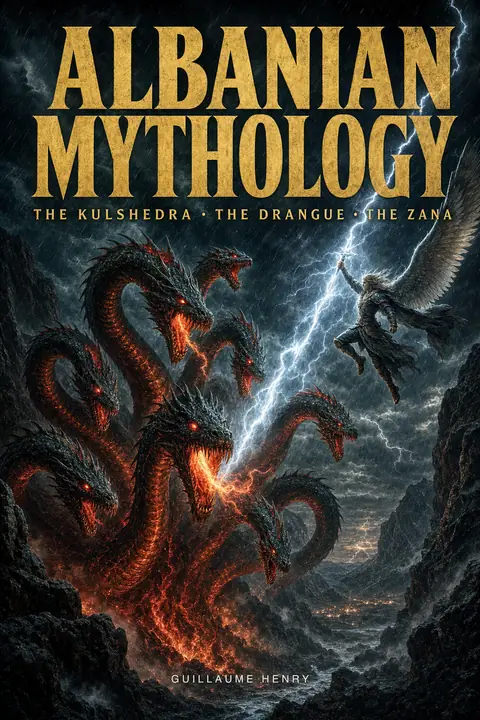
Albanian
The Albanian Mythology Book: The Kulshedra, the Drangue, and the Spirits of the Mountains
The Kulshedra, the Drangue, and the Zana
The mythology of the Albanian highlands: the Kulshedra, a fire-belching dragon-hag who hoards the rains, the Drangue, winged heroes born to fight her, and the Zana, mountain nymphs who bless and curse. A pagan world that survived in the songs of the highland warriors.
More from Albanian
All articles
Albanian
The Shtriga: Witch-Vampire of Albanian Folklore
The Shtriga is a witch-vampire hybrid from Albanian folklore who feeds on the life force of sleeping children. Part demon, part woman, entirely dangerous, she embodies the fears of a culture caught between Christianity, Islam, and older Balkan beliefs.
Albanian
Muji and Halili: The Epic Heroes of Albanian Legend
Muji and Halili are the legendary twin heroes of Albanian epic poetry, warriors bound by blood and honor who defend their land against mythical monsters and foreign invasion. Discover how their deeds shaped Albanian cultural identity for centuries.
Albanian
The Besa: Sacred Code of Honor in Albanian Culture
The Besa is Albania's oldest unwritten law: a sacred pledge of honor, protection, and hospitality that has shaped Albanian identity for centuries. Discover how this ancient code binds community, defies conquest, and survives in modern Albania.
Albanian
E Bukura e Dheut: The Earthly Beauty and Goddess of Nature in Albanian Mythology
E Bukura e Dheut embodies the earthly beauty and goddess of nature in Albanian mythology, representing fertility, growth, and the sacred landscape. Discover how this ancient figure shaped Albanian spiritual life and persists in folk tradition today.