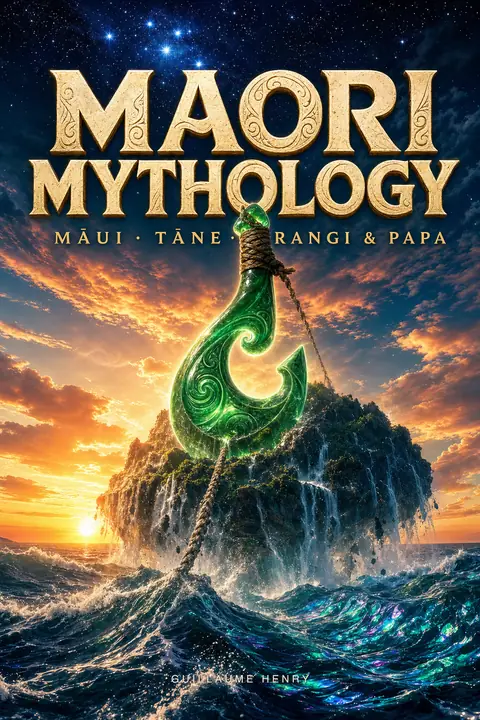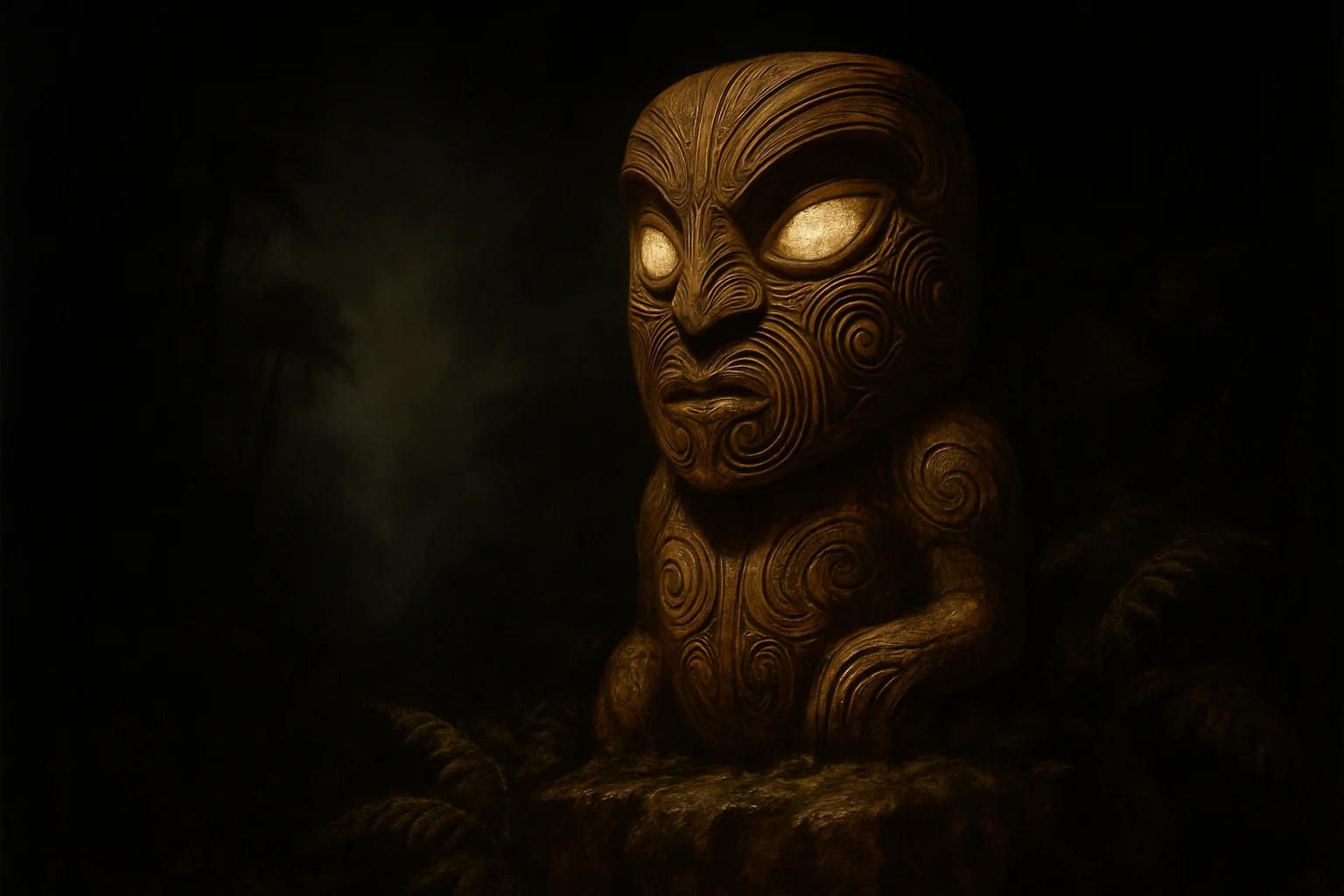
Maori
Discover the rich mythology of Aotearoa (New Zealand), from Io the supreme being to Maui the legendary demigod. Learn the creation stories, major deities, and sacred traditions that shaped Maori culture for centuries.
Browse Maori
In the beginning, there was nothing but void. No light, no sound, no separation between what might be and what could not. From this darkness, a supreme being named Io emerged, and through acts of spiritual will alone, Io spoke everything into being. The sky Father and Earth Mother were born, then their children, and the world took shape. This is how the Maori story starts, not with drama or combat, but with quiet creation through thought and word. What follows is the mythology that held a nation together across centuries, carried in chants, in carved wood, in the landscape itself.
The Maori people are the indigenous inhabitants of Aotearoa, the Polynesian islands we now call New Zealand. Their mythology is not a relic kept in museums. It is alive. Maori children still grow up hearing stories of Maui the demigod who slowed the sun and fished up islands from the sea. Maori artists carve the faces of gods and ancestors into meeting houses. Maori communities still perform rituals rooted in stories thousands of years old. Understanding Maori mythology means understanding a living tradition, one that survived colonisation and continues to shape identity and art.
The mythology we know today comes from multiple sources. Early Maori scholars and anthropologists like Sir Peter Buck and the tohunga (experts) of the 19th and 20th centuries recorded these stories in writing. But the real keepers were the kaumatua, the elders, who passed stories mouth to mouth, in poetry, in song. There are regional variations. The stories of Taranaki differ slightly from those of Northland. What you read here represents the threads that run through most Maori iwi (tribes), the core narratives that hold Aotearoa together.
The Creation of the World: Io and the Separation of Sky and Earth
Long before the sun existed, before light had a name, Io the supreme being existed in thought alone. Io was neither male nor female, neither separate from anything nor part of anything. Io simply was. From this nothingness, Io created thought itself, then substance. The first act of creation was the birth of Ao and Po: light and night, consciousness and the unconscious. Then came the separation of Rangi and Papa.
Rangi is the sky father, and Papa is the earth mother. Imagine them pressed together in complete darkness and closeness, unable to separate, unable to move. Their children grew in the space between them, crowded in darkness. The sons of Rangi and Papa grew tired of this prison. Tane, god of forests and light, pushed his parents apart. He placed his feet on his mother Earth and his back against his father Sky, and he thrust upward with all his strength. The separation happened. Light flooded in. Sky and Earth were torn from each other, and the world as we know it began.
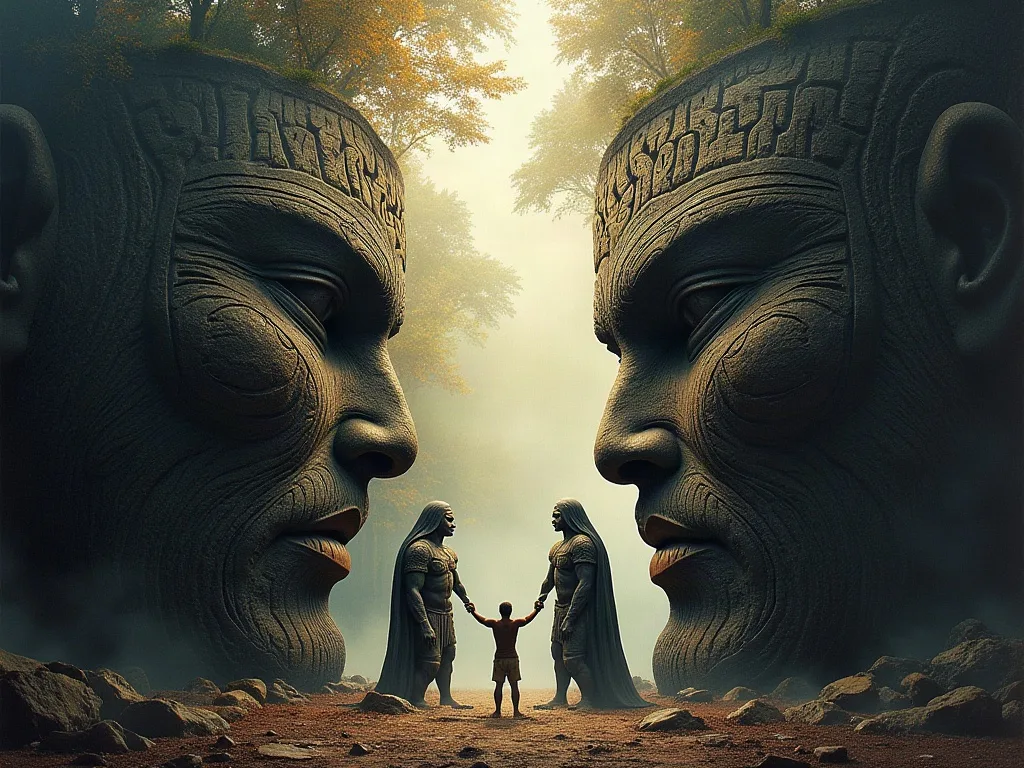
This act of separation by Tane had consequences. Some of the children of Rangi and Papa sided with the sky father, grieving the loss. Tawhirimatea, god of weather and storms, fought alongside Rangi, sending down hurricanes and tempests that batter the earth to this day. Other children sided with Papa and Tane. Tangaroa became god of the sea. Rongo became god of plants and agriculture. Tu Matauenga became god of war and humanity. Each deity governs a part of the separated world, and the tension between them explains the forces we see around us: growth and decay, calm and storm, abundance and scarcity.
This story is not about punishment or sin. It is about transformation. The world could not exist in the form we know it without that separation. The children of Rangi and Papa did not rebel; they chose to make room for life. The separation remains incomplete. Every night, Rangi and Papa reach for each other, and the morning dew is their tears of longing. This kind of imagery runs through Maori mythology: gods are not distant judges, but forces bound up with the natural world, grieving and acting within it.
The Major Deities: Gods of Land, Sea, and Sky
The atua, or gods, are not abstract forces. They have stories, preferences, moods. They interfere in human affairs. They demand respect and offerings. The major deities are known as the Kiekie, the elder gods, and their names and domains shape how Maori people understand the world.
Tane Mahuta is perhaps the most important god for the Maori. He is god of forests, light, and also of knowledge and human creation. After he separated his parents, Tane created the first human being. He pulled down the vine plant Hinauri and shaped it into the form of a woman. This woman became Hine-ahu-one, literally "maiden formed from earth", the first female being. From her, all humans descended. Tane is also god of birds, and the forest is his domain. When Maori hunters moved through the bush, they acknowledged Tane. When they cut timber or harvested birds, they made offerings and asked permission. Tane was not worshipped in grand temples, but in the forest itself, through respectful action.
Tangaroa is god of the sea and all things that live in water. He is Tane's brother, and the rivalry between forest and ocean explains why forests and seas do not easily blend in nature. Tangaroa is greedy and protective of his domain. Maori navigators and fishermen made offerings to Tangaroa before setting out. A bad storm at sea, or a catch that suddenly disappears, is understood as Tangaroa's anger or his decision to withhold. Unlike Tane, who is generous, Tangaroa keeps what is his. This distinction reflects the actual experience of Maori life: forests offered food and materials freely if treated with respect, but the sea was unpredictable and demanded constant negotiation.
Rongo (also called Rongo-ma-Tane) is god of agriculture, peace, and kumara, the sweet potato that was central to Maori food security. Rongo is associated with abundance, harvest, and the settled season when communities could grow crops and gather together. In contrast to Tawhirimatea the storm god, Rongo represents stability. Maori communities made offerings to Rongo at planting and harvest. The sweet potato itself carried Rongo's mana, his spiritual power, and eating it properly meant acknowledging the god.
Tu Matauenga (often called simply Tu) is god of war, hunting, and human strength. Tu is the deity most directly concerned with human victory and survival. When Tawhirimatea sent storms, it was Tu who urged his brothers to fight back. Tu's realm includes both hunting (a form of warfare against animals) and actual combat between people. Maori warriors made offerings to Tu before battle and thanked him after. Tu is more volatile than Rongo; he does not offer comfort, but he offers power. Many Maori people claim descent from Tu, and war leaders invoked his name and mana.
Tawhirimatea is the god of weather, storms, wind, and the unpredictable forces that move through the sky. His children are the winds, the clouds, the hail, and the lightning. Tawhirimatea remains angry about the separation of his parents, and this anger never ceases. He is not evil, but he is difficult to manage. You do not make offerings to Tawhirimatea to ask for favor, but rather to ask him to calm his rage or to move his anger elsewhere. Maori communities understood Tawhirimatea's unpredictability as natural and permanent; they built and planned with his moods in mind.
Hine-nui-te-po is goddess of night and death. She is the keeper of the underworld, and when humans die, they descend to her domain. Hine-nui-te-po is not cruel, but she is final. She represents the boundary between living and the ancestors. In some stories, she is also the mother of Maui (the demigod hero), and her relationship with Maui shapes much of what we know about her: she is powerful, she cannot be fooled, and death is not negotiable even for someone as clever as Maui.
Makemake appears in some Maori traditions as a creator deity associated with birds and sky. However, his role is less universal than the other atua, and his stories often appear in more southern regions of Aotearoa.
These gods are not thought of as living far away in a distant realm. They are present in the land. A mountain may have the mana of a specific ancestor or atua. A river may be sacred to Tangaroa. The forest itself is the body of Tane. This is not metaphorical; it is how Maori spirituality understands the world. To walk through the land respectfully means to acknowledge that you are walking through the bodies and domains of gods.
Maui: The Demigod Hero Who Slowed the Sun
No figure in Maori mythology is better known or more beloved than Maui. He is a demigod, not a full atua, but his deeds rival those of gods. Maui is clever, resourceful, often funny, and occasionally vain. He makes mistakes that have huge consequences. He is not a hero in the European sense of moral perfection; he is a trickster who achieves extraordinary things through cleverness and stubbornness.
Maui was born to Taranga, a human woman, and a divine father. Because Taranga feared scandal, she wrapped the newborn Maui in hair (some versions say seaweed) and threw him into the sea. Most children would have drowned. Maui was found and raised by Tama-nui-a-Rangi, the grandfather of the sky. He grew up with godly knowledge and power but remained fundamentally different from the gods; he was half human, half divine, and this duality gives him his power. Maui is on the boundary between worlds.
One of Maui's most famous deeds is slowing the sun. The sun, Ra, moved too quickly across the sky in those early days, and there was not enough daylight for humans to work and gather food. Maui decided to trap the sun and force it to move slower. He wove rope from the fibers of his sister's hair (a practical detail Maori audiences would recognize). With his brothers, he dug a pit where the sun rose. When Ra descended into the pit, Maui and his brothers threw the ropes and lassoed the sun. Ra struggled and fought, but Maui beat it with a club made from his grandmother's jawbone. Eventually, Ra surrendered and agreed to move more slowly across the sky. This is why there is day and night, why the sun is slower now than it was then. This story explains a real phenomenon (the sun's apparent movement) through Maui's character: his refusal to accept the world as it is, his use of intelligence and family cooperation, his willingness to fight even against a god.
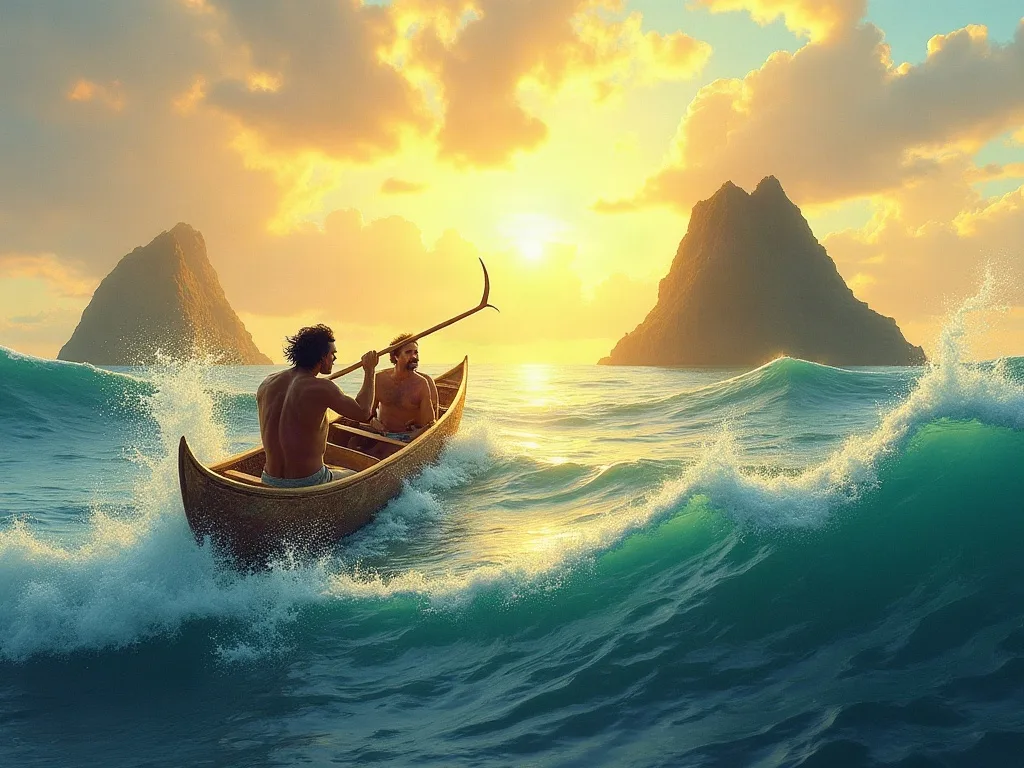
Another famous feat was fishing up islands. In early times, there was no land; only sea. Maui and his brothers went out fishing. Using a hook made from his grandmother's jawbone (the same one he used against the sun; practical magic in Maori tradition comes from family objects), Maui cast his line into the deep. He caught something enormous. His brothers wanted to cut it up and divide it, but Maui insisted on landing it whole. Through patience and strength, he pulled it to the surface. What he caught was the North Island of Aotearoa (New Zealand). The Maori still speak of the islands as having been "fished up" by Maui. The South Island is sometimes said to be the canoe he used. Geographic features are named after Maui's feats: the Bay of Plenty is associated with his fishing, and various mountains and valleys are explained through his actions.
However, Maui's most famous attempt ended in failure, and this failure is his most important story. Maui decided to conquer death itself. He learned that Hine-nui-te-po, goddess of death, must sleep to allow humans to continue living. If he could enter her body while she slept and make his way back out, he believed he could defeat death and make humans immortal. He told his brothers to wait outside and not to laugh, no matter what they saw. Maui transformed himself into a worm and began to crawl inside Hine-nui-te-po's body. He almost succeeded. But as he was emerging from the other side, one of his brothers laughed. Hine-nui-te-po woke up. She crushed Maui, and he died. This is why humans still die. This story is not shameful; it is the explanation for mortality. Maui came as close to defeating death as anyone ever has. The fact that he failed teaches an important lesson: some things cannot be conquered, not through cleverness or strength, but only through acceptance and respect.
Taniwha: The Supernatural Guardians of Water and Land
Taniwha are supernatural beings that appear throughout Maori mythology and still feature in contemporary Maori tradition. A taniwha is not a god, but something between a god and a creature. Taniwha inhabit specific places, usually in or near water, and they can be helpful or dangerous depending on how humans treat them.
Some taniwha are helpful guardians who protect a particular river or lake. A taniwha might warn of danger or offer safe passage to people who treat it with respect. Other taniwha are fierce and must be respected and avoided. A taniwha might drag swimmers to the bottom of a river, or guard a mountain pass and demand a offering before allowing passage.
The key thing about taniwha is that they are local. Each region of Aotearoa has its own taniwha stories. A taniwha associated with a river in the Bay of Plenty is different from a taniwha in the Waikato. These are not generic monsters; they are the guardian presences of specific places, and they are still part of how Maori communities understand their lands. When Maori people speak of protecting a river or mountain, they may frame it as protecting the taniwha that lives there, or respecting the mana (spiritual power) that the taniwha represents.
The Maori Cosmology: Layers of Being and the Journey of Souls
Maori mythology describes multiple layers of existence. The living world is just one layer. Beyond it, there are other realms where gods, ancestors, and spirits exist.
Te Po is the realm of darkness, night, and the underworld. It is ruled by Hine-nui-te-po, the goddess of death. When a Maori person dies, their spirit is believed to journey to Te Po. The journey is not instantaneous; spirits sometimes linger near their homes or communities before making the final descent. Te Ao is the realm of light, the living world where humans move during the day. Te Ao Marama is the world of light and consciousness. These categories overlap and blend; they are not separate but interlocking.
Ancestors, once they have fully passed into Te Po, do not disappear. They become tupuna, and they retain influence over the living world. When Maori people make offerings or speak the names of ancestors, they acknowledge that the ancestors are still present, still watching, still capable of helping or hindering. This is not ancestor worship in the sense of treating them as gods, but rather a recognition that the line between the living and the dead is not absolute. Ancestors are part of the community.
The journey of the soul after death is understood differently by different iwi (tribes), but a common version is that the spirit travels to the far north of Aotearoa and descends into the underworld at a place called Cape Reinga. At this point, the spirit breaks its ties with the living world and continues its journey with ancestors.
How Maori Mythology Survived and Evolved
The history of Maori mythology is also the history of its suppression and revival. When European colonisation began in the late 1700s, Maori people faced enormous pressure to abandon their traditions. Colonial policies discouraged the speaking of the Maori language. Schools punished children for speaking te reo Maori. The rich oral tradition that had carried mythology for centuries was at risk of being lost entirely.
However, Maori communities fiercely maintained their traditions. In the late 19th and early 20th centuries, Maori scholars began recording mythology in written form, partly to preserve it against loss, partly to reclaim it as part of Maori intellectual history. Figures like Sir Peter Buck collected and published Maori stories. Maori artists continued to carve traditional motifs and include mythological scenes. The language itself was kept alive in homes and communities, even as it was discouraged in public spaces.
The real turning point came in the 1970s and 1980s with the Maori Renaissance. Language immersion schools (kura kaupapa) were established where children could learn in te reo Maori and study Maori history and mythology as core subjects. Maori artists, writers, and filmmakers began creating new work based on traditional myths. Koro and kuia, grandfathers and grandmothers, began teaching grandchildren the old stories again. Today, Maori mythology is not a relic; it is an active, living tradition that informs Maori identity, art, and community.
Contemporary Maori artists have retold and reinterpreted Maori myths in film, theater, literature, and visual art. Films like "Whale Rider" (2002) drew directly on Maori mythology and cosmology. Visual artists like Ralph Hotere and Lisa Reihana have used mythological imagery and themes in their work. Writers like Keri Hulme and Patricia Grace have woven mythology into fiction. This is not nostalgia; it is ongoing creative engagement with living tradition.
Maori Mythology in Landscape and Place
A distinctive feature of Maori mythology is that it is embedded in landscape. Nearly every geographic feature in Aotearoa has a mythological story. Mountains, rivers, valleys, and forests are not empty backdrops to myths; they are the physical bodies of gods and the locations where mythological events took place.
Mount Taranaki (also called Mount Egmont) is a volcano in the southwestern part of the North Island. According to Maori tradition, Taranaki is actually a chief from the central plateau who fell in love with Mount Tongariro. Tongariro's lover, Mount Ruapehu, fought to keep Taranaki away. The battle between the mountains caused enormous damage to the land. Taranaki was defeated and driven westward, where he eventually settled in his current location, far from his rivals. You can see this in the landscape itself: Taranaki stands alone, separated from the other mountains, its cone intact while the surrounding land shows the scars of the ancient conflict.
Similarly, the Bay of Plenty is named after Maui's fishing expedition. The Waikato River is associated with the demigod or ancestor Raukatauri, who is said to have shaped it. Lake Taupo was formed when a mountain was destroyed in a mythological battle. These are not arbitrary names or poetic interpretations; they are the physical geography understood through myth. When Maori people move through their land, they are moving through the body of their mythology.
This connection between place and story is so fundamental that land rights and tribal identity are inseparable from mythology. When a Maori tribe claims connection to a particular area, that connection is expressed partly through the myth attached to that place. To lose the land is to lose the link to the story; to forget the story is to lose the connection to the land. This is why the protection of language and mythology is understood as inseparable from land rights and indigenous sovereignty.
Mythology in Maori Ritual and Daily Life
Maori mythology is not confined to stories told for entertainment. It is embedded in ritual, in the structure of society, and in everyday practices.
Whakapapa, which literally means "layer upon layer," is the genealogy that connects a Maori person to their ancestors and through them to gods and the land. A person's whakapapa typically traces their line back through parents, grandparents, and earlier ancestors, eventually connecting to an eponymous ancestor or founding chief of their iwi (tribe), and further back to the gods themselves. Knowing and reciting one's whakapapa is a fundamental part of Maori identity. It is not history in the Western sense; it is the living connection that ties a person to place, to family, and to the mythology that explains the world.
Karakia are ritual chants or incantations that invoke the power of gods and ancestors. A karakia might be performed before eating, before a journey, before hunting, or in times of illness or danger. The words are often ancient and are believed to have real power; they call down the mana (spiritual power) of the gods. A proper karakia requires the right words in the right order, spoken with proper intention. This is magic in the practical sense: the belief that carefully chosen words, spoken with focus and respect, can affect reality. Mythology provides the words and the framework for karakia.
Tapu and noa are concepts central to Maori spirituality. Tapu means sacred, dangerous, forbidden. Something is tapu if it is connected to gods, if it is the site of death or birth, if it is reserved for a particular person or purpose. Noa means free from tapu, safe, ordinary. Managing the boundary between tapu and noa is essential to Maori spiritual practice. For example, a tapu place should not be entered casually; entering requires ritual acknowledgment and preparation. Food prepared in a place associated with death is tapu and cannot be eaten without ritual cleansing. These concepts come directly from Maori mythology's understanding of the world as alive with spiritual power.
Hui, or gatherings, often include the telling of myths and stories. Elders teach young people the stories of their iwi, stories that explain where they come from, what values matter, what the land means. These are not classroom lessons; they are woven into conversation, into jokes, into the natural rhythm of gathering. A good storyteller can make a myth that is thousands of years old seem immediate and relevant. This is how mythology survives in the modern world: not in books alone, but in the living practice of community.
Frequently Asked Questions About Maori Mythology
Frequently asked questions
Is Maori mythology still practiced today?
Absolutely. Maori communities continue to practice rituals, speak the language, and teach mythology in schools and homes. The Maori Renaissance beginning in the 1970s actively revived the tradition. Contemporary Maori artists, filmmakers, and writers regularly create new work based on traditional myths. Maori spirituality, including offerings to gods and respect for places as sacred, remains part of living Maori culture.
What is the primary source for Maori mythology?
Maori mythology was transmitted orally for centuries before being written down. Major written collections were compiled by Maori scholars and anthropologists in the 19th and 20th centuries, most notably Sir Peter Buck. Regional variations exist, so different iwi (tribes) may have different versions of core stories. The authentic sources are the memories and teachings of iwi themselves, preserved through family lines and cultural institutions.
How does Maui compare to other demigod heroes in world mythology?
Like the Greek Heracles or the Polynesian demigods of other islands, Maui is half human and half divine, giving him extraordinary power. Unlike Heracles, Maui is more trickster than straightforward hero; he wins through cleverness and persistence rather than strength alone. His failure to defeat death (a lesson in acceptance) is unusual among demigod narratives and reflects Maori philosophy about limits and respect for natural forces.
What happened to Maori mythology during colonisation?
Colonial authorities actively discouraged Maori language and culture. Schools punished children for speaking te reo Maori. However, Maori communities kept the tradition alive through family teaching and eventually through written collections. The Maori Language Act (1987) and the establishment of kura kaupapa (Maori immersion schools) officially revived and legitimised the teaching of mythology and language. The tradition never died, though it faced periods of severe suppression.
Are the Maori gods different from Polynesian gods in other Pacific islands?
Maori mythology shares a common foundation with other Polynesian traditions because Maori people are Polynesian and migrated from Central Polynesia around 700-800 AD. Many gods have similar names and roles across the Pacific (Tane appears in multiple Polynesian traditions, for example). However, Maori mythology developed its own distinct character over centuries of living in Aotearoa. The specific emphasis on landscape, the detailed mythology of Maui, and the integration into Maori social structure are uniquely developed in the Aotearoa context.
The Enduring Power of Maori Mythology Today
Maori mythology continues to shape how Maori communities understand their place in the world. The stories of creation, of gods, of ancestors, and of the demigod Maui are not ancient history but living tradition. They explain who Maori people are, what the land means, and how to move through the world with respect and intention.
In contemporary Maori art, theater, film, and literature, mythology remains a primary source of inspiration and cultural grounding. The connection between people and place, articulated through mythology and whakapapa, is central to debates about land rights and indigenous sovereignty in New Zealand. When Maori communities fight to protect a river or mountain, they do so partly through asserting the sacred connection expressed in mythology.
The principles embedded in Maori mythology are increasingly recognized as relevant to broader conversations about ecology and sustainability. The idea that humans are part of a living world governed by gods and ancestors, that we have responsibilities to that world, and that our actions have consequences we cannot control, speaks to contemporary concerns about environmental damage and climate change. Maori concepts like kaitiakitanga (stewardship) and manaakitanga (hospitality and care) are rooted in mythology and are now being adopted as frameworks for environmental protection.
Maori mythology is not exotic or quaint. It is a sophisticated, living system of meaning-making that has survived colonisation, suppression, and cultural erasure, and that continues to shape identity and action. To understand Maori mythology is to understand a people who have maintained their connection to land, language, and ancestors despite centuries of pressure to abandon them. It is to recognize that the gods and stories are not relics, but active forces in the present day.
Major gods of Maori
View all →
Maori
Hine-nui-te-po: Goddess of Death and the Underworld
Hine-nui-te-po rules the Maori underworld with obsidian eyes and hair like the horizon at dusk. Learn who she is, how she became death, and why Maui could not outrun her.
Maori
Ranginui and Papatuanuku: The Sky Father and Earth Mother
Before light, before separation, sky and earth lay locked in an embrace so tight nothing could exist between them. Ranginui and Papatuanuku, the primordial parents of Maori tradition, held the cosmos in darkness until their children forced them apart to birth the world.
Maori
Tane Mahuta: God of Forests and Birds
Tane Mahuta breathed life into the first forests, shaped the first woman from earth, and carried light itself into the sky. This is the full story of the Maori god who holds the living world together.
Maori
Tangaroa: God of the Sea and Fish in Maori Mythology
Tangaroa rules the ocean depths in Maori mythology, commanding every fish and sea creature. Trace his origins, his cosmic rivalry with Tane, and his enduring power across Polynesia.
Maori
Tawhirimatea: God of Weather and Storms
Tawhirimatea, the Maori god of weather and storms, unleashed his fury on his siblings when their parents were torn apart. Learn who he is, why he still rages, and what his myth reveals.

Maori
Whiro: God of Darkness and Evil in Māori Mythology
Whiro stands as the Māori god of darkness, chaos, and evil, a primal force of destruction born from the separation of sky and earth. Discover how this ancient deity shaped Polynesian cosmology and what his eternal struggle with light reveals about Māori understanding of creation.
Famous Maori myths
View all →Recent in Maori
6 entriesMaori
Hine-nui-te-po: Goddess of Death and the Underworld
Hine-nui-te-po rules the Maori underworld with obsidian eyes and hair like the horizon at dusk. Learn who she is, how she became death, and why Maui could not outrun her.
Maori
The Marae: Sacred Meeting Ground in Maori Culture
The marae stands at the heart of Maori identity: a sacred communal space where land, genealogy, and spiritual power converge. Discover how this open courtyard became the foundation of Maori society, ceremony, and connection to place.
Maori
Maui: The Trickster Hero Who Shaped the World
Meet Maui, the shape-shifting demigod who fished up islands from the ocean, slowed the sun, and stole fire for humanity. Born from magic and mischief, Maui stands as Polynesia's greatest trickster hero, clever, reckless, and forever reshaping the world around him.
Maori
Ranginui and Papatuanuku: The Sky Father and Earth Mother
Before light, before separation, sky and earth lay locked in an embrace so tight nothing could exist between them. Ranginui and Papatuanuku, the primordial parents of Maori tradition, held the cosmos in darkness until their children forced them apart to birth the world.
Maori
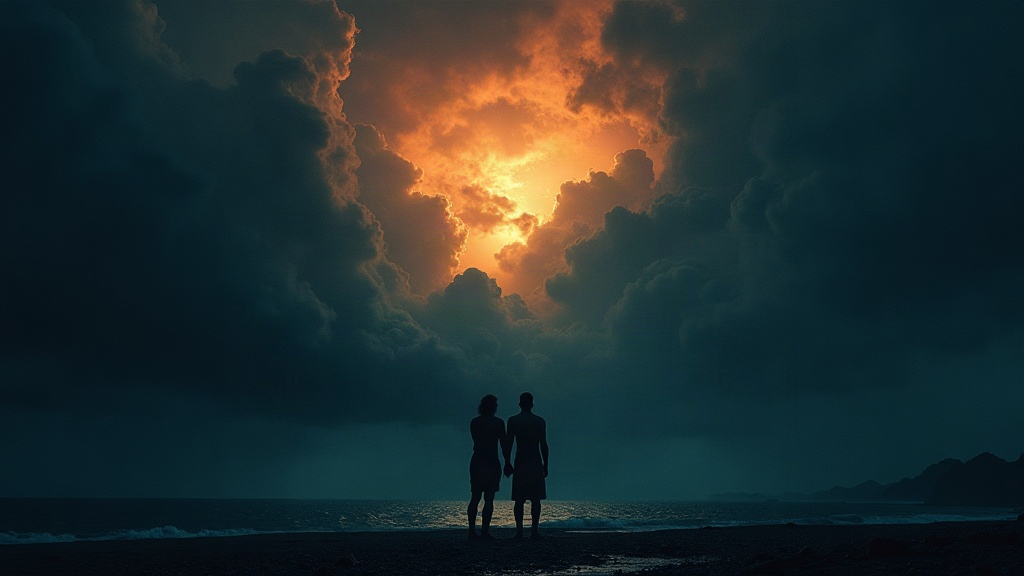
The Separation of Rangi and Papa: Creation Through Division
When sky and earth were wrenched apart, light and life flooded a world that had only known darkness. This is the Maori creation myth that still shapes how Polynesia understands existence.
Maori
Tane Mahuta: God of Forests and Birds
Tane Mahuta breathed life into the first forests, shaped the first woman from earth, and carried light itself into the sky. This is the full story of the Maori god who holds the living world together.