Ouroboros: A Timeless Symbol of Unity and Continuity
The ouroboros appears first in Egyptian funerary texts as a serpent encircling the sun god. Trace its path through alchemy, Gnosticism, and Norse myth.
Contents
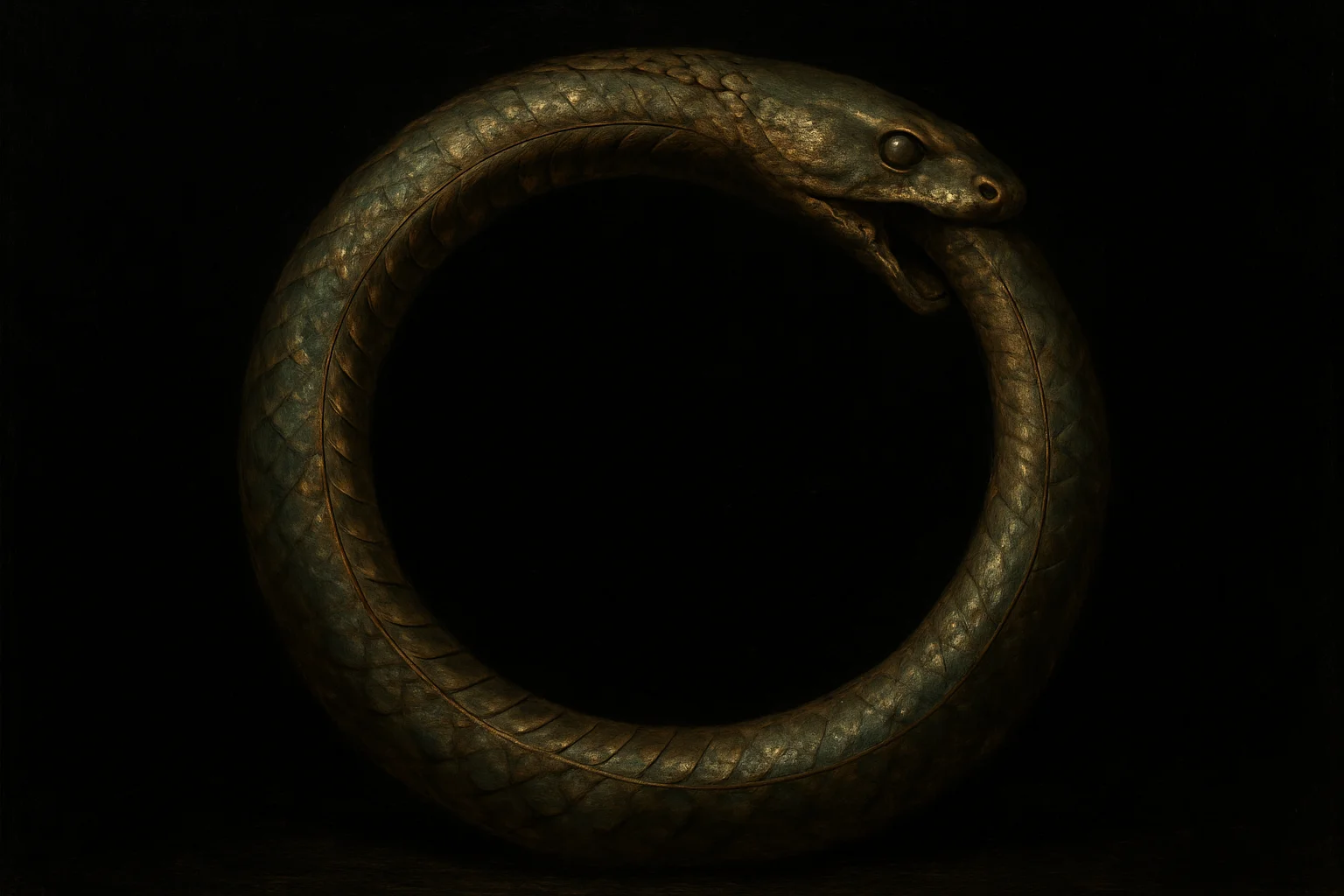
The ouroboros is a symbol depicting a serpent or dragon consuming its own tail, first attested in Egyptian funerary texts of the New Kingdom around 1600 BCE, where it encircles the solar barque and represents the cyclical journey of the sun through the underworld and the eternal regeneration of time itself. The name derives from Greek ouroboros, meaning "tail-devourer," but the image predates Hellenic culture by more than a millennium. It appears in contexts as varied as Greco-Roman alchemy, Gnostic cosmology, and Norse myth, each tradition reading into the serpent's circular form a different metaphysical claim about boundaries, transformation, and the structure of existence.
Most treatments of the ouroboros flatten it into a generic emblem of eternity or self-reference. The symbol's actual history is more specific and more interesting. It moves from Egyptian solar theology through Greek alchemical manuscripts and into Norse cosmology as Jörmungandr, the world-encircling serpent. Each iteration preserves the circular form but assigns it new meaning. What follows is a reconstruction of that transmission, grounded in primary texts and material evidence where they survive.
The Earliest Attestations: Egypt and the Solar Serpent
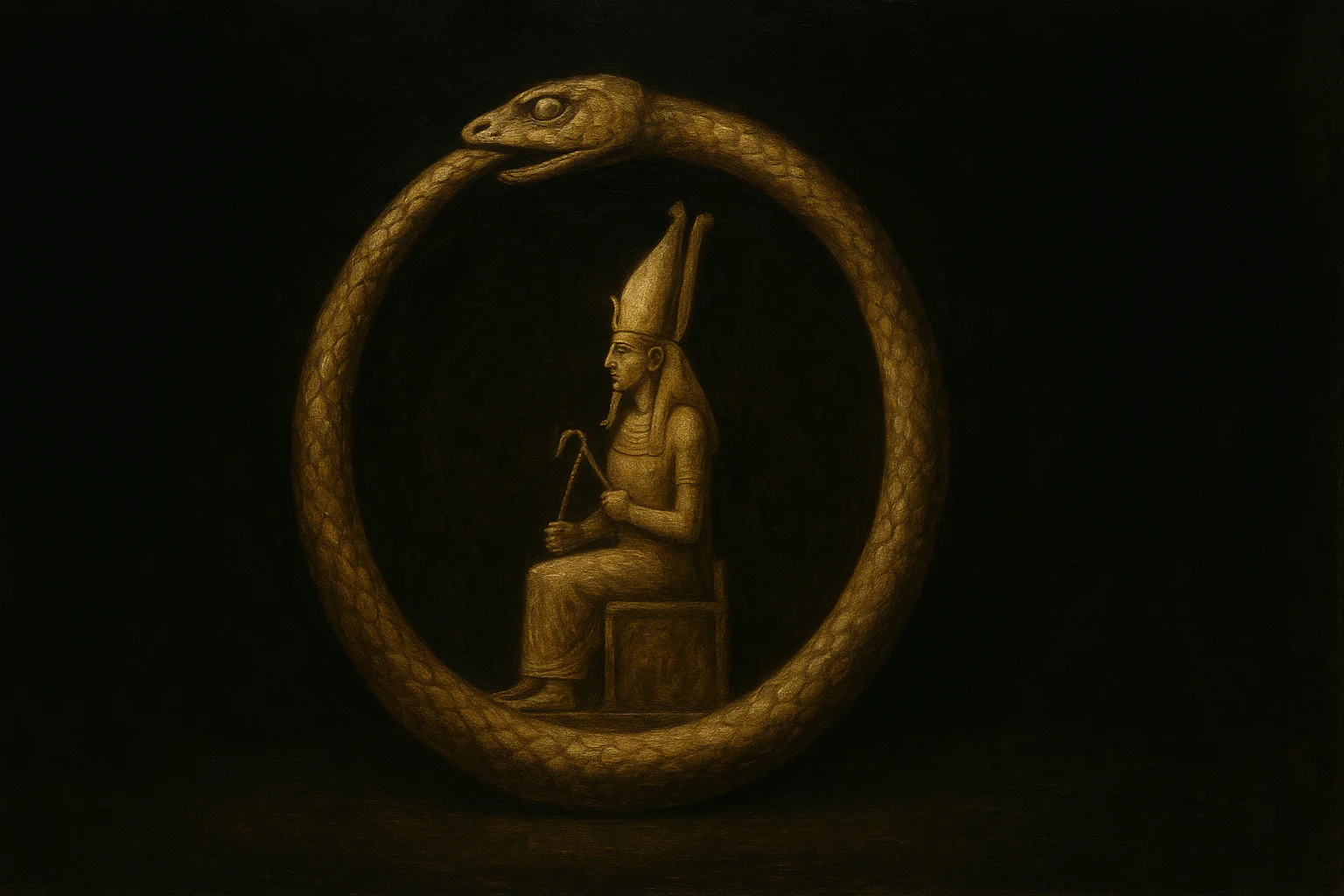
The oldest known depictions of the tail-eating serpent appear in the Enigmatic Netherworld Books, a collection of Egyptian funerary texts inscribed on the walls of royal tombs in the Valley of the Kings during the 18th and 19th Dynasties. The Darnells' 2018 study identifies the ouroboros in the Book of the Hidden Chamber and related compositions, where it encircles the body of Osiris or the solar barque of Ra. The serpent's circular form represents neheh and djet, the two Egyptian concepts of time: cyclical recurrence and linear eternity.
In these texts, the serpent does not merely symbolize time in the abstract. It enacts the boundary between the ordered cosmos and the waters of chaos, Nun, from which creation emerged and to which it will return. The ouroboros holds the world in place by consuming itself, a paradox that Egyptian theology does not resolve but holds in tension. The serpent is both protective and threatening, both inside and outside the created order.
The Egyptian gods associated with the ouroboros include Ra, the solar deity whose nightly passage through the underworld requires the serpent's encircling protection, and Osiris, whose death and resurrection mirror the cyclical renewal the serpent embodies. Spell 87 of the Book of the Dead invokes the serpent as a guardian figure, though it does not name the ouroboros explicitly. The image also appears alongside other Egyptian symbols of regeneration, including the scarab beetle and the ankh.
The Name and Its Greek Transmission
The term ouroboros first appears in Greek alchemical texts of the Hellenistic period, though the symbol itself was borrowed from Egyptian sources. The word combines oura, "tail," and boros, "eating," a straightforward description that lacks the theological weight of the Egyptian original. Greek writers encountered the image in Egypt, likely through contact with temple priests or funerary iconography, and imported it into their own symbolic vocabulary.
Plato's Timaeus 33b-34a describes the cosmos as a self-sufficient sphere, complete and perfect, requiring no external sustenance. Some later commentators read this passage as an oblique reference to the ouroboros, though Plato does not mention a serpent. The connection is speculative but persistent in the secondary literature. What is certain is that by the first century CE, the ouroboros had become a fixture in Greek and Roman magical papyri, where it appears as a protective amulet and a symbol of the eternal return.
The Greeks also associated the ouroboros with the cosmic serpent Ophion, who in some Orphic cosmogonies encircles the primordial egg from which the world hatches. This is a different myth from the Egyptian solar cycle, but the circular serpent serves a similar function: it marks the boundary of the cosmos and the point at which creation begins.
Ouroboros in Greco-Roman Alchemy
The Chrysopoeia of Cleopatra, preserved in the 10th or 11th-century Codex Marcianus, contains one of the most famous depictions of the ouroboros in alchemical literature. The image shows a serpent biting its tail, inscribed with the Greek phrase hen to pan, "the all is one." This is not a mystical slogan but a technical claim about the nature of matter: that all substances are transformations of a single underlying principle, and that the alchemical process is a cycle of dissolution and coagulation, death and rebirth.
The alchemists read the ouroboros as a diagram of their work. The serpent's body represents the prima materia, the undifferentiated substance that must be broken down and reconstituted. The act of self-consumption is the opus, the Great Work, in which the alchemist participates by manipulating fire, water, and metal. The circular form indicates that the process has no true beginning or end, only stages that repeat in ascending spirals.
"The ouroboros is the one, the all, through which all things are accomplished. It is the dragon that devours its own tail, the beginning and the end, the alpha and the omega." Chrysopoeia of Cleopatra, Codex Marcianus
This alchemical reading influenced later Hermetic and Gnostic traditions, which saw in the ouroboros a symbol of the soul's journey through matter and its eventual return to the divine source. The serpent became a map of spiritual transformation, not merely a chemical one.
The Serpent in Norse Cosmology: Jörmungandr
Jörmungandr, the Midgard Serpent, encircles the world in Norse cosmology and holds the ocean in place by gripping its own tail. Snorri Sturluson's Prose Edda, Gylfaginning 34, describes how Thor attempts to lift the serpent disguised as a cat during his visit to Útgarða-Loki, and how the two will meet again at Ragnarök, where each will kill the other. The structural parallel to the ouroboros is obvious: a serpent in a circle, marking the boundary of the known world.
But the theological function is different. Jörmungandr is not a symbol of regeneration or cyclical time. It is a threat, a child of Loki, cast into the sea by Odin and destined to destroy the world when it releases its tail. The Norse serpent does not protect the cosmos; it waits to end it. The circular form here represents containment, not continuity. When the circle breaks, the world breaks with it.
Egyptian Ouroboros
Protective boundary, cyclical regeneration, solar theology, holds chaos at bay through eternal self-consumption.
Norse Jörmungandr
Hostile containment, apocalyptic threat, linear eschatology, releases tail to trigger cosmic collapse at Ragnarök.
The similarity in form does not imply direct transmission. The Norse sources show no evidence of Egyptian influence, and the ouroboros motif appears independently in other cultures, including Mesoamerican and Hindu traditions. The circular serpent may be a recurring solution to the problem of representing cosmic boundaries, not a borrowed symbol.
Gnostic and Hermetic Interpretations
Gnostic texts of the second and third centuries CE adopt the ouroboros as a symbol of the material world's self-enclosed nature. In the Pistis Sophia and related writings, the serpent represents the archons' prison, the cycle of birth and death from which the soul must escape. The ouroboros here is not a positive image. It is the wheel of heimarmene, fate, which binds human beings to matter and prevents their ascent to the Pleroma, the realm of light.
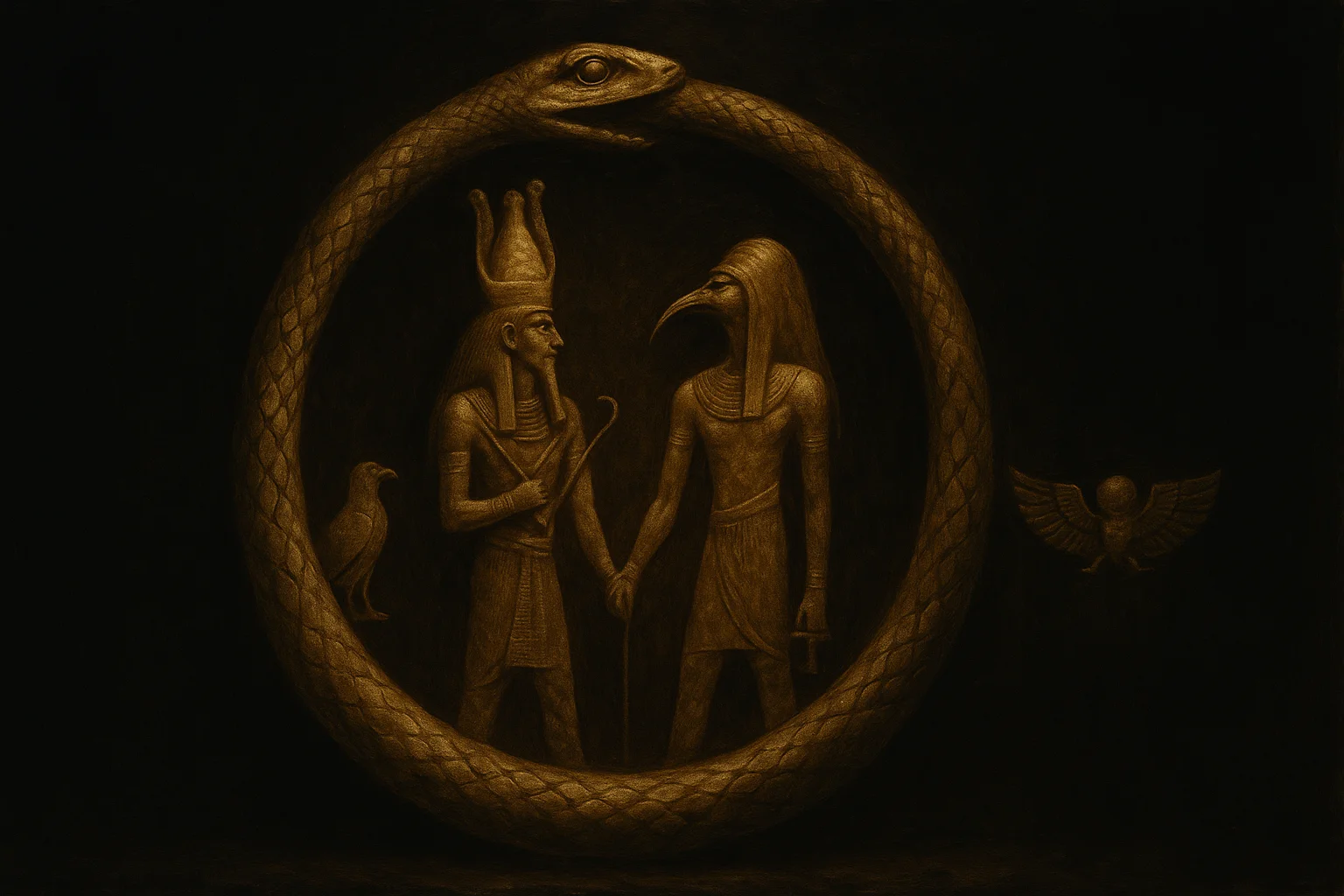
Hermetic texts take a more ambivalent view. The Corpus Hermeticum describes the cosmos as a living organism, self-sustaining and self-renewing, an idea that resonates with the ouroboros without naming it directly. Later Hermetic commentators, influenced by alchemical traditions, read the serpent as a symbol of the philosopher's journey: the soul must descend into matter, experience dissolution, and return transformed. This reading bridges the Egyptian and Gnostic interpretations, treating the ouroboros as both prison and path.
The connection to dying-and-rising gods is implicit in these texts. The serpent's self-consumption mirrors the death and rebirth of deities like Osiris, Dionysus, and Christ, figures who descend into the underworld and return bearing the promise of renewal. The ouroboros becomes a visual shorthand for this mythic pattern, a way of representing the paradox of life through death.
Modern Readings: Jung, Alchemy, and Popular Culture
Carl Jung's Psychology and Alchemy (1944) reintroduced the ouroboros to modern audiences, interpreting it as a symbol of the self's integration and the union of opposites. Jung read alchemical texts as psychological allegories, and the ouroboros became, in his system, an image of individuation, the process by which the conscious and unconscious minds are reconciled. This interpretation has been influential but also reductive, flattening the symbol's historical complexity into a single psychoanalytic framework.
Popular culture has adopted the ouroboros as a generic emblem of infinity, recursion, and self-reference. It appears in fantasy literature, video games, and corporate logos, often stripped of its original theological and alchemical context. The serpent's circular form lends itself to modern concepts like feedback loops and systems theory, but these applications bear little resemblance to the Egyptian or Greek sources.
The ouroboros also appears in discussions of dragons and serpent symbolism across cultures, though the tail-eating motif is relatively rare outside the Egyptian and Greco-Roman traditions. Comparisons to the Hindu serpent Shesha, who supports the world on his coils, or the Mesoamerican feathered serpent Quetzalcoatl, are suggestive but speculative. The circular serpent is not a universal archetype, despite Jung's claims.
What the Ouroboros Actually Represents
The ouroboros does not have a single meaning. It is a flexible symbol, adapted by different traditions to represent different metaphysical claims. In Egyptian theology, it marks the boundary of the cosmos and the cyclical nature of solar time. In Greco-Roman alchemy, it diagrams the process of material transformation and the unity of all substances. In Gnostic thought, it represents the prison of matter. In Norse myth, it is a threat, not a promise.
What these readings share is an interest in boundaries and cycles. The ouroboros always marks a limit: the edge of the world, the boundary between life and death, the point at which transformation begins and ends. It is a threshold symbol, not a static emblem. The serpent's self-consumption is an action, not a state, and the meaning of that action depends on the cosmology in which it appears.
The modern tendency to treat the ouroboros as a universal symbol of eternity or self-reference misses this specificity. The serpent does not mean the same thing in every context, and the differences matter. An Egyptian priest and a Greek alchemist looking at the same image would see different things, ask different questions, draw different conclusions. The ouroboros is not a cipher with a single solution. It is a question about how the world holds together, and the answers vary.
Frequently asked questions
Where does the ouroboros symbol first appear in ancient texts?
The ouroboros first appears in Egyptian funerary texts of the New Kingdom, specifically in the Enigmatic Netherworld Books inscribed on tomb walls in the Valley of the Kings around 1600 BCE, where it encircles the solar barque of Ra or the body of Osiris. The Darnells' 2018 study identifies these as the earliest known attestations. The symbol represents the cyclical journey of the sun through the underworld and the boundary between the ordered cosmos and the primordial waters of chaos.
What does the ouroboros mean in Egyptian funerary tradition?
In Egyptian funerary tradition, the ouroboros represents the cyclical nature of time, specifically the concepts of neheh (cyclical recurrence) and djet (linear eternity), and serves as a protective boundary that holds the forces of chaos at bay while the deceased travels through the underworld. It appears in contexts associated with solar theology and the nightly regeneration of Ra. The serpent's self-consumption enacts the paradox of eternal renewal through continuous transformation, a central theme in Egyptian cosmology and resurrection beliefs.
How did Greek alchemists interpret the tail-eating serpent?
Greek alchemists interpreted the ouroboros as a technical diagram of material transformation, representing the principle that all substances derive from a single underlying matter and that the alchemical process is a cycle of dissolution and coagulation, death and rebirth. The Chrysopoeia of Cleopatra, preserved in medieval manuscripts, depicts the ouroboros inscribed with the phrase hen to pan, "the all is one," indicating the unity of matter. The circular form signified that the Great Work had no true beginning or end, only repeating stages of transformation that the alchemist facilitated through manipulation of the elements.
Is the ouroboros related to Jörmungandr in Norse mythology?
Jörmungandr, the Midgard Serpent, shares the ouroboros's circular form, encircling the world and gripping its own tail, but serves a different theological function: it represents hostile containment and apocalyptic threat rather than cyclical regeneration or protection. The Prose Edda describes how Jörmungandr will release its tail at Ragnarök, triggering the collapse of the cosmos. There is no evidence of direct transmission from Egyptian or Greek sources to Norse tradition; the similarity in form likely represents independent solutions to the problem of representing cosmic boundaries rather than a borrowed symbol.
Why is the ouroboros associated with alchemy and transformation?
The ouroboros became central to alchemical symbolism because its circular, self-consuming form visually represented the cyclical process of breaking down and reconstituting matter that alchemists believed was necessary to achieve the Great Work, the transformation of base metals into gold or the creation of the philosopher's stone. Greco-Roman alchemists adopted the symbol from Egyptian sources and reinterpreted it as a diagram of their technical procedures. The serpent's continuous self-consumption mirrored the repeated cycles of calcination, dissolution, and coagulation that characterized alchemical practice, making it an ideal emblem for a tradition concerned with material and spiritual transformation.
What is the difference between the ouroboros and other serpent symbols in mythology?
The ouroboros is distinguished from other serpent symbols by its specific circular, tail-eating form and its function as a boundary marker or symbol of cyclical process, whereas most mythological serpents serve as guardians, adversaries, or chthonic deities without the self-consuming motif. Serpents like the Greek Python, the Mesopotamian Tiamat, or the Hindu Shesha represent chaos, wisdom, or cosmic support but do not enact the paradox of self-renewal through self-destruction that defines the ouroboros. The circular form is relatively rare in serpent iconography and appears to have developed independently in a few traditions rather than spreading from a single source.
Further reading on Mythologis
Free 25-page sample
Want the whole story?
Take the first 25 pages free. If it pulls you in, the full edition is yours as an instant PDF download, with a paperback on Amazon for selected titles.
Egyptian
The Egyptian Mythology Book: Ra, Osiris, Isis, Anubis, and the Sacred Stories of the Pharaohs
Ra, Osiris, Isis, Anubis, and the Sacred Stories of the Pharaohs
Three thousand years of Egyptian sacred stories. The Duat, the weighing of the heart, the cult of Osiris, and the daily voyage of the sun.
More from Egyptian
All articles
Egyptian
The Book of the Dead: Egypt's Guide to Eternity
Ancient Egypt's most sacred funerary text was not a single book but a living archive of spells, maps, and prayers that guided the dead through the perils between death and eternal life.
Egyptian
Eye of Horus: The Protective Amulet That Watched Over the Living and the Dead
Worn by pharaohs and fishermen alike, the Eye of Horus is one of antiquity's most potent protective symbols, carrying the weight of cosmic battle, divine healing, and eternal vigilance.
Egyptian
Ra the Sun God: Egypt's Supreme Ruler of Light and Creation
Ra, the ancient Egyptian sun god, blazed at the very heart of a civilization that worshipped light as the pulse of creation itself. Discover his origins, his many forms, and the sacred journey he took across the sky and through the underworld every single day.
Egyptian
The Ankh: Egypt's Eternal Symbol of Life
The ankh is ancient Egypt's most recognizable hieroglyph, a looped cross carried by gods and pharaohs alike as the very key to immortal life. Discover its origins, meanings, and sacred legacy.