
Mari: The Supreme Goddess of Basque Mythology
Mari reigns over Basque mountains as the oldest surviving goddess of Western Europe. Storm-maker, earth-shaper, and judge of human honesty, she has endured while empires rose and fell around her.
Contents
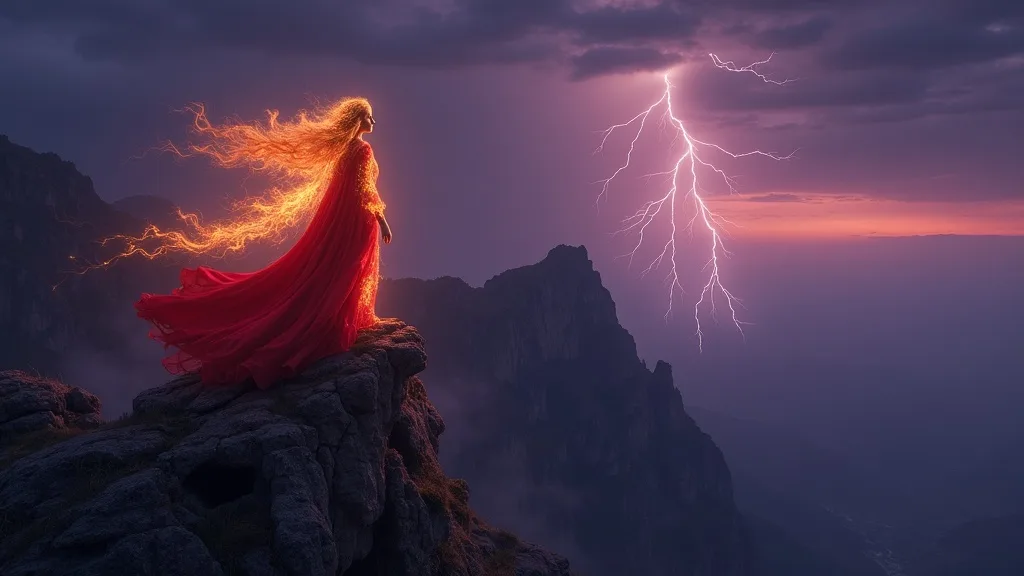
She rides a chariot of fire across the sky above the Pyrenees, her hair a river of flame, her hands pulling clouds from nothing. Lightning is her mood. The mountain is her throne. No temple was ever built for her, because she did not need one: she lived inside the peaks themselves, deep in the limestone caverns of the Basque Country, older than the Christian God who tried for centuries to displace her.
Mari: The Supreme Goddess of Basque Mythology is arguably the most ancient surviving female deity in Western Europe whose cult persisted in living oral tradition well into the twentieth century. Farmers in Gipuzkoa and Bizkaia still whispered her name before storms in the 1950s. Ethnographer Jose Miguel de Barandiaran spent decades collecting her stories and concluded she was no mere folk spirit: she was the sovereign of the Basque cosmos, the source of weather, the keeper of moral order, the being on whom the entire pre-Christian worldview rested.
Her story is not a single myth. It is a geography. Every peak, every cave, every thunder-crack over the western Pyrenees carries her signature.
The Mountain as Sanctuary: Mari's Dwelling Places
The Basques do not imagine Mari living on a distant Olympus or in an invisible spirit world. She lives inside specific mountains, and local people can name them precisely.
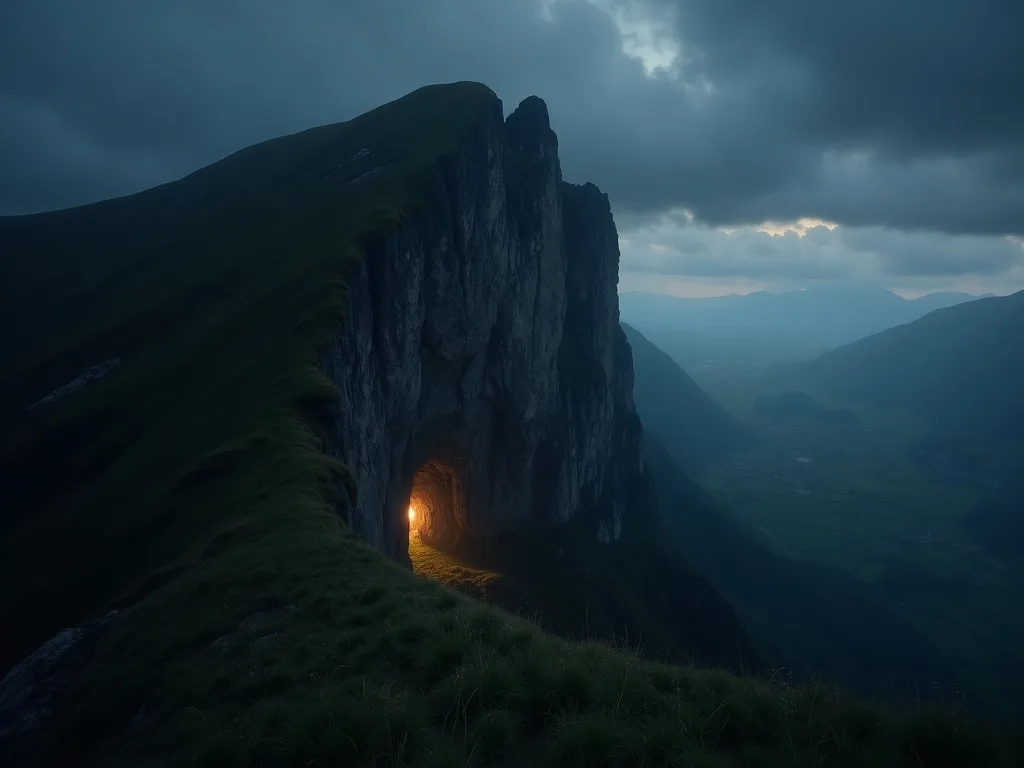
Anboto, a sharp limestone summit in Bizkaia reaching 1331 meters, is her primary abode. Tradition holds that when she is at Anboto, storms roll in from the Atlantic. When she moves to Murumendi or Aizkorri in Gipuzkoa, the weather turns dry. Farmers tracked her migrations the way a meteorologist watches pressure systems. This is not metaphor: it was practical knowledge embedded in the landscape.
Her caves open at the base of these peaks or halfway up their flanks. Inside, according to the collected testimonies in Barandiaran's Mitologia Vasca (1960), her palace blazes with gold. She sits combing her luminous hair with a golden comb. Outside, the sky answers her moods.
The mobility between mountains is significant. Mari is not a static idol. She travels, she changes form, she responds to the season. Summer brings her closer to inhabited valleys; winter pushes her toward the high crags. This movement mirrors the actual behavior of Atlantic weather over the Basque Pyrenees, which suggests her mythology grew organically from centuries of acute environmental observation.
Forms of Fire: How Mari Appears
No single image captures Mari because she refuses to hold one shape for long. Eyewitness accounts collected by Barandiaran and his collaborators across the early twentieth century describe her in at least six distinct forms:
- A woman with blazing hair, often depicted seated on a crescent moon or riding a chariot drawn by four white horses.
- A tree in flames, standing on a mountaintop, burning without being consumed (an image that predates the biblical burning bush in Basque folk memory).
- A sickle of fire crossing the sky, which locals distinguished from ordinary lightning.
- A gust of wind that bends every tree in one direction simultaneously, a sign of her passage rather than her presence.
- A beautiful woman in red, encountered by travelers on mountain paths who then vanish if they are dishonest.
- A vulture or crow, circling the peaks, her animal avatar when she scouts the valleys below.
The red woman deserves particular attention. Red in Basque tradition carries no diabolical association. It is the color of vitality, of the sun's warmth, of blood that sustains life. When Mari appears dressed in red, she is not a demon in Christian clothing: she is the living force of the mountain itself, walking among people.
Shape-shifting goddesses appear across many traditions. Circe in Homer changes others; Mari changes herself. The Aztec Coatlicue wears a skirt of serpents to embody earth's duality; Mari absorbs weather, fire, and wind into a single sovereign body. The Basque case is distinctive because her transformations are tied not to narrative episodes but to observable natural phenomena: every form she takes corresponds to something a shepherd or farmer could actually see in the sky.
Sugaar: The Serpent Consort and the Logic of Basque Thunder
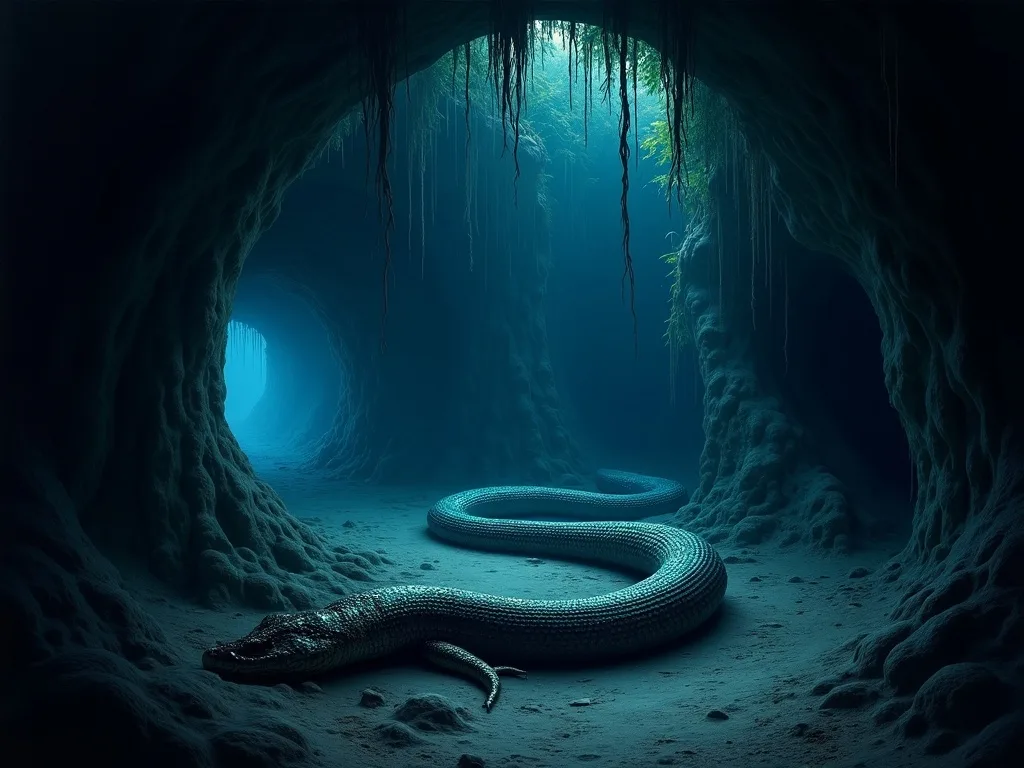
Mari does not rule alone. Her consort is Sugaar (also called Maju in some valley dialects), a serpentine or dragon-like figure who dwells in underground passages beneath the mountains. His name may derive from the Basque suge (serpent) combined with ar (male). He is the male force of the earth: subterranean, powerful, subordinate.
Their relationship is explicitly periodic. Mari and Sugaar meet on Friday nights, a detail repeated consistently across the collected oral traditions. From their union, storms are born. The logic is elemental: she is the sky-mountain force, he is the underground earth force, and when they meet, the collision produces thunder, lightning, and the rain that Basque agriculture depended on.
They also had children. The most discussed are Atarrabi and Mikelatz, a pair of brothers who embody a moral binary. Atarrabi is honest, virtuous, and inclined toward human welfare. Mikelatz is cunning, dark, and disruptive. Scholars including Julio Caro Baroja, in his landmark study Los Vascos (1949), noted the resemblance to Christian good-and-evil binaries, but also argued convincingly that this sibling opposition predates Christian influence and reflects an older Basque cosmological dualism.
The Moral Architecture of Mari's Cosmos
Mari is not only a weather goddess. She is a judge. This is the aspect of her character that most surprises first-time readers, and it is also the aspect most resistant to later Christian reinterpretation.
Several core rules govern her relationship with humanity:
Lying is her single greatest taboo. Any person who lies in her presence, or who swears a false oath on her name, faces direct retribution. Hailstorms destroy their crops. Livestock die. The punishment is material and immediate. Scholars like Barandiaran noted that this moral enforcement made Mari a mechanism for social cohesion: oaths sworn in her name carried genuine weight in Basque rural communities.
Arrogance toward nature invites disaster. Farmers who waste food, hunters who kill more than they need, households that burn wood carelessly: all are subject to her correction. This is not environmental mysticism projected backward; it is documented in the folk narratives themselves, where specific families in specific villages are named as having suffered Mari's punishment for particular acts of excess.
Gifts must be returned. When Mari loans good weather, the community owes her reciprocal acts of respect. The failure to acknowledge this debt is described in multiple stories as the cause of the catastrophic storms that periodically scour the Basque highlands.
This moral architecture sets her apart from most weather deities in the Indo-European tradition, where storm gods like Thor or Zeus are primarily combative figures. Mari governs moral ecology. She enforces reciprocity between humans and the natural world. Her closest structural parallel outside the Basque context may be the Andean concept of Pachamama, the earth-mother to whom offerings are owed and from whom abundance flows conditionally.
Origins and the Pre-Indo-European Question
The Basque language, Euskara, has no proven genetic relationship to any Indo-European tongue. Its roots predate the great Bronze Age migrations that reshaped European languages and religions between roughly 3000 and 1200 BCE. This linguistic fact makes Mari: the supreme goddess of Basque mythology potentially relevant to one of the most contested questions in European prehistory: what did pre-Indo-European religious life look like?
Most scholars working on Basque archaeology and mythology, including Barandiaran, the linguist Larry Trask, and the anthropologist Jesús Altuna, agree that while Mari's mythology as recorded in the twentieth century almost certainly absorbed Christian and pan-European folk elements over the centuries, her core features show no convincing Indo-European template. She is not a cognate of the Norse Frigg, the Greek Hera, or the Roman Juno. Her relationship with specific mountains, her role as weather-controller tied to observable meteorological patterns, and the absence of any male creator-god above her all point toward a genuinely pre-Indo-European substrate.
The cave-dwelling detail is especially telling. Across Paleolithic sites in the Basque Country, particularly in the Basque cave complexes of Santimamiñe and Ekain, there is evidence of ceremonial activity oriented toward caves as sacred thresholds. Whether this constitutes direct continuity with the Mari cult is unprovable, but the spatial logic is consistent across at least fifteen thousand years of Basque habitation.
Mari and the Church: A Conflict Spanning Centuries
Christian missionaries reached the Basque Country in the early medieval period. The region was formally Christianized by the ninth and tenth centuries, and the institutional Church worked steadily afterward to suppress non-Christian practices. Mari was a problem the Church never fully solved.
She was not simply demonized, though that was attempted. Some ecclesiastical records describe her as a laminak (a supernatural female being, cognate in usage with the word for a fairy or sorceress), which had the effect of reducing her without engaging her directly. Other records, from the Inquisition trials of the sixteenth and seventeenth centuries in Navarre, show villagers being prosecuted for leaving offerings at mountain caves or invoking Mari's name during storms. The historian Gustav Henningsen, in The Witches' Advocate (1980), documented that many Basque accused of witchcraft were essentially practitioners of the older mountain cult.
Yet she persisted. The key mechanism of survival was her complete integration into landscape and practice. Mari required no priests, no calendar of feast days, no church building. She was the sound of thunder. She was the shape of the cloud over Anboto. Suppressing her would have meant suppressing the Basques' ability to read their own weather, which was a survival skill. The Church could replace the calendar; it could not replace the mountain.
By the twentieth century, she was reclassified in popular discourse as folklore rather than religion, which paradoxically ensured her preservation. Folklorists documented her. Nationalist intellectuals in the late nineteenth and early twentieth centuries, seeking cultural markers of Basque distinctiveness, celebrated her. She became a cultural symbol precisely at the moment her cult as a living religious practice faded.
The Living Symbol: Mari in Modern Basque Culture
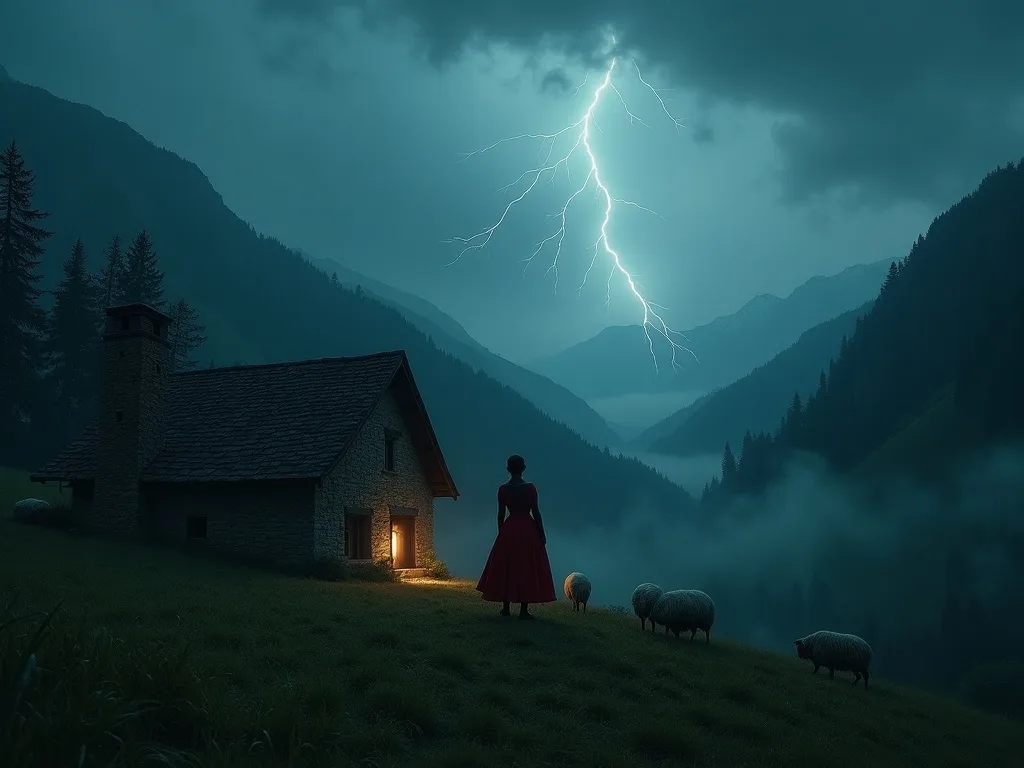
The contemporary Basque Country, split between Spain and France, has found renewed interest in Mari since the late twentieth century. The Basque independence and cultural revival movements that gained momentum from the 1960s onward reclaimed her as an emblem of indigenous identity, a goddess from before Rome, before the Visigoths, before Castile.
She appears in murals in Bilbao and San Sebastián. Her name surfaces in modern Basque literature and poetry. A significant body of academic work has emerged in both Euskara and Spanish, refining and sometimes challenging Barandiaran's foundational studies.
There is also a serious feminist reclamation of Mari underway in contemporary Basque scholarship and popular writing. As the single sovereign deity without a male superior, she offers a model of pre-Christian female divine authority that fits neither the Venus-mother archetype nor the warrior-maiden archetype common in Indo-European traditions. She is a ruler, a judge, a force of nature that answers to nothing above it.
This does not mean she was ever worshipped in an organized, temple-based cult analogous to Greek or Roman religion. The evidence, read carefully, points to something more diffuse: a shared orientation toward certain peaks, a set of behavioral prohibitions enforced in her name, a vocabulary for understanding storm and drought that was also a vocabulary for understanding obligation and reciprocity. That diffuse quality is exactly what allowed her to survive where more institutionalized pre-Christian religions collapsed.
Frequently Asked Questions About Mari, the Basque Goddess
Frequently asked questions
Is Mari the same figure as the Virgin Mary in Basque folk tradition?
Some scholars, including the folklorist Menéndez Pidal, suggested early Christian missionaries deliberately mapped the Virgin Mary onto pre-existing Mari veneration to ease conversion. The name similarity is striking, but Barandiaran and more recent researchers argue the association is largely coincidental or a later folk conflation. The two figures have opposite mythological structures: the Virgin is intercessory and passive within Catholic theology, while Mari is a sovereign, self-acting force of nature. Local communities sometimes did merge prayers to both, but this syncretism does not collapse the two into one original figure.
What is the relationship between Mari and the Basque figure of Basajaun?
Basajaun, the "Lord of the Forest," is a large, hairy, protective figure associated with forests and livestock rather than peaks and weather. He occupies a different tier of the Basque supernatural landscape. In some regional variants he is loosely associated with Mari's sphere of influence, but the two are not typically described as partners or relatives in the oral tradition. Basajaun protects flocks from wolves; Mari commands the storms that determine whether those flocks have pasture. Their functions are parallel but not directly connected.
What primary sources document Mari's mythology?
The foundational scholarly source is Jose Miguel de Barandiaran's Mitologia Vasca, first published in 1960, which consolidates decades of fieldwork in Basque villages. Julio Caro Baroja's Los Vascos (1949) provides essential cultural and historical context. More recent English-language treatments include Hartsuaga Uranga's work and various chapters in comparative European mythology volumes. The oral testimonies themselves, recorded from elderly informants in the early twentieth century, remain the closest thing to primary sources: no pre-Christian written record of Basque religion survives.
Why does Mari live inside mountains rather than in the sky?
This is one of the details that most clearly separates her from Indo-European sky-gods. In Basque cosmology, power flows upward from the earth rather than downward from the heavens. The mountain peak is the point where earth meets sky, making it the most sacred location rather than a distant celestial realm. Mari's residence inside the mountain means she is literally grounded in Basque territory. This terrestrial sovereignty gives her authority over weather because in the Basque cosmological model, storms originate from the mountains, as indeed they do meteorologically when Atlantic systems hit the Cantabrian range.
Does Mari have a direct parallel in other European mythologies?
No close structural parallel exists, which is part of what makes her significant to researchers of pre-Indo-European Europe. Superficial comparisons are sometimes drawn to the Celtic earth-goddess tradition or to the Slavic figure of Mokosh, but the theological architecture differs substantially. The closest structural analog outside Europe may be the Andean Pachamama: a female earth-force who grants agricultural abundance conditionally on correct human behavior, who is not subordinate to a male sky-deity, and whose veneration survived continuous Christian suppression by embedding itself in daily practice rather than formal ritual.
An Unresolved Debate: How Old Is the Cult of Mari?
The most genuinely unresolved question in Basque mythology scholarship is not what Mari means but when she emerged. The oral tradition as Barandiaran recorded it cannot be dated earlier than the last few centuries of continuous transmission. The absence of written Basque texts before the sixteenth century means there is no medieval document equivalent to the Norse Eddas or the Irish mythological cycles to anchor the tradition.
What archaeology offers is suggestive but not conclusive. The Basque Country contains some of the densest concentrations of Paleolithic cave art in the world, including the extraordinary painted caves of Ekain, Santimamiñe, and Altamira just across the border in Cantabria. These sites show consistent use of caves as special, ceremonially significant spaces over thousands of years. The specific mountains associated with Mari were inhabited and named long before the medieval period. Whether the name and the stories changed while the underlying orientation toward the mountain-as-sacred-center remained stable, nobody can say with confidence.
The linguist Larry Trask, in his rigorous analysis of Basque pre-history, was appropriately cautious about projecting twentieth-century ethnographic data backward ten thousand years. But he also acknowledged that the cultural continuity of Basque-speaking populations in the region is unusually high compared to most of Europe, making long-term transmission of religious ideas more plausible than it would be elsewhere.
That caution is worth holding alongside genuine awe. When a woman in a Bizkaia farmhouse, sometime around 1935, tells a visiting ethnographer that she still leaves a small offering of bread near the cave at the base of Anboto before a difficult season, she is performing an act whose structural logic may be older than agriculture itself. Mari endures not because she was preserved but because she was never fully replaceable. The mountain does not require believers. It simply remains.
Read the full book
Want the whole story?
The complete edition is an instant PDF download here, with a paperback on Amazon for selected titles.
Basque
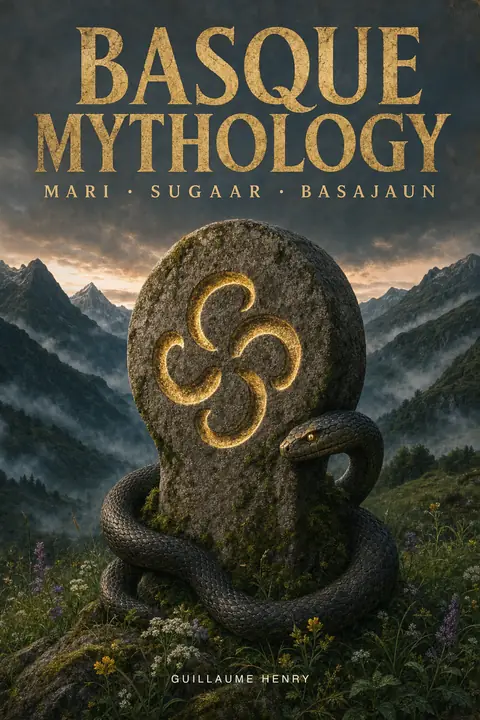
The Basque Mythology Book: Mari, Sugaar, Basajaun, and the Oldest Gods of Europe
Mari, Sugaar, and Basajaun
The mythology of Europe’s oldest people, who speak a language related to no other on earth. Mari the goddess of the mountains, her serpent-consort Sugaar, the wild lord of the woods Basajaun, and a pre-Indo-European world that survived in the Pyrenees.
More from Basque
All articles
Basque
The Lauburu: Basque Cross and Solar Symbol
The Lauburu is a four-pointed cross with curved arms that has protected Basque homes and souls for centuries. This ancient symbol weaves solar magic, Christian faith, and pre-Christian cosmology into a single rotating form.

Basque
Eguzkilore: The Sun Flower Symbol of Basque Protection and Renewal
The Eguzkilore is the sacred sun flower of Basque culture, hung above doorways for protection and blessing. Rooted in ancient sun worship and Christianised into a mark of spiritual abundance, this eight-petalled symbol endures as a living emblem of Basque identity and resilience.
Basque
Anbotoko Mari: The Cave Sanctuaries of the Goddess
High in the Basque mountains, deep inside caves that pierce the earth, Mari dwells. The Anbotoko Mari tradition reveals how a people carved sacred space into rock itself, honoring a goddess whose storms feed the valleys below. Enter the caves where Basque faith shaped the land.
Basque
Gaueko: The Spirit of the Night
Gaueko haunts the Basque night as a shadowy, restless spirit who protects livestock and travelers but demands respect. Learn how this being embodies the Basques' relationship with darkness in the mountains of northern Spain and France.