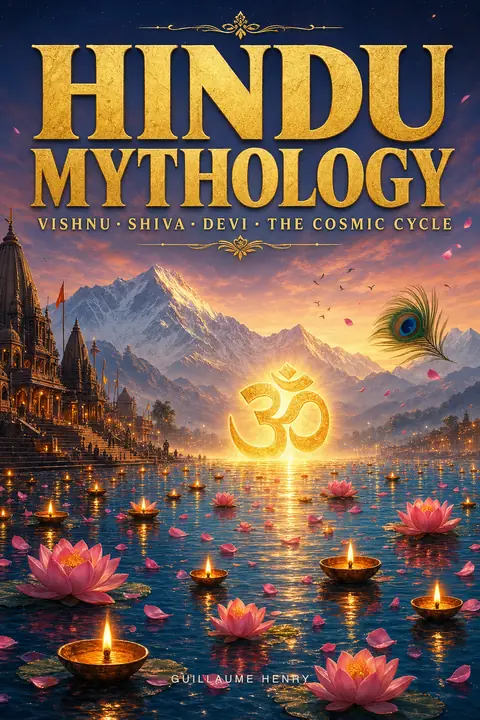
Hindu
A complete guide to Hindu mythology, from Vedic origins and epic narratives to Puranic cosmology and living traditions across South Asia.
Browse Hindu
Hinduism is not a religion in the sense that Christianity or Islam is. It has no single founder, no fixed creed, no central authority, and no moment of revelation that marks its beginning. What it has instead is a library: thousands of years of hymns, dialogues, epics, genealogies, and ritual manuals composed in Sanskrit and vernacular languages across the Indian subcontinent. These texts do not agree on everything. They argue, revise, and reinterpret one another. Yet they share a vocabulary of cosmology, a respect for ritual precision, and a conviction that the divine can take countless forms without contradiction.
This is a guide to that library and the living tradition it sustains. It draws on the oldest hymns of the Vedas, the philosophical inquiries of the Upanishads, the narrative sweep of the Mahabharata and Ramayana, and the devotional cosmology of the Puranas. It treats these texts not as museum artefacts but as sources still read, recited, and enacted in temples and households today.
The essentials
-
Hinduism spans three millennia of texts, from Vedic hymns (circa 1500 BCE) to medieval Puranas, with no single founder or orthodoxy.
-
The Rigveda, Upanishads, Mahabharata, Ramayana, and Puranas form the textual backbone of cosmology, ritual, and narrative.
-
Brahma, Vishnu, and Shiva form the Trimurti; goddesses as Devi or Shakti hold equal theological weight.
-
Hindu cosmology describes cyclical creation and destruction across vast time scales, not a single linear history.
-
Ritual, festival, and household practice keep these myths alive in daily life, not confined to scripture.
What Hinduism is, and what it is not
The term "Hinduism" is a nineteenth-century coinage, borrowed from Persian and English colonial usage. The traditions it names call themselves Sanatana Dharma, the eternal order, or simply dharma, the way things ought to be done. Dharma is context-sensitive: it shifts with caste, life stage, and circumstance. A warrior's dharma differs from a priest's. A student's differs from a householder's. There is no universal commandment that applies to all people at all times.
What unites the tradition is not belief but practice and a shared textual heritage. Sacrifice, pilgrimage, mantra recitation, temple worship, and domestic ritual all draw on a common pool of stories, deities, and cosmological assumptions. The gods are many, and they are also one. Monotheism and polytheism are Western categories that fit poorly here. A devotee may worship Vishnu as the supreme reality and still honour Shiva, Ganesha, and the local goddess without contradiction.
The tradition is also geographically rooted. The Ganges, the Yamuna, Mount Kailash, and the city of Varanasi are not symbols. They are sacred in themselves, places where the boundary between human and divine thins. Pilgrimage is not metaphor.
The Vedic foundation: hymns, sacrifice, and the oldest gods
The Vedic foundation: hymns, sacrifice, and the oldest gods
The Vedas are the oldest layer of Hindu scripture, composed in an archaic form of Sanskrit between roughly 1500 and 500 BCE. They are not narrative texts. They are liturgical: hymns, invocations, and ritual instructions meant to be chanted aloud by priests during sacrifice. The tradition considers them shruti, heard rather than authored, revealed to seers in states of heightened perception.
The Rigveda and the early pantheon
The Rigveda, the oldest of the four Vedas, contains 1,028 hymns arranged in ten books. It addresses a pantheon of devas, gods who govern natural and cosmic forces. These are not distant creators. They are invoked, praised, and bargained with. The hymns ask for cattle, sons, victory in battle, long life, and protection from enemies both human and demonic.
The cosmology is not yet systematic. One hymn, the Nasadiya Sukta (Rigveda 10.129), speculates on the origin of existence with a frankness rare in sacred literature:
Then even nothingness was not, nor existence. There was no air then, nor the heavens beyond it. Who covered it? Where was it? In whose keeping? Was there then cosmic water, in depths unfathomed?
The hymn ends without certainty. Even the gods, it suggests, came after creation's beginning. Perhaps the one who surveys it from the highest heaven knows. Or perhaps not.
Indra, Agni, Varuna, and the devas
Indra dominates the Rigveda. He is the warrior god, wielder of the thunderbolt, slayer of the serpent Vritra who hoarded the waters. Rigveda 1.32 recounts the battle: Indra strikes Vritra with his bolt, releases the rivers, and establishes the order of the cosmos. He is not a moral exemplar. He drinks soma, a ritual intoxicant, in prodigious quantities. He is boastful, violent, and effective. His role is to maintain cosmic order through force.
Agni, the fire god, is the intermediary. Every sacrifice requires fire, and Agni carries offerings from the human realm to the gods. He is invoked more than any other deity in the Rigveda. Without him, the ritual system collapses.
Varuna oversees cosmic and moral law, rita. He sees all, knows all, and punishes those who violate the order. His gaze is inescapable. Later texts will subordinate him, but in the Vedic period he is among the most feared and revered.
Indra's prominence in Vedic literature links him to a broader pattern of thunder gods who wield storm weapons and battle chaos serpents, from Thor to Baal.
Sacrifice as cosmic maintenance
Vedic religion is transactional. The gods need sacrifice as much as humans need divine favour. The ritual is precise: the wrong word, gesture, or ingredient can render it void or dangerous. Priests spend years memorising the hymns and the procedures. The sacrifice does not symbolise cosmic order. It enacts it. When performed correctly, it sustains the universe.
This is not metaphor. The Brahmanas, prose texts attached to the Vedas, describe sacrifice as the hinge between human and divine realms. If the rituals cease, the cosmos unravels.
The Upanishads and the turn inward
Sometime after 800 BCE, a shift occurs. The Upanishads, composed as appendices to the Vedas, begin to question the efficacy of external ritual. They ask: what is the self? What is the ultimate reality? Can liberation be achieved through knowledge rather than sacrifice?
The answer they propose is Brahman, the unchanging ground of all existence, and Atman, the innermost self. The two are identical. Brihadaranyaka Upanishad 1.4.10 states it plainly: "I am Brahman." To realise this identity is to escape the cycle of birth, death, and rebirth (samsara) and attain moksha, liberation.
The Upanishads do not reject the Vedic gods. They reframe them. Indra, Agni, and the others are manifestations of Brahman, not independent powers. The ritual remains valid, but it is no longer the only path. Meditation, asceticism, and philosophical inquiry become equally legitimate.
This inward turn reshapes the tradition. The gods do not disappear, but they share the stage with concepts: karma, dharma, samsara, moksha. Hindu mythology will continue to tell stories of gods and demons, but it will also embed those stories in a metaphysical framework.
The great epics: Mahabharata and Ramayana
The Mahabharata and Ramayana are not scripture in the Vedic sense. They are itihasa, "thus it was," historical narrative blended with myth, moral instruction, and theological reflection. Both were composed over centuries, reaching their current forms between 400 BCE and 400 CE. Both are still performed, recited, and adapted across South and Southeast Asia.
The Mahabharata: war, dharma, and the Bhagavad Gita
The Mahabharata is the longest poem ever composed: over 100,000 verses. Its core narrative concerns a dynastic war between two branches of the Kuru family, the Pandavas and the Kauravas. The war is catastrophic. Nearly everyone dies. The Pandavas win, but the victory is hollow.
The epic's genius lies in its refusal of easy answers. Dharma is context-dependent, and contexts conflict. The Adiparva, the first book, sets up the genealogies and the curse that will drive the plot. The war itself occupies only a fraction of the text. The rest is digression: stories within stories, legal debates, cosmological speculation, and moral philosophy.
Embedded in the sixth book is the Bhagavad Gita, a dialogue between the warrior Arjuna and his charioteer Krishna, who is Vishnu incarnate. On the eve of battle, Arjuna refuses to fight. His enemies are his cousins, teachers, and friends. Krishna's response is theological and practical. He explains karma yoga, the path of selfless action, and reveals his cosmic form. He tells Arjuna that the soul is eternal, that bodies are temporary, and that a warrior's dharma is to fight.
The Gita's teaching on divine intervention is explicit. Krishna declares in Bhagavad Gita 4.7-8:
Whenever dharma declines and adharma rises, I manifest myself. For the protection of the good, the destruction of the wicked, and the establishment of dharma, I am born age after age.
This doctrine of avatars, divine descent, will become central to later devotional traditions.
The Ramayana: exile, devotion, and the ideal king
The Ramayana is shorter, more focused, and more concerned with exemplary behaviour. Its hero, Rama, is Vishnu's seventh avatar. He is exiled from his kingdom through palace intrigue, wanders the forest for 14 years with his wife Sita and his brother Lakshmana, and wages war against Ravana, the demon king of Lanka, who abducts Sita.
The Balakanda, the first book, recounts Rama's birth and youth. The Yuddhakanda, the war book, describes the siege of Lanka, Ravana's death, and Sita's rescue. But the epic does not end with reunion. Rama doubts Sita's chastity. She undergoes a trial by fire to prove her purity. Later versions add a final book in which Rama, bowing to public suspicion, exiles Sita despite her innocence.
The Ramayana is beloved not for its happy ending but for its characters' adherence to dharma under unbearable pressure. Rama is the ideal king, even when kingship demands cruelty. Sita is the ideal wife, even when her husband fails her. The text does not excuse these outcomes. It presents them.
The Puranas: cosmology, genealogy, and devotional literature
The Puranas: cosmology, genealogy, and devotional literature
The Puranas are later texts, composed mostly between 300 and 1500 CE, though they claim to transmit ancient knowledge. There are 18 major Puranas and dozens of minor ones. They are encyclopedic: genealogies of gods and kings, descriptions of pilgrimage sites, ritual instructions, and above all, stories of the gods' deeds.
Cycles of creation and destruction
Puranic cosmology is cyclical and vast. Time is measured in kalpas, days of Brahma, each lasting 4.32 billion human years. Each kalpa contains 1,000 mahayugas, great ages, and each mahayuga is divided into four yugas of decreasing length and virtue. We live in the Kali Yuga, the age of strife, the last and worst. When it ends, the universe dissolves. Brahma sleeps. Then he wakes, and creation begins again.
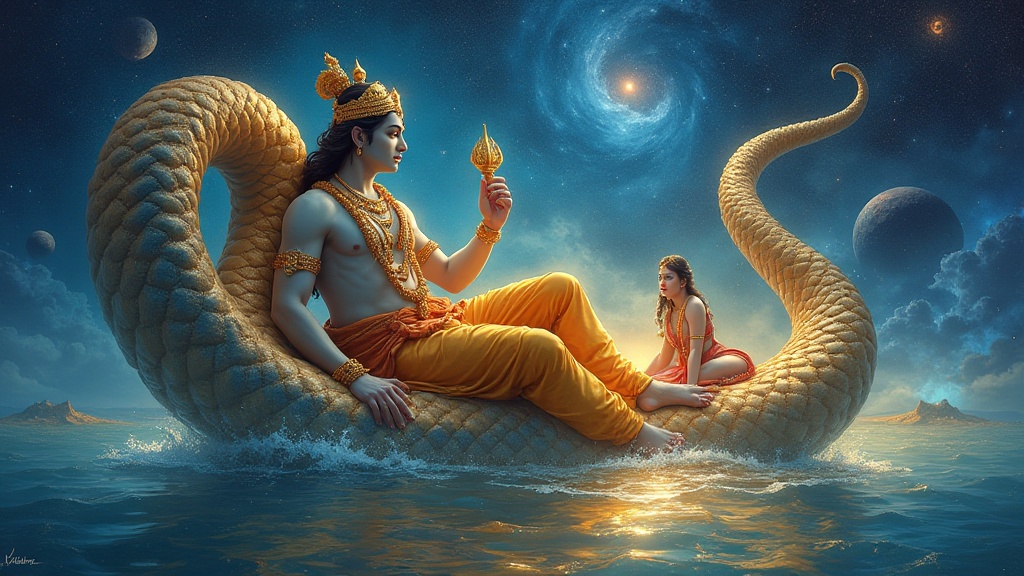
The Vishnu Purana 1.3 describes the process: at the end of a kalpa, fire consumes the earth, the oceans evaporate, and the worlds collapse into the cosmic waters. Vishnu sleeps on the serpent Shesha, floating on the formless deep. When he wakes, a lotus grows from his navel. Brahma emerges from the lotus and begins the work of creation anew.
This is not a single event but an eternal pattern. Creation myths in other traditions often describe a singular beginning; Hindu cosmology describes an infinite series of beginnings and endings.
Brahma, Vishnu, Shiva: the Trimurti
The Trimurti, the triple form, assigns three cosmic functions to three gods: Brahma creates, Vishnu preserves, Shiva destroys. The schema is tidy, but actual worship is more complex. Brahma has almost no temples. Vishnu and Shiva dominate, and their devotees often claim their chosen deity performs all three functions.
Vishnu is the preserver, the god who intervenes when dharma falters. He descends in avatars: fish, tortoise, boar, man-lion, dwarf, Rama, Krishna, and others. The number varies by text. His consort is Lakshmi, goddess of prosperity.
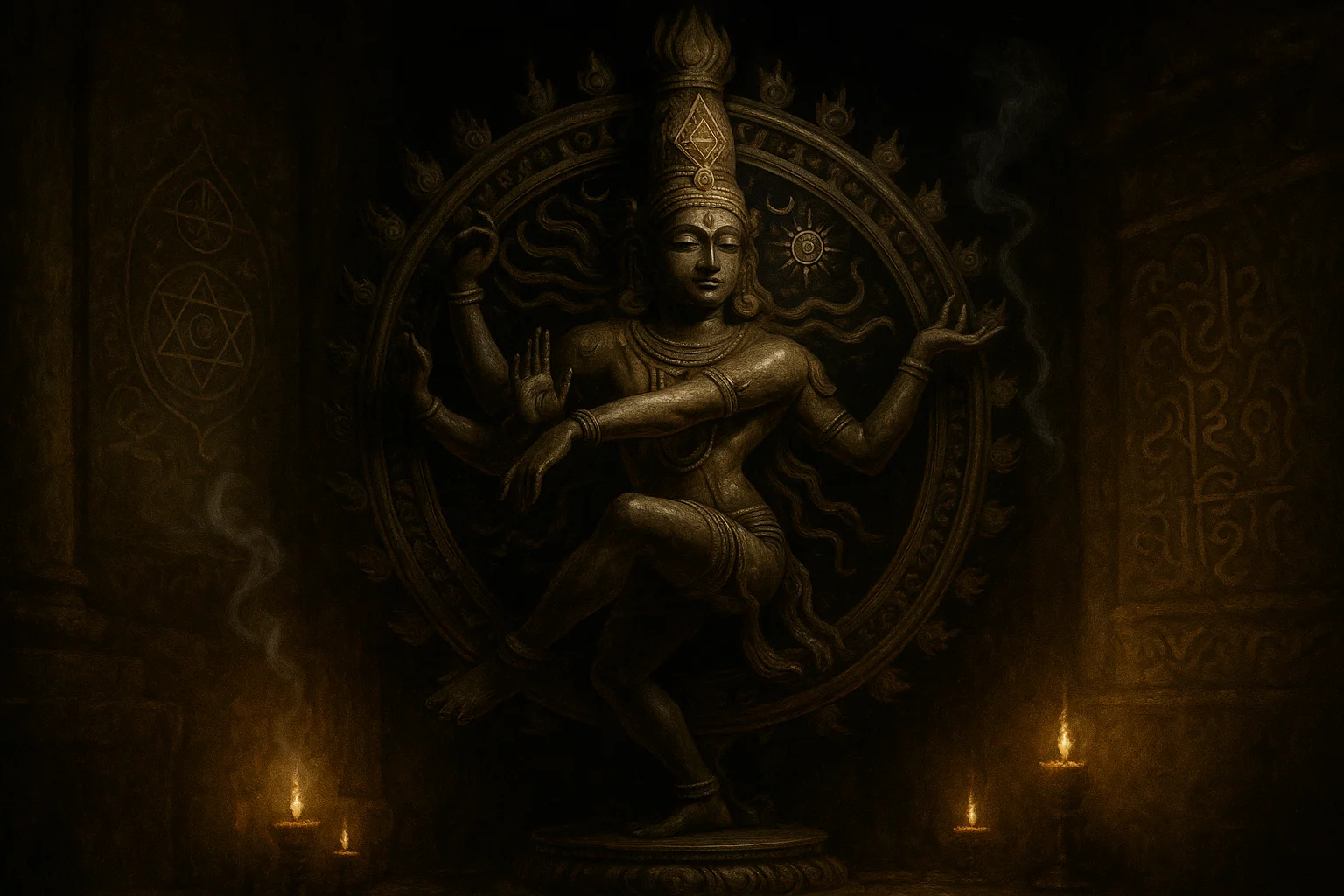
Shiva is the ascetic and the destroyer, but destruction is not evil. It clears space for new creation. He meditates on Mount Kailash, his body smeared with ash, a serpent coiled around his neck. He is also the lord of dance, Nataraja, whose cosmic dance sustains and dissolves the universe. His consort is Parvati, though she takes many forms.
The Shiva Purana, Rudra Samhita, recounts his marriage to Parvati, his battles with demons, and his role as the ultimate yogi. Shiva is paradox: ascetic and householder, destroyer and creator, terrifying and benevolent.
Avatars and divine descent
The doctrine of avatars allows the divine to enter history without diminishing its transcendence. Vishnu's incarnations respond to specific crises. As Matsya, the fish, he saves Manu, the first man, from a great flood. The Matsya Purana describes how Manu, warned by the fish, builds a boat and preserves the seeds of all life. The parallels to flood myths across cultures are striking: a righteous survivor, a divine warning, a vessel, and a new beginning.
As Krishna, Vishnu is born into a royal family, raised by cowherds, and becomes the charioteer and counsellor to the Pandavas. His life is both human and divine. He plays, loves, fights, and teaches. The Bhagavata Purana, one of the most beloved texts in the tradition, recounts his childhood pranks and his dalliances with the gopis, the cowherd women, whose love for him is read as a metaphor for the soul's longing for God.
Goddesses: Devi, Shakti, and the divine feminine
The goddess is not an afterthought. In many traditions, she is the supreme power, Shakti, the active energy without which even the great gods are inert. The Devi Mahatmya, embedded in the Markandeya Purana (chapters 81 to 93), tells of her victories over demons that the male gods could not defeat. She is Durga, the warrior who rides a lion and wields weapons given by the gods. She is Kali, the dark mother who dances on Shiva's corpse, her tongue red with the blood of demons.
The text is unambiguous: the goddess is not subordinate. She is the source. Brahma, Vishnu, and Shiva are her instruments. When the gods fail, they turn to her. She manifests, fights, and restores order. Her worship is ancient, predating the Vedas in some regions, and it persists in temples and festivals across India.
The theological weight given to goddesses in Hinduism places them alongside the mother goddesses venerated in other ancient traditions, though Devi's martial aspect and her identification with ultimate reality set her apart.
Did you know?
The festival of Navaratri, nine nights dedicated to the goddess, culminates in Durga Puja, when clay images of Durga slaying the buffalo demon Mahishasura are worshipped and then immersed in rivers. The ritual enacts the myth and renews the cosmos.
Living traditions: temple, festival, and household practice
Hindu mythology is not confined to texts. It is performed, painted, danced, and sung. Temples are not museums. They are active sites where the divine is made present through ritual. The deity resides in the image, and the image is bathed, dressed, fed, and put to rest each day. Darshan, seeing and being seen by the god, is the central act of worship.
Festivals map the mythological calendar onto the agricultural and lunar year. Diwali celebrates Rama's return from exile. Holi re-enacts Krishna's playful battles with coloured powder. Shivaratri honours Shiva's cosmic dance. These are not commemorations. They are participations.
Household practice is equally vital. Daily puja, offerings of flowers, incense, and food to a home shrine, sustains the relationship between family and deity. Weddings, funerals, and life-cycle rites draw on Vedic mantras and Puranic narratives. The myths are not ancient history. They are present tense.
Comparative threads: flood, apocalypse, and the world tree
Hindu cosmology shares motifs with traditions across Eurasia and beyond, though the meanings differ. The flood narrative in the Matsya Purana resembles Mesopotamian and biblical accounts: a deluge, a survivor, a divine warning, and a new beginning. But Hindu floods are cyclical, not singular. They recur at the end of each kalpa, part of the cosmic rhythm rather than a unique punishment or reset.
The concept of cyclical destruction aligns with apocalypse narratives in other traditions, though Hindu cosmology lacks the finality of Ragnarok or the Last Judgement. The universe ends, but it also begins again. There is no final victory, no ultimate defeat.
The cosmic tree, Ashvattha, appears in the Bhagavad Gita (15.1-3) as an inverted tree with roots in the heavens and branches spreading downward into the material world. It is a symbol of samsara, the cycle of existence, and must be cut with the sword of detachment. This image resonates with the world trees of Norse and Siberian cosmology, though its theological function differs.
These parallels do not imply borrowing. They suggest that certain structures, certain images, recur when humans try to map the cosmos and their place in it. Hinduism offers one such map, drawn over millennia and still unfolding.
Further reading on Mythologis
- Creation myths: typology and patterns across cultures
- Flood myths across cultures: deluge narratives from Mesopotamia to Mesoamerica
- Mother goddesses across cultures: from Inanna to Pachamama
- Thunder gods across cultures: storm deities and their weapons
- Apocalypse and end-of-the-world myths: from Ragnarok to Kali Yuga
Major gods of Hindu
View all →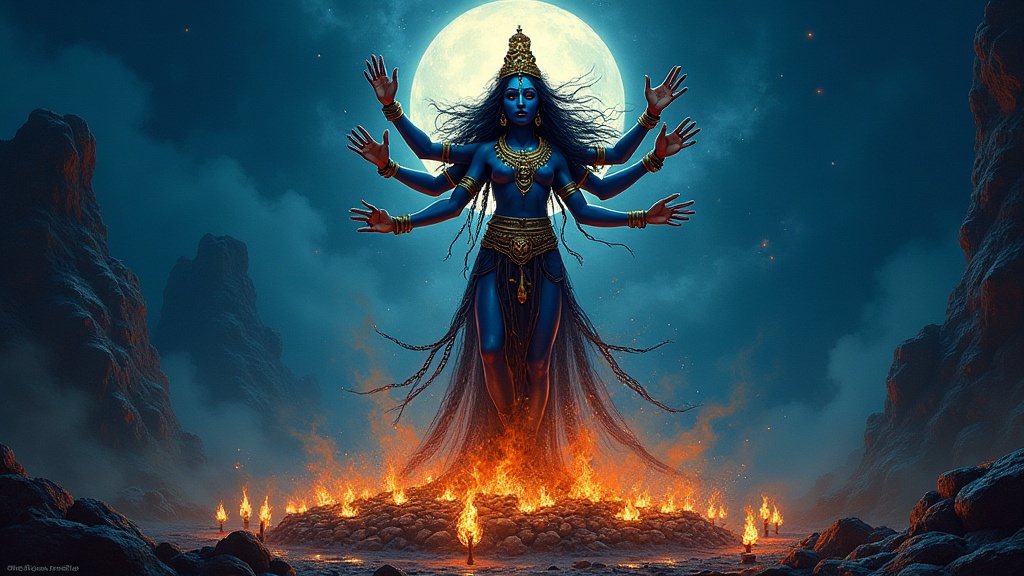
Hindu
Kali: The Fierce Mother Goddess Who Devours Time Itself
Kali is Hinduism's most electrifying deity: a goddess of death, liberation, and ferocious maternal love whose dark form conceals the deepest compassion in the cosmos.
Hindu
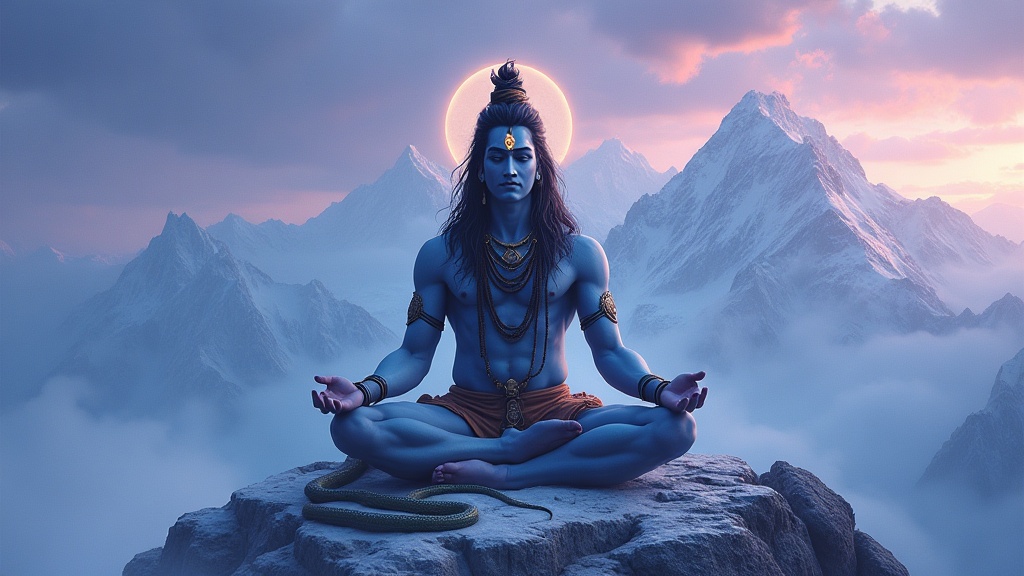
Shiva the Destroyer: Lord of Dissolution, Transformation, and Cosmic Renewal
Shiva the Destroyer stands at the heart of Hindu cosmology not as a god of mere annihilation, but as the force that dissolves reality so creation can begin again. His mythology is among the richest and most paradoxical in the world.
Hindu
Vishnu the Preserver: Keeper of Cosmic Order
Vishnu stands at the heart of Hindu cosmology as the eternal guardian of dharma, descending into the world age after age to restore balance whenever creation tilts toward ruin.
Recent in Hindu
3 entriesHindu
Kali: The Fierce Mother Goddess Who Devours Time Itself
Kali is Hinduism's most electrifying deity: a goddess of death, liberation, and ferocious maternal love whose dark form conceals the deepest compassion in the cosmos.
Hindu
Shiva the Destroyer: Lord of Dissolution, Transformation, and Cosmic Renewal
Shiva the Destroyer stands at the heart of Hindu cosmology not as a god of mere annihilation, but as the force that dissolves reality so creation can begin again. His mythology is among the richest and most paradoxical in the world.
Hindu
Vishnu the Preserver: Keeper of Cosmic Order
Vishnu stands at the heart of Hindu cosmology as the eternal guardian of dharma, descending into the world age after age to restore balance whenever creation tilts toward ruin.