
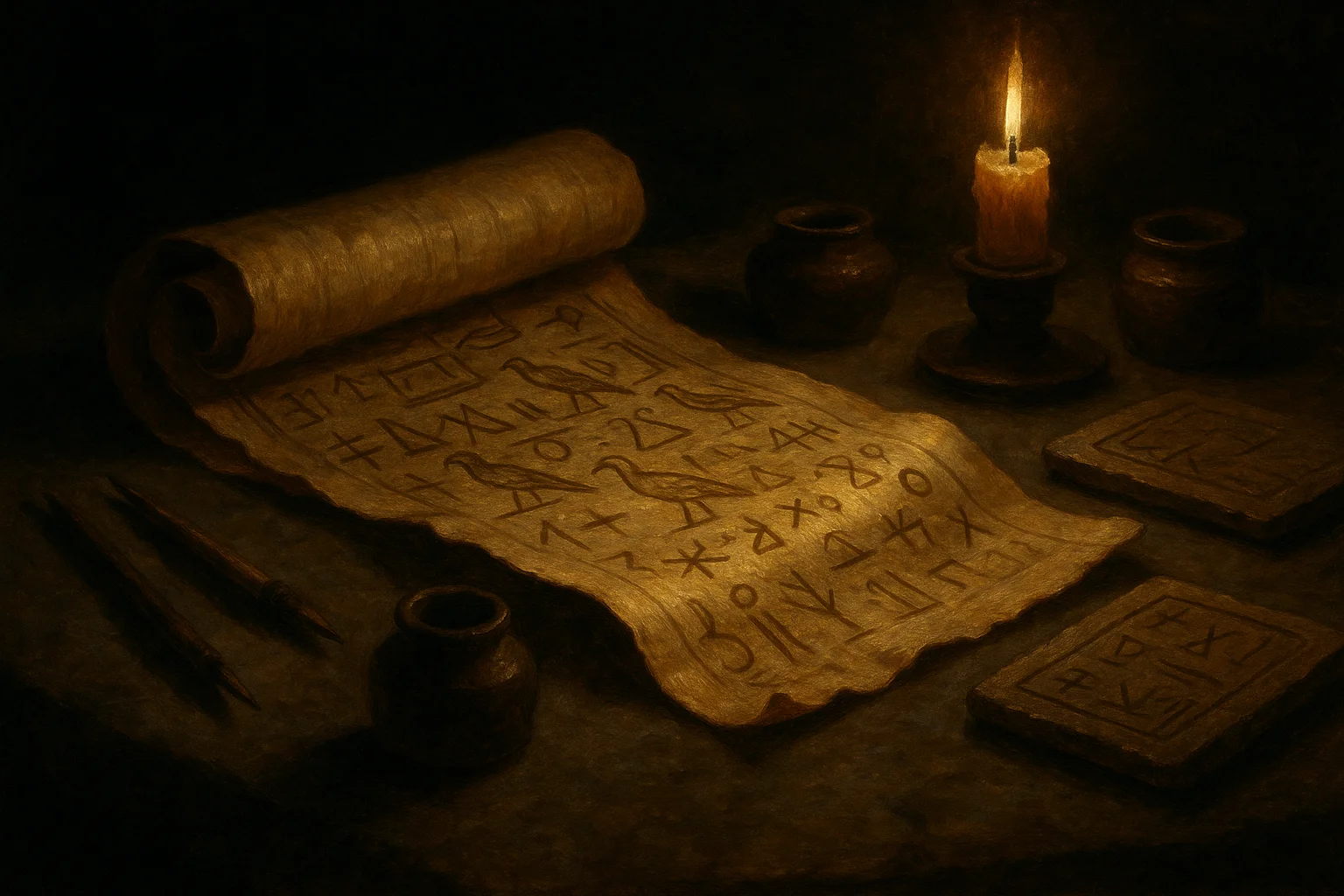
Education in Ancient Egypt: Training Scribes and Priests
How Egypt trained scribes and priests through hieratic drills, temple schools, and sacred texts. Grounded in papyri and primary sources.
Contents
Formal education in ancient Egypt was restricted to a small elite of boys training to become scribes or priests, learning hieratic script, arithmetic, model letters, and religious texts in temple schools or the House of Life. Surviving papyri such as the Kemyt, the Satire of the Trades, and Papyrus Anastasi I reveal a curriculum designed to produce literate administrators who could manage the state's grain stores, tax rolls, and temple rituals. Mastery of writing was inseparable from religious authority and administrative power, making the scribe one of the most privileged professions in a society where fewer than one percent could read.
The textbooks often reduce Egyptian schooling to a social filter, a way to keep the bureaucracy closed. That misses the point. Literacy was not simply a credential. It was the operating system of the state, and the curriculum preserved in student exercises shows exactly how that system was taught, line by line.
Who Received Formal Education
Ancient Egypt had no public schooling. Formal instruction was reserved for boys whose families could afford to release them from agricultural or craft labour. Most students came from the households of scribes, priests, or military officers. A few talented sons of artisans might be sponsored by a temple or a wealthy patron, but this was the exception.
Girls were excluded from scribal training. The evidence for female literacy is thin: a handful of titles such as "overseer of the house" or "chantress" suggest some women in elite families could read, but no surviving school text addresses a female student. The profession was male, and the state machinery it served was male.
Training began young, often around age five or six, and could last a decade or more depending on the student's destination. A village scribe might complete his education by fifteen; a priest destined for the House of Life might study into his twenties. The timeline of Egyptian history shows this pattern held across dynasties, from the Old Kingdom through the Ptolemaic period.
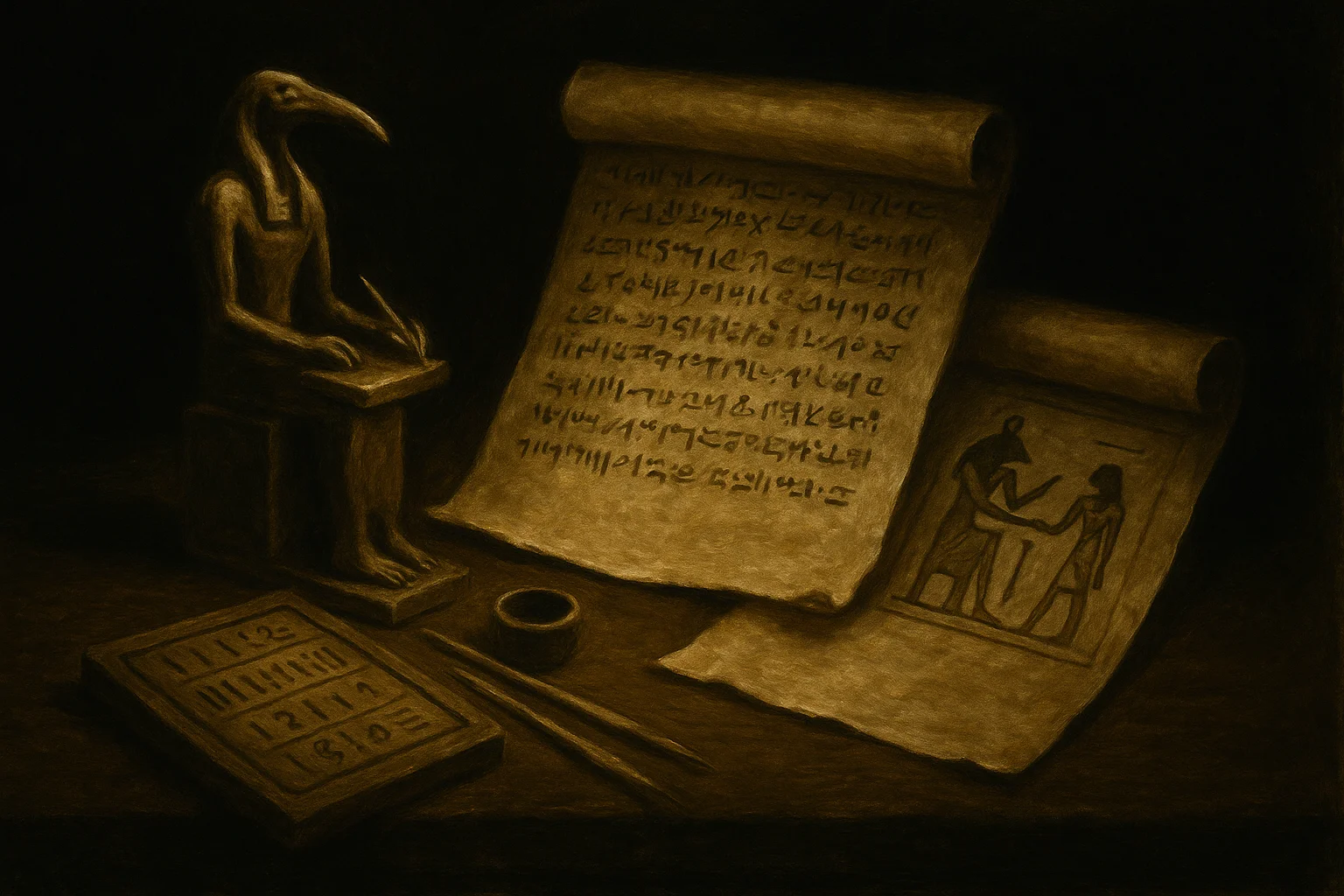
The Scribal Curriculum: Hieratic, Arithmetic, and Model Texts
The core of scribal education was hieratic script, the cursive form of hieroglyphic writing used for administrative and literary texts. Students did not begin with monumental hieroglyphs; those were the domain of stonecutters. They learned the rapid, abbreviated strokes of hieratic, practiced on cheap materials: pottery shards, limestone flakes, and eventually papyrus.
The Kemyt and Early Writing Drills
The earliest surviving school text is the Kemyt, a Middle Kingdom composition copied by students for centuries. The word means "the completion" or "the summary," and the text is exactly that: a collection of model phrases, greetings, and epistolary formulae. It opens with a standard greeting: "May you be healthy, may you be prosperous, may you be favoured by the god of your city." Students copied this line hundreds of times.
The Kemyt is not literature. It is a template for correspondence, a phrase book for bureaucrats. But it also encodes social hierarchy. The greetings shift register depending on whether the writer addresses a superior, a peer, or a subordinate. A boy learning the Kemyt was learning how power spoke.
Model Letters and Administrative Formulae
Once a student could write cleanly, he moved to model letters. Papyrus Anastasi I, a New Kingdom collection, contains elaborate epistolary exchanges between scribes, full of technical vocabulary: grain measurements, chariot repairs, troop movements, canal dredging. One letter mocks a rival scribe who cannot calculate the number of bricks needed for a ramp or the rations required for a military expedition. The subtext is clear: a scribe who cannot do arithmetic is no scribe at all.
These letters were not real correspondence. They were pedagogical fictions, designed to teach both writing and the specific knowledge a scribe would need in the field. The student learned to write "I have received your letter concerning the delivery of 500 sacks of emmer wheat" at the same moment he learned what emmer wheat was and how it was measured.
Mathematics and Land Measurement
Arithmetic was inseparable from literacy. The mathematics in ancient Egypt was practical, not theoretical. The Rhind Mathematical Papyrus and the Moscow Mathematical Papyrus, both used in scribal training, contain problems about dividing loaves, calculating the volume of granaries, and measuring the slope of a pyramid. Problem 48 of the Rhind Papyrus asks: "A round field has a diameter of 9 khet. What is its area?" The answer is given in terms of the seked, a unit derived from the practical needs of land surveyors.
Students also learned the calendar, the flood cycle of the Nile, and basic astronomy for dating festivals. A scribe who could not calculate the correct day for a temple offering was worse than useless.
Priestly Education and Temple Schools
Not every scribe became a priest, but every priest was a scribe. The boundary between administrative and religious literacy was porous. Temple schools trained boys in the same hieratic script and arithmetic, then added layers of ritual knowledge, hymns, and sacred texts.
The House of Life (Per Ankh)
The House of Life was the intellectual heart of the temple complex. Attached to major temples at Memphis, Thebes, and Heliopolis, the Per Ankh was part library, part scriptorium, part medical school. Priests copied and preserved religious texts, compiled medical treatises, recorded sacred symbols, and trained the next generation of lector priests.
The curriculum included the recitation of hymns to the Egyptian gods, the interpretation of dreams, the preparation of funerary texts, and the performance of temple rituals. A priest had to know not only how to read the sacred books but how to chant them, when to burn incense, and which offerings corresponded to which deities.
The House of Life also functioned as a hospital and observatory. Papyrus Chester Beatty IV, a medical text copied by students, contains prescriptions for eye diseases, instructions for setting broken bones, and spells to drive out demons. The line between medicine and magic was thin, and both required literacy.
Sacred Texts and Ritual Knowledge
Priestly students memorized long passages from the Pyramid Texts, the Coffin Texts, and later the Book of the Dead. These were not casual readings. A lector priest who stumbled over a funerary spell could jeopardize the deceased's journey through the underworld. The stakes were cosmic.
Training also included the interpretation of omens, the maintenance of cult statues, and the performance of the daily temple ritual: washing the god's image, dressing it, offering food, and sealing the shrine. Each action had a corresponding text, and the priest had to know it by heart. Under Akhenaten's religious reforms, the curriculum shifted abruptly to hymns to the Aten, but after his death the old texts were restored.
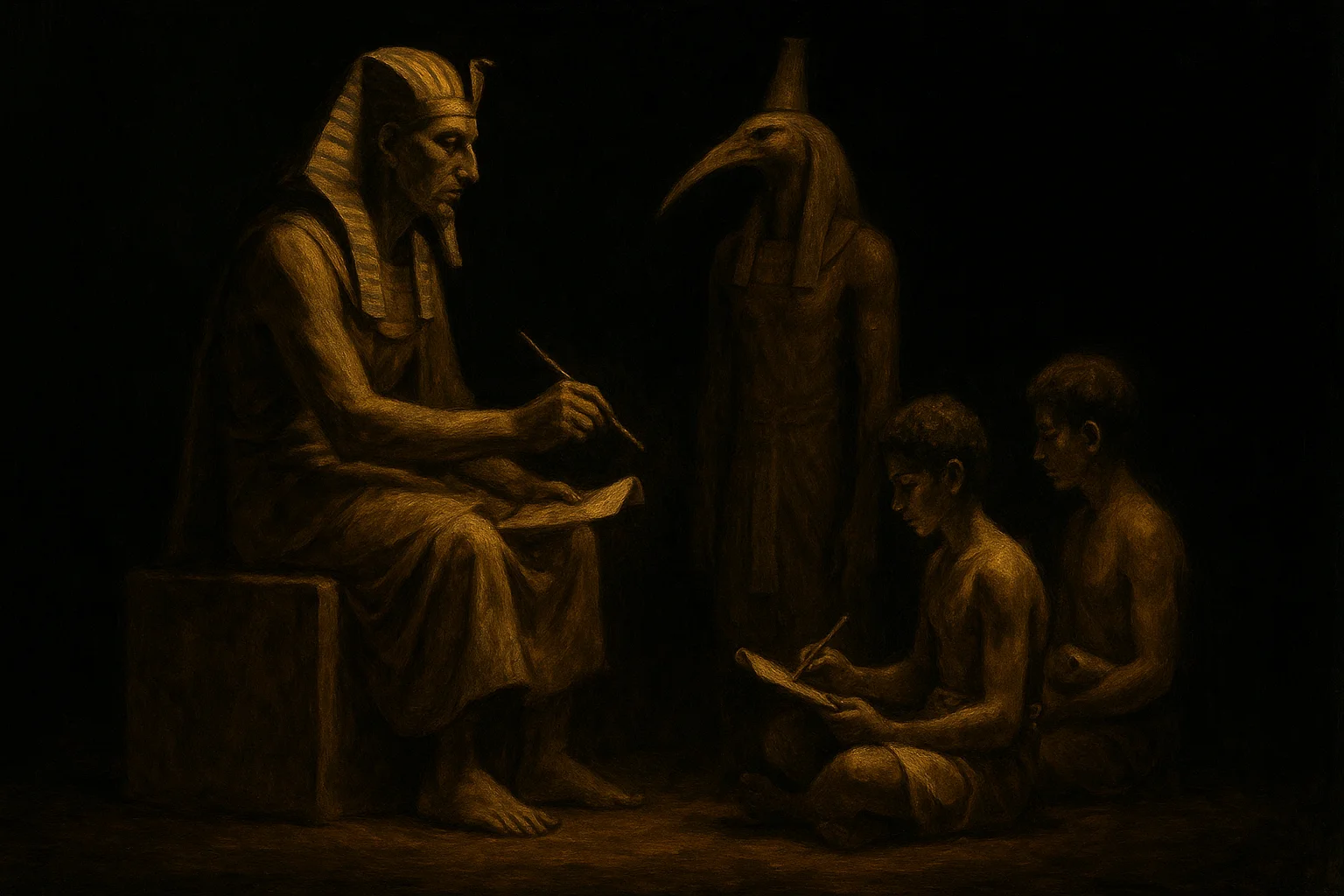
Teachers, Apprenticeship, and Social Mobility
Teachers were called "instructors of the house of books" or simply "scribes of the school." They were working bureaucrats who taught in the mornings before their administrative duties. Discipline was strict. Papyrus Anastasi V quotes a teacher: "A boy's ear is on his back; he listens when he is beaten." Corporal punishment was routine, though some texts also praise patient instruction.
Most students learned through apprenticeship. A boy would attach himself to an experienced scribe, copying his letters, carrying his writing kit, and gradually taking on minor tasks: tallying grain, recording deliveries, drafting routine correspondence. The relationship was formal, often sealed by a contract, and could last years.
Did scribal education offer social mobility? In theory, yes. A talented boy from a modest family could rise to high office if he mastered the curriculum and found a patron. In practice, the system reproduced itself. Sons of scribes became scribes. The profession was a guild, and entry required not only skill but connections. Still, the evidence from Deir el-Medina shows that some artisans' sons did cross the threshold, becoming village scribes or temple clerks.
Scribal education
Focused on hieratic script, model letters, arithmetic, and administrative formulae. Students trained for careers in tax collection, land surveying, and grain management. Practical, secular, and tied to the state bureaucracy.
Priestly education
Included all scribal skills plus sacred texts, hymns, ritual performance, and medical knowledge. Students trained in the House of Life for careers as lector priests, temple administrators, and guardians of religious tradition.
The Satire of the Trades: Propaganda for the Scribal Life
The most famous school text is the Satire of the Trades, preserved in Papyrus Sallier II and other New Kingdom copies. A father advises his son to become a scribe by cataloguing the miseries of every other profession. The carpenter's hands are cracked, the metalworker's fingers are like crocodile claws, the fisherman is eaten by crocodiles, the farmer is robbed by tax collectors. Only the scribe sits in comfort, his hands clean, his status secure.
I have seen the metalworker at his work at the mouth of his furnace. His fingers are like the claws of a crocodile, and he stinks more than fish roe.
The text is comic, exaggerated, and deeply ideological. It was copied by students for centuries, which means generations of boys internalized the message: literacy is salvation, manual labour is degradation. The Satire is propaganda, but it is also evidence. It shows what the scribal class wanted to believe about itself.
The text also reveals anxiety. If the scribal life was so obviously superior, why did it need such aggressive marketing? Perhaps because the work was tedious, the competition fierce, and the rewards uncertain. Not every student became a high official. Many ended their careers as village clerks, copying grain receipts in the provinces. The Satire of the Trades promised more than it could deliver.
What the Papyri Preserve and What They Do Not
The surviving school texts are biased toward the successful. We have the model letters, the arithmetic problems, the hymns. We do not have the voices of the boys who failed, who were beaten too hard, who left school to work in the fields. We do not have the curriculum of the girls who learned to read at home, if they existed. We do not have the oral instruction that surely accompanied the written exercises: the teacher's commentary, the mnemonic songs, the jokes.
What we do have is remarkable. The Kemyt, Papyrus Anastasi I, the Rhind Mathematical Papyrus, and the Satire of the Trades give us the actual texts that shaped the minds of Egypt's administrators for a thousand years. These are not philosophical treatises. They are instruction manuals for running a state. They show us how Ramses II and his predecessors trained the men who built the pyramids, collected the taxes, and kept the gods fed.
The papyri also show us the limits of literacy. Even at the height of the New Kingdom, the literate population was tiny. The vast majority of Egyptians lived and died without reading a single word. The scribes were gatekeepers, and the curriculum was the gate. To learn hieratic was to enter a closed world, a world where knowledge was power and power was knowledge.
Frequently asked questions
Who was allowed to attend school in ancient Egypt?
Formal schools in ancient Egypt were restricted to elite boys, primarily the sons of scribes, priests, military officers, and wealthy landowners, though a small number of talented boys from artisan families could gain entry through temple sponsorship or patronage. Girls were almost entirely excluded from scribal training, with only rare evidence of female literacy among the highest-ranking families. The vast majority of the population, including farmers, labourers, and craftsmen, received no formal education and remained illiterate throughout their lives. Education was a privilege, not a right, and it functioned as a mechanism to reproduce the administrative and priestly elite across generations.
What texts did scribal students copy and memorize?
Scribal students copied the Kemyt, a collection of model greetings and epistolary formulae, as their first major text, followed by model letters such as those in Papyrus Anastasi I, which taught administrative vocabulary and technical knowledge. They also worked through arithmetic problems from papyri like the Rhind Mathematical Papyrus, learning to calculate grain volumes, land areas, and pyramid slopes. Advanced students and those training for the priesthood memorized hymns to the gods, funerary spells, and medical texts preserved in the House of Life. The Satire of the Trades, a satirical text extolling the scribal profession, was copied repeatedly as both a writing exercise and ideological instruction.
How long did it take to train as a scribe or priest?
Scribal training typically began around age five or six and lasted at least a decade, with village scribes completing their education by their mid-teens and more specialized administrators studying into their twenties. Priestly education took longer, often extending into a student's late twenties, because it required mastery of sacred texts, ritual performance, medical knowledge, and astronomical observation in addition to the standard scribal curriculum. The length of training depended on the student's aptitude, family resources, and intended career, with apprenticeship to a working scribe or priest providing the final stage of practical instruction. No fixed graduation age existed; a student was considered trained when his teacher judged him competent to perform the required duties.
What was the House of Life and what happened there?
The House of Life, or Per Ankh, was an institution attached to major temples at Memphis, Thebes, and Heliopolis that functioned as a library, scriptorium, medical school, and training centre for priests. Priests copied and preserved religious texts, compiled medical treatises, recorded astronomical observations, and taught advanced students the sacred knowledge required for temple service. The curriculum included the recitation of hymns, the interpretation of dreams, the preparation of funerary texts, and the performance of complex rituals. The House of Life also served as a hospital where medical papyri were consulted and treatments administered, blending practical medicine with ritual healing.
Did scribal education offer social mobility in ancient Egypt?
Scribal education theoretically offered a path to social mobility, and some talented boys from artisan or modest families did rise to positions as village scribes or temple clerks through skill and patronage. However, in practice the profession was largely hereditary, with sons of scribes inheriting their fathers' positions and connections, making the system more effective at reproducing the existing elite than at creating new opportunities. The evidence from workers' villages like Deir el-Medina shows that social mobility was real but rare, and even successful students from lower-status families rarely reached the highest administrative offices. Literacy was a necessary but not sufficient condition for advancement; family networks, patronage, and political favour mattered just as much.
What primary sources describe Egyptian education?
The primary sources for Egyptian education include the Kemyt, a Middle Kingdom collection of model phrases copied by students for centuries, and the Satire of the Trades preserved in Papyrus Sallier II, which satirizes non-scribal professions to promote the scribal life. Papyrus Anastasi I contains model letters teaching administrative vocabulary and technical knowledge, while Papyrus Lansing and Papyrus Chester Beatty IV preserve scribal exercises and moral instruction. Mathematical training is documented in the Rhind Mathematical Papyrus and the Moscow Mathematical Papyrus, both containing practical problems for land measurement and resource calculation. Hundreds of signed ostraca from Deir el-Medina show student handwriting and practice exercises, offering direct evidence of the learning process.
Further reading on Mythologis
Free 25-page sample
Want the whole story?
Take the first 25 pages free. If it pulls you in, the full edition is yours as an instant PDF download, with a paperback on Amazon for selected titles.
Egyptian
The Egyptian Mythology Book: Ra, Osiris, Isis, Anubis, and the Sacred Stories of the Pharaohs
Ra, Osiris, Isis, Anubis, and the Sacred Stories of the Pharaohs
Three thousand years of Egyptian sacred stories. The Duat, the weighing of the heart, the cult of Osiris, and the daily voyage of the sun.
More from Egyptian
All articles
Egyptian
The Book of the Dead: Egypt's Guide to Eternity
Ancient Egypt's most sacred funerary text was not a single book but a living archive of spells, maps, and prayers that guided the dead through the perils between death and eternal life.
Egyptian
Eye of Horus: The Protective Amulet That Watched Over the Living and the Dead
Worn by pharaohs and fishermen alike, the Eye of Horus is one of antiquity's most potent protective symbols, carrying the weight of cosmic battle, divine healing, and eternal vigilance.

Egyptian
Ra the Sun God: Egypt's Supreme Ruler of Light and Creation
Ra, the ancient Egyptian sun god, blazed at the very heart of a civilization that worshipped light as the pulse of creation itself. Discover his origins, his many forms, and the sacred journey he took across the sky and through the underworld every single day.
Egyptian
The Ankh: Egypt's Eternal Symbol of Life
The ankh is ancient Egypt's most recognizable hieroglyph, a looped cross carried by gods and pharaohs alike as the very key to immortal life. Discover its origins, meanings, and sacred legacy.