
How Hieroglyphics Were Deciphered 200 Years Ago
The 23-year process from the Rosetta Stone's discovery in 1799 to Champollion's breakthrough in 1822, built on Coptic, false starts, and rivals.
Contents
Egyptian hieroglyphics were deciphered between 1799 and 1822 through a collaborative process in which Jean-François Champollion combined the bilingual Rosetta Stone with his knowledge of Coptic, the last stage of the Egyptian language, to prove that hieroglyphs functioned as both phonetic and symbolic signs. The breakthrough came on 14 September 1822, when Champollion correctly read the names of Ramesses II and Thutmose in cartouches. The decipherment opened access to three millennia of texts written by scribes who had written in hieroglyphs for three millennia, transforming Egyptian history from myth into documented record.
The story is not one of sudden genius. It required two decades of false starts, international rivalry, and the slow realisation that the script worked in ways no living language did. Champollion stood on the shoulders of earlier scholars, corrected their mistakes, and had one advantage they lacked: fluency in Coptic, the liturgical language of Egyptian Christians.
The Rosetta Stone: Found by Accident, Recognised by Design
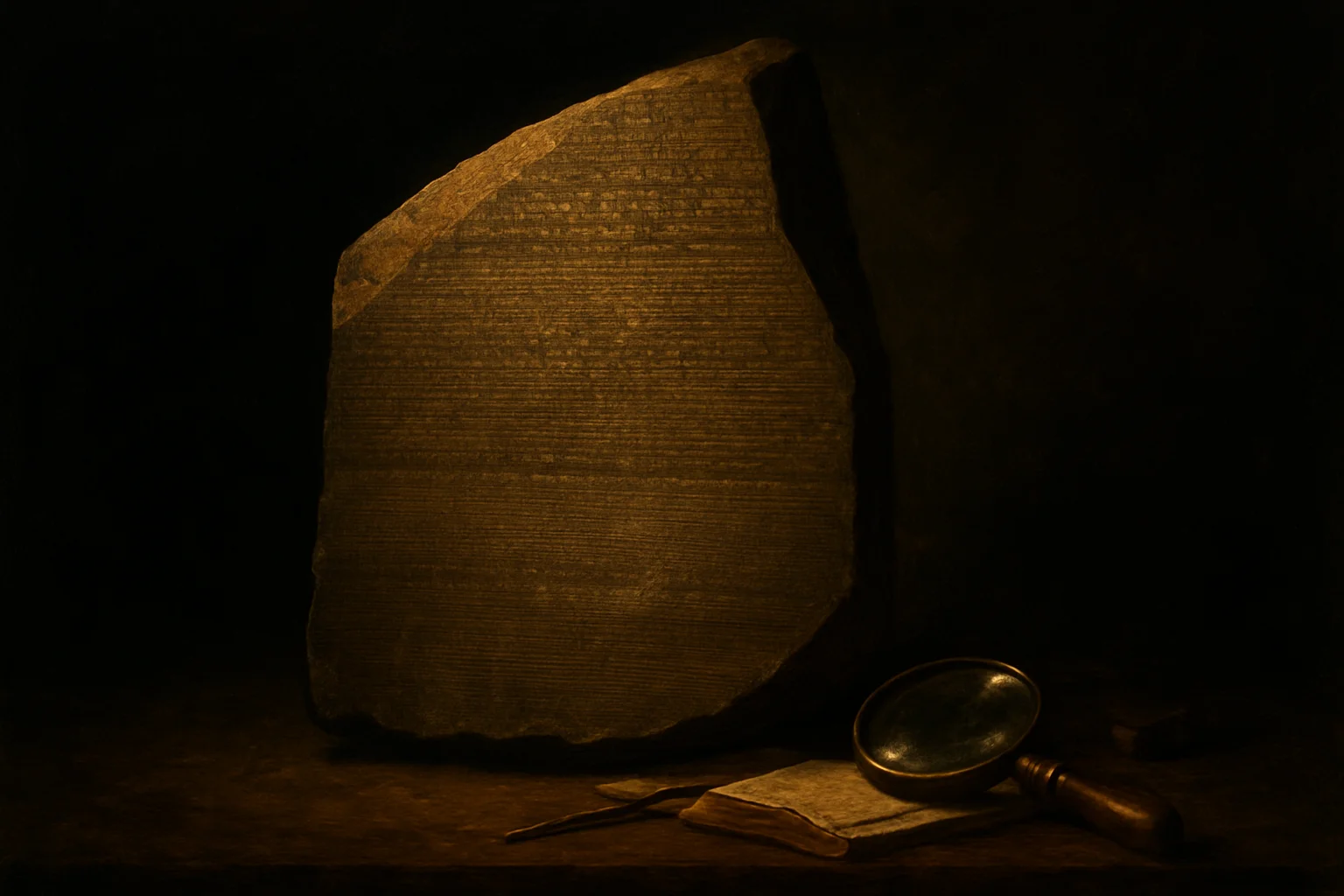
On 15 July 1799, a French officer named Pierre-François Bouchard uncovered a granite slab while supervising the demolition of an old wall near the town of Rashid, known to Europeans as Rosetta, in the Nile Delta. The stone bore three scripts: Greek at the bottom, Demotic Egyptian in the middle, hieroglyphs at the top. Bouchard recognised the Greek and understood immediately that the stone might be a key.
Napoleon's expedition to Egypt had brought not only soldiers but also scholars, part of his ambition to map and catalogue the ancient world. The stone reached Cairo within weeks. Copies of the inscriptions circulated among European academies even before the original fell into British hands in 1801, a spoil of war after the French surrender. It has sat in the British Museum ever since.
The Greek portion was legible from the start. It recorded a decree issued in 196 BCE by priests gathered at Memphis to honour the teenage Ptolemy V. The assumption was simple: if the three texts said the same thing, the hieroglyphs could be read by matching them to the Greek.
That assumption proved harder to execute than anyone expected.
What the Stone Actually Said
The Ptolemaic Decree of Memphis is not a religious or mythological text. It is administrative propaganda. The priests thank Ptolemy V for tax exemptions, confirm his divinity, and order that copies of the decree be placed in every major temple. The tone is formal, the content bureaucratic.
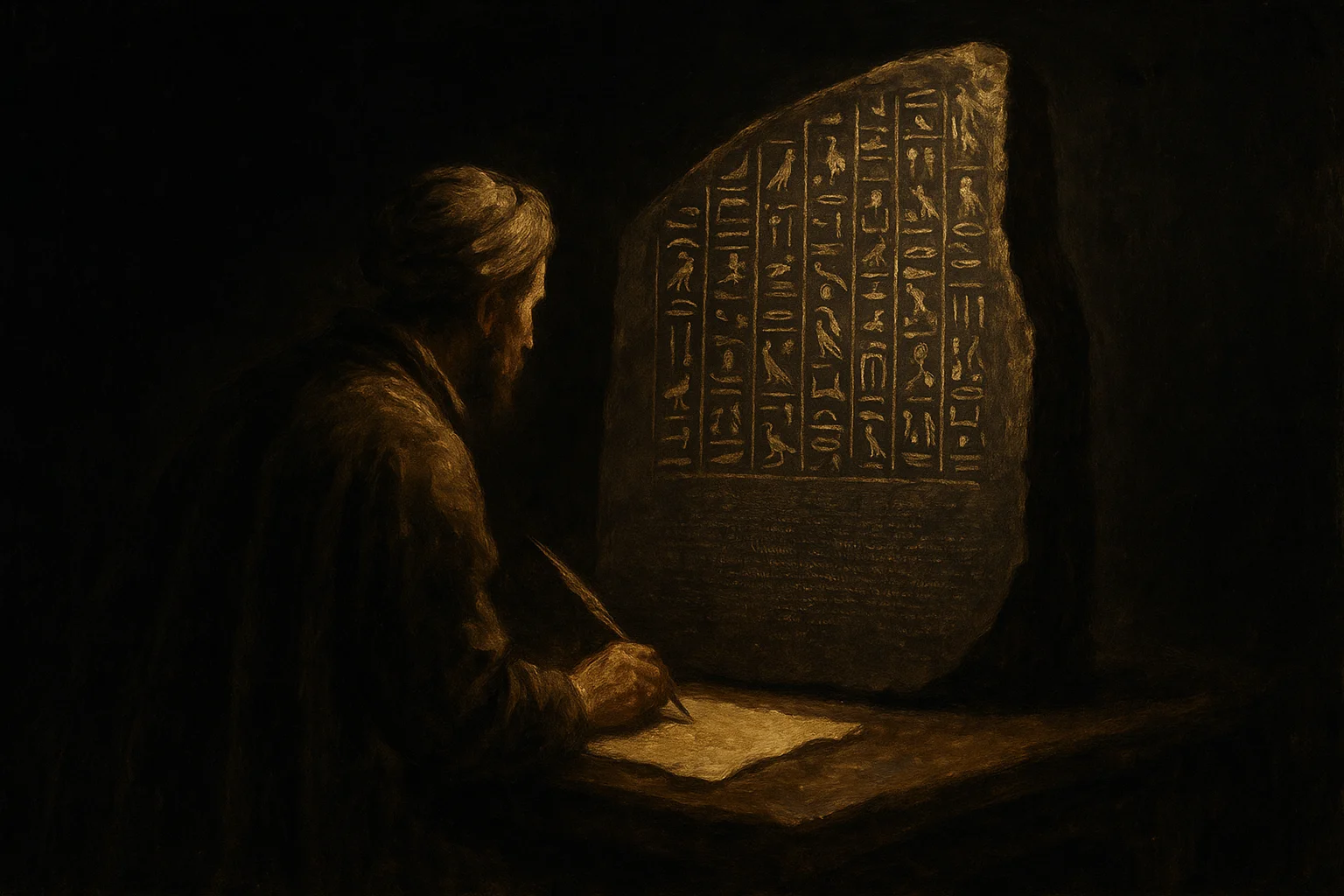
This mundane subject matter turned out to be an advantage. The Greek text named the king repeatedly, and those names appeared inside oval frames, called cartouches, in the hieroglyphic section. Scholars guessed early that cartouches enclosed royal names. What they did not know was whether those names were spelled phonetically or represented by symbolic pictures.
The False Start: Hieroglyphs as Pure Symbols
For centuries, European scholars believed hieroglyphs were purely symbolic, each sign representing an idea rather than a sound. This view had classical pedigree. Plutarch and later Neoplatonists treated Egyptian writing as mystical, a visual language of allegory. Renaissance humanists inherited that assumption and added their own: that hieroglyphs encoded secret wisdom, accessible only to initiates.
The Rosetta Stone challenged that view, but slowly. Early attempts to match hieroglyphs to Greek words produced nonsense. Scholars counted roughly 1,400 hieroglyphic signs on the stone but only 486 Greek words. If each hieroglyph stood for a word, the ratio made no sense.
The breakthrough required abandoning the idea that hieroglyphs were a code and accepting that they functioned, at least in part, as a script: signs that recorded sounds.
Thomas Young and the Cartouche Hypothesis
Thomas Young, an English polymath, made the first real progress. By 1814, he had identified that the cartouches on the Rosetta Stone enclosed the name Ptolemy. He assigned phonetic values to several signs inside the cartouche and correctly guessed that some hieroglyphs represented sounds, not just ideas.
Young's method was comparative. He aligned the Greek and hieroglyphic texts line by line, looking for recurring patterns. He also worked with a second bilingual inscription, brought from the island of Philae, which paired Greek and hieroglyphic texts on an obelisk. The Greek named Cleopatra VII, and Young found her name in a cartouche.
He published his findings in 1819. His work was cautious, incomplete, and correct in outline. He identified the phonetic principle but applied it only to foreign names, assuming that native Egyptian words were still written symbolically.
That assumption held him back.
Champollion's Coptic Advantage
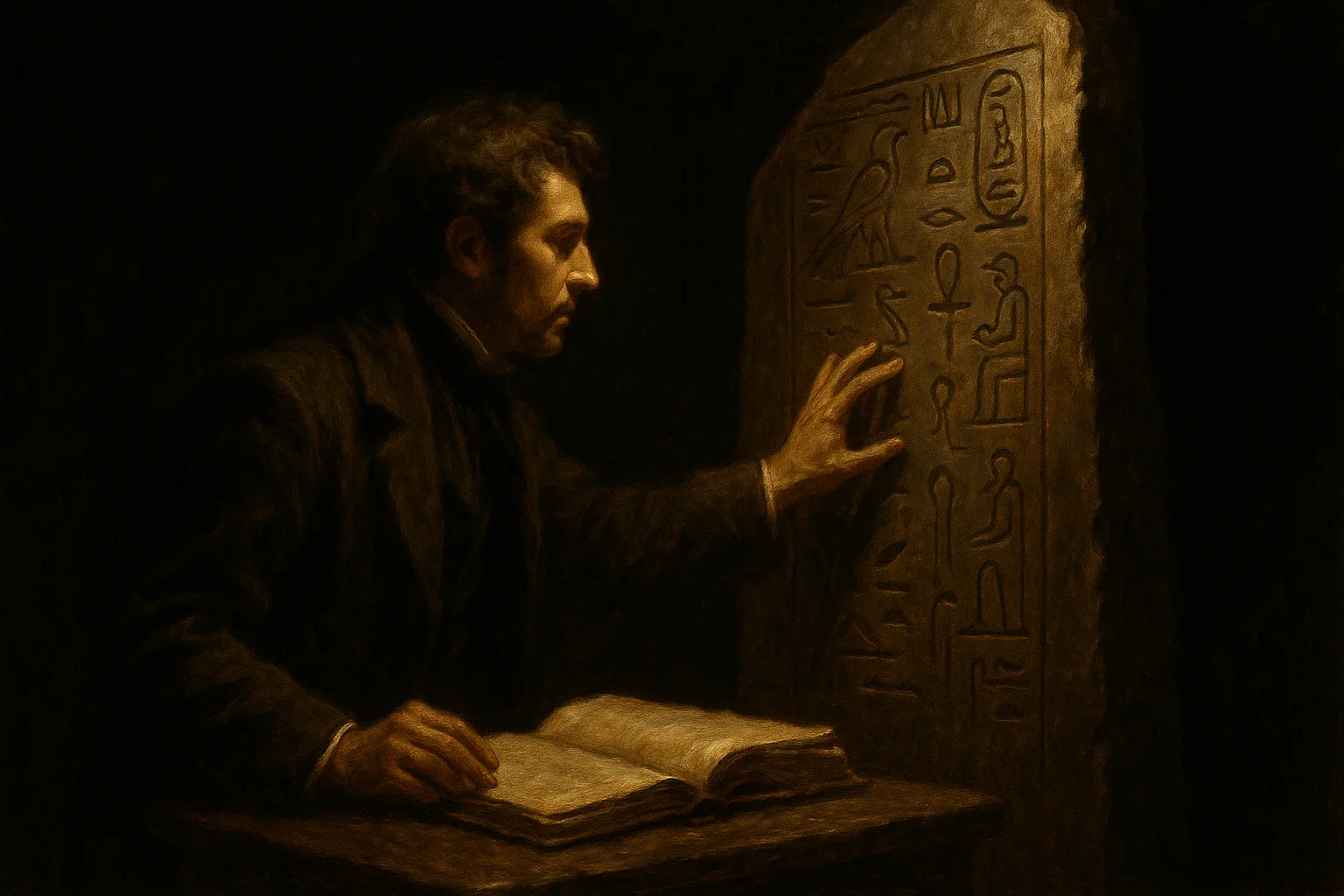
Jean-François Champollion had been obsessed with Egypt since childhood. By his teens, he had taught himself Coptic, the liturgical language of Egypt's Christian minority. Coptic is the final stage of the Egyptian language, written in a modified Greek alphabet. It preserves vocabulary and grammar that stretch back to the age of the pharaohs.
Champollion understood what Young did not: Coptic was not a foreign import but the direct descendant of the language encoded in hieroglyphs. If he could match Coptic words to hieroglyphic signs, he could decode not just names but entire sentences.
He spent years building a phonetic alphabet, testing it against bilingual inscriptions, and comparing signs across different texts. He worked in near isolation, often ill, and chronically short of money. His rivals, particularly Young, accused him of intellectual theft. Champollion ignored them.
September 1822: The Breakthrough
On 14 September 1822, Champollion received copies of inscriptions from the temples of Abu Simbel. Inside two cartouches, he recognised a repeated sign: a circle with a dot, which he knew from Coptic meant "sun" and was pronounced ra. Another sign, three strokes, appeared twice. In Coptic, repetition often indicated the sound s.
He read the cartouche as Ra-s-s. He added the missing vowel and arrived at Ramesses, a name he knew from Greek historians. The second cartouche began with an ibis, the bird of Thoth, whose name in Coptic was Djehuti. He read it as Thutmose.
These were not foreign names. They were Egyptian, written phonetically, centuries before the Ptolemies. The script had always been phonetic.
The Philae Obelisk
The Philae Obelisk, now in Dorset, England, provided crucial confirmation. Its Greek inscription named both Ptolemy and Cleopatra. Champollion compared the two cartouches and found overlapping signs: the p, the t, the l. Each sign carried the same phonetic value in both names.
This was proof. The script was not a symbolic puzzle but a working phonetic system, capable of recording any word in the Egyptian language.
Ramesses and Thutmose
Champollion's reading of Ramesses II and Thutmose opened the floodgates. He could now read royal titles, divine epithets, and the names of Egyptian gods. Within weeks, he had deciphered hundreds of signs. He published his findings in a letter to the Académie des Inscriptions et Belles-Lettres, addressed to Bon-Joseph Dacier, on 27 September 1822. The Lettre à M. Dacier is the birth certificate of Egyptology.
"I have succeeded in deciphering the hieroglyphic texts by means of the Coptic language, which is nothing other than the ancient Egyptian language written in Greek letters." Jean-François Champollion, Lettre à M. Dacier, 1822
Why It Took 23 Years
The delay was not for lack of effort. Several factors compounded the difficulty:
- The symbolic assumption: scholars believed hieroglyphs encoded ideas, not sounds, and tested hypotheses accordingly.
- Incomplete texts: the Rosetta Stone was damaged, and few other bilingual inscriptions were available before 1815.
- Lack of linguistic continuity: no one spoke ancient Egyptian. Coptic was known only to a handful of specialists, and its connection to hieroglyphs was not obvious.
- Script complexity: hieroglyphs mix phonetic signs, logograms, and determinatives. A single word might use all three. The system resists intuitive decoding.
- Nationalist rivalry: French and British scholars competed for credit, slowing collaboration and the sharing of inscriptions.
Champollion succeeded because he combined linguistic knowledge with relentless pattern recognition. He treated the script as a cipher, not a mystery, and applied the discipline of a codebreaker.
Thomas Young's approach
Focused on Greek names in cartouches. Assumed native Egyptian words were symbolic. Published partial phonetic alphabet in 1819 but did not extend it to non-royal texts.
Champollion's approach
Used Coptic to decode native Egyptian vocabulary. Recognised that phonetic signs applied to all words, not just foreign names. Built complete phonetic system by 1822.
What Decipherment Unlocked
Once hieroglyphs could be read, Egypt's history ceased to be a collection of Greek anecdotes and became a documented record. Temples, tombs, and papyri spoke in their own voices. Scholars could now read funerary texts, royal annals, medical treatises, love poetry, and administrative records.
The timeline of Egyptian history expanded and clarified. Dynasties that existed only as names in Manetho's king lists acquired dates, genealogies, and political context. The reigns of Tutankhamun and Akhenaten's religious revolution became accessible through their own inscriptions, not through the distortions of later tradition.
Egyptian mythology could now be studied in primary sources. The Pyramid Texts, the Coffin Texts, and the Book of the Dead revealed a cosmology more complex and varied than Greek and Roman writers had suggested. Sacred symbols acquired precise meanings, tied to specific deities and ritual contexts.
Decipherment also revealed the limits of the Greek sources. Herodotus and Plutarch had been useful guides, but they had misunderstood much. Egyptian religion was not a static system of allegory but a living tradition that evolved over millennia.
Frequently asked questions
How did the Rosetta Stone help decode hieroglyphics?
The Rosetta Stone contained the same decree in Greek, Demotic, and hieroglyphic scripts, allowing scholars to match known Greek words to unknown hieroglyphic signs and test hypotheses about how the script functioned. The Greek text named Ptolemy V repeatedly, and those names appeared inside cartouches in the hieroglyphic section, providing the first clues that some signs were phonetic. However, the stone alone was insufficient without Coptic linguistic knowledge and additional bilingual inscriptions like the Philae Obelisk.
Who actually deciphered Egyptian hieroglyphs?
Jean-François Champollion deciphered Egyptian hieroglyphs in 1822, building on earlier work by Thomas Young, who had identified phonetic signs in royal cartouches by 1814. Champollion's breakthrough came from his fluency in Coptic, which allowed him to recognise that hieroglyphs recorded the sounds of the Egyptian language, not just symbolic ideas. He published his findings in the Lettre à M. Dacier on 27 September 1822, demonstrating that the script was fully phonetic and could be read using Coptic vocabulary.
Why did it take 23 years to decode the Rosetta Stone?
Decipherment took 23 years because scholars initially believed hieroglyphs were purely symbolic rather than phonetic, the Rosetta Stone was damaged and incomplete, and few other bilingual inscriptions were available for comparison before 1815. No one spoke ancient Egyptian, and the connection between hieroglyphs and Coptic was not recognised until Champollion applied his linguistic knowledge. The script itself is complex, mixing phonetic signs, logograms, and determinatives, which resisted intuitive decoding and required systematic pattern recognition.
What role did Coptic play in deciphering hieroglyphs?
Coptic, the final stage of the Egyptian language written in a modified Greek alphabet, provided the phonetic and grammatical key to reading hieroglyphs because it preserved ancient Egyptian vocabulary and structure. Champollion used Coptic to assign sound values to hieroglyphic signs and to recognise native Egyptian words in inscriptions, proving that the script was phonetic rather than purely symbolic. Without Coptic, scholars could not move beyond decoding foreign names in cartouches to reading complete Egyptian sentences and texts.
Did Thomas Young contribute to the decipherment?
Thomas Young made significant early contributions by identifying in 1814 that cartouches enclosed royal names and that some hieroglyphs represented sounds rather than ideas, correctly reading parts of the name Ptolemy on the Rosetta Stone. He published a partial phonetic alphabet in 1819 and worked with the Philae Obelisk to decode Cleopatra's name. However, Young believed phonetic signs applied only to foreign names and that native Egyptian words remained symbolic, an assumption that prevented him from achieving full decipherment, which Champollion completed in 1822.
What did scholars learn once hieroglyphs were decoded?
Once hieroglyphs were decoded, scholars gained access to three millennia of Egyptian written records, including royal annals, religious texts, administrative documents, medical treatises, and literary works, transforming Egyptian history from myth into documented fact. The decipherment clarified the timeline of dynasties, revealed the complexity of Egyptian religion through primary sources like the Pyramid Texts and the Book of the Dead, and corrected misunderstandings in Greek and Roman accounts. It also allowed precise readings of temple inscriptions, funerary texts, and the political and religious contexts of reigns such as those of Ramesses II, Tutankhamun, and Akhenaten.
Further reading on Mythologis
Free 25-page sample
Want the whole story?
Take the first 25 pages free. If it pulls you in, the full edition is yours as an instant PDF download, with a paperback on Amazon for selected titles.
Egyptian
The Egyptian Mythology Book: Ra, Osiris, Isis, Anubis, and the Sacred Stories of the Pharaohs
Ra, Osiris, Isis, Anubis, and the Sacred Stories of the Pharaohs
Three thousand years of Egyptian sacred stories. The Duat, the weighing of the heart, the cult of Osiris, and the daily voyage of the sun.
More from Egyptian
All articles
Egyptian
The Book of the Dead: Egypt's Guide to Eternity
Ancient Egypt's most sacred funerary text was not a single book but a living archive of spells, maps, and prayers that guided the dead through the perils between death and eternal life.
Egyptian
Eye of Horus: The Protective Amulet That Watched Over the Living and the Dead
Worn by pharaohs and fishermen alike, the Eye of Horus is one of antiquity's most potent protective symbols, carrying the weight of cosmic battle, divine healing, and eternal vigilance.

Egyptian
Ra the Sun God: Egypt's Supreme Ruler of Light and Creation
Ra, the ancient Egyptian sun god, blazed at the very heart of a civilization that worshipped light as the pulse of creation itself. Discover his origins, his many forms, and the sacred journey he took across the sky and through the underworld every single day.
Egyptian
The Ankh: Egypt's Eternal Symbol of Life
The ankh is ancient Egypt's most recognizable hieroglyph, a looped cross carried by gods and pharaohs alike as the very key to immortal life. Discover its origins, meanings, and sacred legacy.