
Howard Carter: The Man Behind the Tutankhamun Discovery
The archaeologist who found Tutankhamun's tomb was a self-taught artist turned excavator. His career, conflicts, and forensic methods.
Contents
Howard Carter was a British archaeologist and Egyptologist who discovered the intact tomb of Tutankhamun in the Valley of the Kings in November 1922, the most complete royal burial ever found in Egypt. Born in 1874 to a working-class family with no formal university education, Carter spent three decades in Egypt developing meticulous excavation and documentation methods that set new standards for archaeological practice. His discovery transformed public understanding of ancient Egyptian history but also exposed the tensions between colonial archaeology and Egyptian national sovereignty in the early twentieth century.
The popular image of Carter stops at the moment he peered through a hole into the tomb and saw "wonderful things." What came before and after that moment reveals a more complex figure: a self-taught specialist who clashed repeatedly with authority, lost his government position over a confrontation with French tourists, and spent years in professional exile before his partnership with Lord Carnarvon gave him a second chance.
Early Life and Arrival in Egypt
Howard Carter was born on 9 May 1874 in Kensington, London, the youngest of eleven children. His father, Samuel Carter, worked as an illustrator of animals for periodicals and country estates. The family had no wealth and no connections to academic circles. Carter received little formal schooling; chronic childhood illness kept him at home, where his father taught him to draw.
That skill opened the door. In 1891, at seventeen, Carter was hired by the Egypt Exploration Fund to trace inscriptions and reliefs at the Middle Kingdom site of Beni Hasan. Percy Newberry, the expedition director, recognised that the boy could render hieroglyphic inscriptions with precision. Carter sailed for Alexandria with a draughtsman's kit and no archaeological training. He would remain in Egypt, with brief interruptions, for the next thirty years.
The Egypt Carter entered in 1891 was under British occupation, administered as a veiled protectorate. Antiquities were extracted by European museums with little oversight. The Egyptian Antiquities Service, established by Auguste Mariette in 1858, was directed by the French and staffed largely by foreigners. Carter arrived as a technical assistant, not a scholar. He had no university degree and never would.
From Artist to Archaeologist
Work Under Flinders Petrie
In 1892, Carter joined Flinders Petrie at Amarna, the short-lived capital of the heretic pharaoh Akhenaten. Petrie was developing stratigraphic excavation methods that prioritised context over objects. He recorded pottery sherds, architectural plans, and the position of finds within layers of soil. Most excavators at the time dug for museum-quality artefacts and discarded the rest.
Carter learned to see a site as a text to be read, not a quarry to be mined. Petrie's camps were spartan: tinned food, no alcohol, twelve-hour days under the sun. Carter thrived. He copied tomb paintings at Deir el-Bahari and worked at the temple of Hatshepsut, refining his ability to reconstruct damaged reliefs from fragments. By 1899, he had published his first archaeological report and earned a reputation for accuracy.
Chief Inspector of Antiquities
In 1899, Gaston Maspero, director-general of the Egyptian Antiquities Service, appointed Carter Chief Inspector of Monuments for Upper Egypt and Nubia. Carter was twenty-five. The position gave him authority over all excavations and conservation work from Asyut to the Sudanese border, including the Valley of the Kings and the temples at Luxor and Karnak.
Carter installed electric lighting in several royal tombs, improving visitor access while reducing damage from torch smoke. He supervised the clearance of the tomb of Ramses II and oversaw security for high-profile excavations by Theodore Davis, an American lawyer funding digs in the Valley of the Kings. Davis discovered several tombs during this period, including caches of mummification practices materials that would later inform Carter's understanding of burial procedures.
In 1904, Carter was transferred north to become Chief Inspector for Lower Egypt, based at Saqqara. The promotion was also a test. Saqqara received more European tourists than Luxor, and the political stakes were higher.
The Saqqara Affair and Exile from Official Service
On 8 January 1905, a group of French tourists attempted to enter the Serapeum at Saqqara without paying. Carter's Egyptian site guards blocked them. The tourists became aggressive. Accounts differ on what happened next, but several guards were struck, and Carter intervened physically. The French consul lodged a formal complaint.
Maspero asked Carter to apologise. Carter refused. He maintained that his guards had acted correctly and that he would not apologise for defending them against assault. The British administration in Cairo, unwilling to provoke the French, pressured Carter to relent. He would not. In October 1905, Carter resigned from the Antiquities Service.
He was thirty-one, unemployed, and effectively blacklisted from official archaeology. For the next four years, Carter survived by painting watercolours for tourists in Luxor, dealing in antiquities, and working as a freelance excavation supervisor. It was a humiliating fall. Some colleagues avoided him. Others admired his stubbornness but considered his career finished.
The Partnership with Lord Carnarvon
In 1907, Maspero introduced Carter to George Herbert, fifth Earl of Carnarvon. Carnarvon was a wealthy aristocrat who had taken up Egyptology as a hobby after a car accident left him in fragile health. He held an excavation concession in the Theban necropolis but had little experience. Maspero suggested Carter as a supervisor.
The partnership was unlikely. Carnarvon was an aristocrat educated at Eton and Cambridge; Carter was a tradesman's son with a provincial accent. But Carnarvon respected Carter's knowledge, and Carter appreciated a patron willing to fund slow, methodical work. Between 1907 and 1914, they excavated nobles' tombs near Deir el-Bahari. The finds were modest but well-documented. They published Five Years' Explorations at Thebes in 1912, a model of clear archaeological reporting.
In 1914, Theodore Davis relinquished his concession to excavate in the Valley of the Kings. Davis had worked there for twelve years and declared the valley exhausted. Carnarvon applied for the concession. It was granted in 1915, but the First World War delayed work until 1917. Carter believed one tomb remained undiscovered: that of the obscure New Kingdom pharaoh Tutankhamun, who had died young and left few monuments.
The Discovery of Tutankhamun's Tomb
November 1922: The First Steps
By the autumn of 1922, Carter had excavated for five seasons in the Valley of the Kings without significant results. Carnarvon was ready to abandon the project. Carter persuaded him to fund one final season. On 4 November 1922, Carter's workmen uncovered a step cut into the bedrock beneath the remains of ancient workmen's huts near the tomb of Ramses VI.
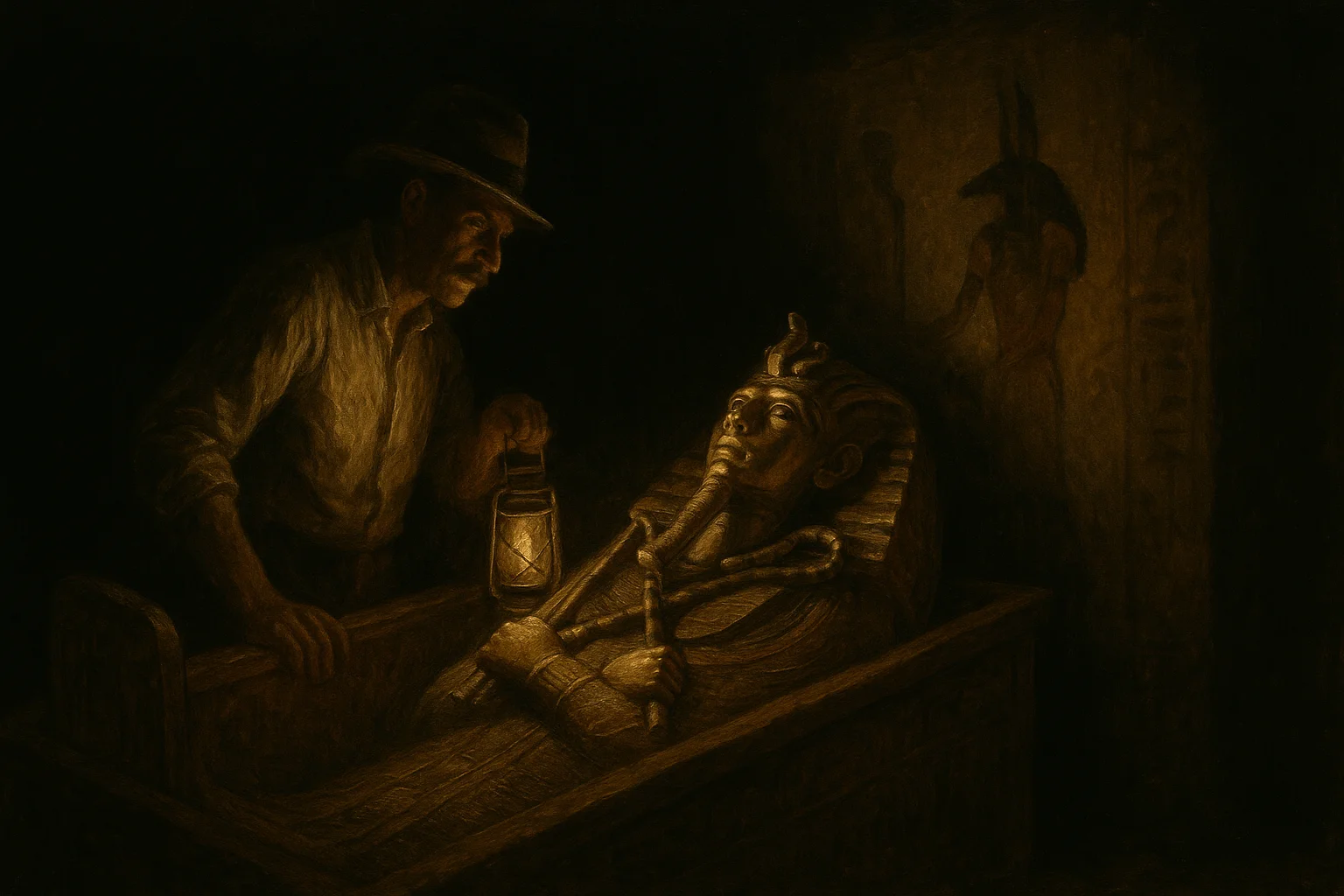
By the next day, twelve steps were visible, leading to a sealed doorway stamped with necropolis seals. Carter sent a telegram to Carnarvon in England: "At last have made wonderful discovery in Valley; a magnificent tomb with seals intact; re-covered same for your arrival; congratulations." Carnarvon sailed immediately. On 26 November, with Carnarvon and his daughter Evelyn present, Carter made a small hole in the inner doorway and held up a candle.
"Can you see anything?" Carnarvon asked. "Yes," Carter replied, "wonderful things."
The antechamber was packed with furniture, chariots, boxes, and statues, many overlaid with gold. Nothing like it had been seen before. Every royal tomb excavated in the valley had been plundered in antiquity. This one, though disturbed twice by thieves shortly after the burial, had been resealed by necropolis officials and left untouched for more than 3,200 years.
The Clearance and Documentation
Carter spent the next ten years clearing the tomb. He photographed every object in situ before moving it, assigned each item a catalogue number, and recorded its position on scaled plans. The tomb contained more than 5,000 objects, from monumental gilded shrines to linen undergarments. Carter enlisted specialists: Harry Burton, a photographer from the Metropolitan Museum of Art; Alfred Lucas, a chemist who stabilised fragile materials; and Alan Gardiner, a philologist who translated inscriptions.
The work was painstaking. Carter built a conservation laboratory in the nearby tomb of Seti II. Each object was cleaned, photographed again, drawn, described on an index card, and packed for transport to the Egyptian Museum in Cairo. Carter's three-volume publication, The Tomb of Tut.Ankh.Amen (1923–1933), remains a primary source. His object cards, now held at the Griffith Institute in Oxford, record details that later scholars have used to reconstruct funerary customs and workshop practices.
Carter's Method: Forensic Archaeology Before Its Time
Carter treated the tomb as a crime scene. He understood that the arrangement of objects, the evidence of ancient robberies, and the sequence of sealing and resealing all told a story. He noted that the tomb had been entered twice in antiquity: thieves had stolen small valuable items, particularly oils and cosmetics, but had been interrupted before they could strip the burial chamber.
His documentation methods were exceptional for the 1920s. Most excavators published only the finest objects. Carter recorded everything, including broken pottery, decayed food offerings, and the floral wreaths left by mourners. He recognised that these details illuminated daily life and ritual practice. James Henry Breasted, in his introduction to The Edwin Smith Surgical Papyrus (1930), acknowledged that Carter's tomb records had set a new standard for archaeological precision.
Typical 1920s excavation
Focus on museum-quality artefacts; minimal photography; objects removed quickly; publication limited to decorated pieces; context often unrecorded.
Carter's Tutankhamun clearance
Every object photographed in situ; numbered catalogue cards; scaled plans; conservation on-site; publication includes mundane items; stratigraphy and disturbance patterns recorded.
Carter's insistence on slow, methodical work frustrated the Egyptian press and the Antiquities Service, both of which wanted the tomb cleared quickly for public display. He refused to rush. The burial chamber alone took four field seasons to dismantle: four nested gilded shrines, a stone sarcophagus, three anthropoid coffins, and the mummy itself, all had to be documented and conserved before removal.
Conflict, Politics, and the Egyptian Antiquities Service
The discovery occurred at a volatile moment. Egypt had declared independence from Britain in 1922, though British troops remained. The new Egyptian government sought control over its cultural heritage. The Antiquities Service, still directed by a Frenchman, Pierre Lacau, was under pressure to assert Egyptian authority.
Carnarvon had negotiated a division of finds with the Antiquities Service, a standard arrangement at the time. But public opinion in Egypt opposed allowing any objects from Tutankhamun's tomb to leave the country. Carnarvon also sold exclusive press rights to The Times of London, angering the Egyptian press. When Carnarvon died suddenly in April 1923 from an infected mosquito bite, his widow inherited the concession and the disputes.
In February 1924, Carter closed the tomb in protest over restrictions imposed by the Antiquities Service. He demanded that his team be allowed to bring their wives to the official opening of the sarcophagus, a request Lacau denied. Carter locked the tomb and left Egypt. The Egyptian government revoked the concession. Carter spent months in legal battles before a compromise was reached: he could return to finish the clearance, but all finds would remain in Egypt, and he would have no further claim.
Carter resumed work in 1925. The relationship with the Antiquities Service remained tense. He completed the clearance in 1932. By then, the political context had shifted entirely. The era of partage, the division of finds between excavator and host country, was ending. Carter's discovery had accelerated that change.
Later Years and Legacy
After 1932, Carter lectured occasionally and worked on the final volume of his tomb publication. He never excavated again. He had no academic position and no pension from the Egyptian government. He lived modestly in London, his health declining. He died of lymphoma on 2 March 1939, at age sixty-four. His obituary in The Times was brief. The Second World War began six months later, and his death passed largely unnoticed.
Carter left no heirs and little money. His notes and photographs were bequeathed to the Griffith Institute, where they remain an essential archive. Scholars continue to use his records to study the tomb's contents, the sequence of burial, and the objects' iconography. His insistence on recording everything, including Egyptian symbols on minor items, has allowed later researchers to reconstruct details he did not fully understand.
Carter's legacy is double-edged. He brought rigour to a field that badly needed it, but he also embodied the colonial structures that treated Egypt's past as a resource to be managed by Europeans. The tension between those two facts defines how he is remembered. The tomb of Tutankhamun made him famous, but it also marked the end of an era in which foreign archaeologists controlled access to Egypt's monuments.
Frequently asked questions
Who was Howard Carter before he discovered Tutankhamun's tomb?
Howard Carter was a self-taught archaeologist and Egyptologist who worked in Egypt for thirty years before discovering Tutankhamun's tomb in 1922, beginning his career in 1891 as a seventeen-year-old archaeological artist hired to trace inscriptions at Beni Hasan. He rose to become Chief Inspector of Antiquities for Upper Egypt in 1899, supervising excavations and conservation in the Valley of the Kings, but resigned in 1905 after refusing to apologise for defending his Egyptian guards during a confrontation with French tourists at Saqqara. He spent the following years working as a freelance excavator and antiquities dealer before partnering with Lord Carnarvon in 1907.
Why did Carter lose his position as Chief Inspector of Antiquities?
Carter resigned as Chief Inspector of Antiquities in October 1905 after refusing to apologise for an incident at Saqqara on 8 January 1905, when French tourists attempted to enter the site without paying and became violent with his Egyptian guards. Carter intervened physically to defend his guards, and the French consul lodged a formal complaint. The British administration in Cairo pressured Carter to apologise to avoid diplomatic friction with France, but Carter refused, maintaining that his guards had acted correctly. His resignation effectively ended his career in official archaeology and forced him into four years of professional exile.
How did Carter's excavation methods differ from his contemporaries?
Carter documented every object in Tutankhamun's tomb with photographs, scaled drawings, and detailed catalogue cards before removal, recording even mundane items like broken pottery and food offerings that most 1920s excavators would have discarded. He treated the tomb as a forensic site, noting the sequence of ancient robberies, the position of objects, and signs of disturbance to reconstruct the burial's history. His insistence on slow, methodical clearance and on-site conservation, using specialists in photography, chemistry, and philology, set a new standard for archaeological practice. Most of his contemporaries focused on extracting museum-quality artefacts quickly, with minimal attention to context or stratigraphy.
What was Carter's relationship with the Egyptian government after 1922?
Carter's relationship with the Egyptian government and the Antiquities Service deteriorated rapidly after the tomb's discovery, reaching a breaking point in February 1924 when he closed the tomb in protest over access restrictions and left Egypt. The Egyptian government revoked his excavation concession, and Carter spent months in legal disputes before a compromise allowed him to return in 1925 to complete the clearance, on the condition that all finds remain in Egypt and he relinquish any claim to a share of the objects. The discovery occurred during Egypt's transition to independence, and public opinion opposed allowing any part of Tutankhamun's burial to leave the country, making Carter a symbol of colonial-era archaeology at a moment when that system was collapsing.
What happened to Carter after the tomb clearance was completed?
After completing the clearance of Tutankhamun's tomb in 1932, Carter never excavated again and spent his remaining years lecturing occasionally and working on the final volume of his tomb publication, living modestly in London with no academic position or pension. He died of lymphoma on 2 March 1939 at age sixty-four, his death receiving little public attention as the Second World War began six months later. He left no heirs and little money, bequeathing his notes and photographs to the Griffith Institute at Oxford, where they remain a primary research archive. Despite the global fame of his discovery, Carter received no knighthood and was largely forgotten by the time of his death.
Further reading on Mythologis
Free 25-page sample
Want the whole story?
Take the first 25 pages free. If it pulls you in, the full edition is yours as an instant PDF download, with a paperback on Amazon for selected titles.
Egyptian
The Egyptian Mythology Book: Ra, Osiris, Isis, Anubis, and the Sacred Stories of the Pharaohs
Ra, Osiris, Isis, Anubis, and the Sacred Stories of the Pharaohs
Three thousand years of Egyptian sacred stories. The Duat, the weighing of the heart, the cult of Osiris, and the daily voyage of the sun.
More from Egyptian
All articles
Egyptian
The Book of the Dead: Egypt's Guide to Eternity
Ancient Egypt's most sacred funerary text was not a single book but a living archive of spells, maps, and prayers that guided the dead through the perils between death and eternal life.
Egyptian
Eye of Horus: The Protective Amulet That Watched Over the Living and the Dead
Worn by pharaohs and fishermen alike, the Eye of Horus is one of antiquity's most potent protective symbols, carrying the weight of cosmic battle, divine healing, and eternal vigilance.

Egyptian
Ra the Sun God: Egypt's Supreme Ruler of Light and Creation
Ra, the ancient Egyptian sun god, blazed at the very heart of a civilization that worshipped light as the pulse of creation itself. Discover his origins, his many forms, and the sacred journey he took across the sky and through the underworld every single day.
Egyptian
The Ankh: Egypt's Eternal Symbol of Life
The ankh is ancient Egypt's most recognizable hieroglyph, a looped cross carried by gods and pharaohs alike as the very key to immortal life. Discover its origins, meanings, and sacred legacy.