
Music in Ancient Egypt: Ritual Technology and Sacred Sound
How Egyptians used harps, sistrums, and voice to maintain cosmic order. Grounded in temple reliefs, tomb inscriptions, and ritual texts.
Contents
Music in ancient Egypt functioned as ritual technology engineered to maintain cosmic order, appease deities, and facilitate communication between the human and divine realms. Temple musicians employed instruments with specific acoustic properties, documented in tomb reliefs and liturgical texts from the Old Kingdom through the Ptolemaic period, to perform ceremonies calibrated to the Egyptian gods' requirements. The sistrum, harp, lute, and percussion ensemble constituted a liturgical toolkit as precisely specified as mathematical precision in temple construction.
The textbooks often reduce Egyptian music to atmospheric backdrop, harp melodies drifting through palace banquets. The temple reliefs tell a different story. Sound was infrastructure, calibrated to cosmic function, performed by trained specialists whose titles appear in administrative papyri alongside scribes and astronomers. What survives in the archaeological record is not a soundtrack but an operating manual.
The Acoustic Architecture of Ma'at
Ma'at, the principle of cosmic order, required constant maintenance through ritual action. Sound occupied a central position in this maintenance program. The Pyramid Texts, inscribed in the burial chambers of Old Kingdom pharaohs, reference musical performance as a mechanism for establishing and preserving divine equilibrium. Utterance 254 describes offerings accompanied by "the sound of the sistrum for thy majesty," linking acoustic output directly to the satisfaction of divine appetite.
Temple architecture amplified this function. The hypostyle halls at Karnak and Dendera were not merely visual spaces but acoustic chambers. Stone columns spaced at intervals that modern acoustic analysis suggests were designed to distribute sound evenly across the ritual space. The Dendera Temple inscriptions describe the sistrum's sound as "driving away the evil one," a phrase that appears in contexts suggesting not metaphor but operational procedure.
The connection between sound and ma'at extended to astronomical observations. Temple rituals aligned with solar and stellar cycles required musical accompaniment timed to celestial events. Papyrus Harris I, a lengthy administrative document from the reign of Ramesses III, records allocations of musicians to specific temples with instructions tied to festival calendars. The musicians did not perform when inspired. They performed when the cosmos required it.
Instruments as Liturgical Tools
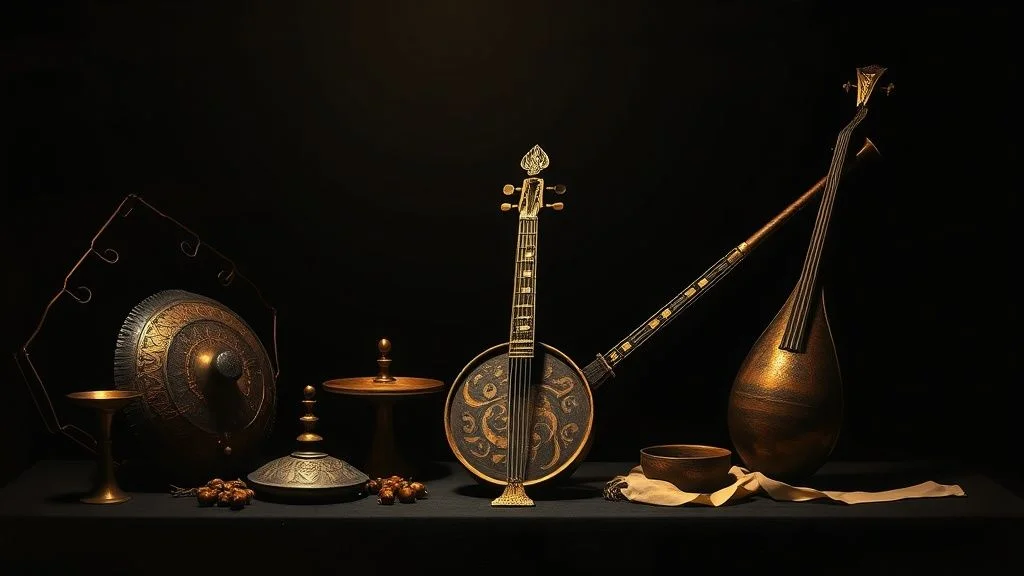
Egyptian instruments were not generic noisemakers. Each type carried specific theological associations and ritual applications, documented in tomb paintings, temple reliefs, and administrative texts that list instruments by name alongside their assigned deities.
The Sistrum: Hathor's Rattle and the Appeasement of Sekhmet
The sistrum remains the most archaeologically attested ritual instrument. Two types existed: the naos sistrum, shaped like a temple shrine, and the simpler loop sistrum. Both consisted of a metal frame with loose rods that produced a rattling sound when shaken. Temple reliefs at Dendera show priestesses holding sistra before Hathor, whose mythology identifies her as both nurturing mother and, in her aspect as Sekhmet, destructive lioness.
The sistrum's function was explicit. The Hymn to Hathor inscribed at Dendera states that the instrument's sound "gladdens the heart of the goddess" and "drives away the rage of the Eye of Ra." Sekhmet, in myth, nearly destroyed humanity before being calmed through intoxication and music. The sistrum ritualized this appeasement daily. Priestesses called "shemayet," documented in administrative records with salaries paid in grain and cloth, performed this function as occupational duty.
Harps, Lutes, and the Voice of the Divine
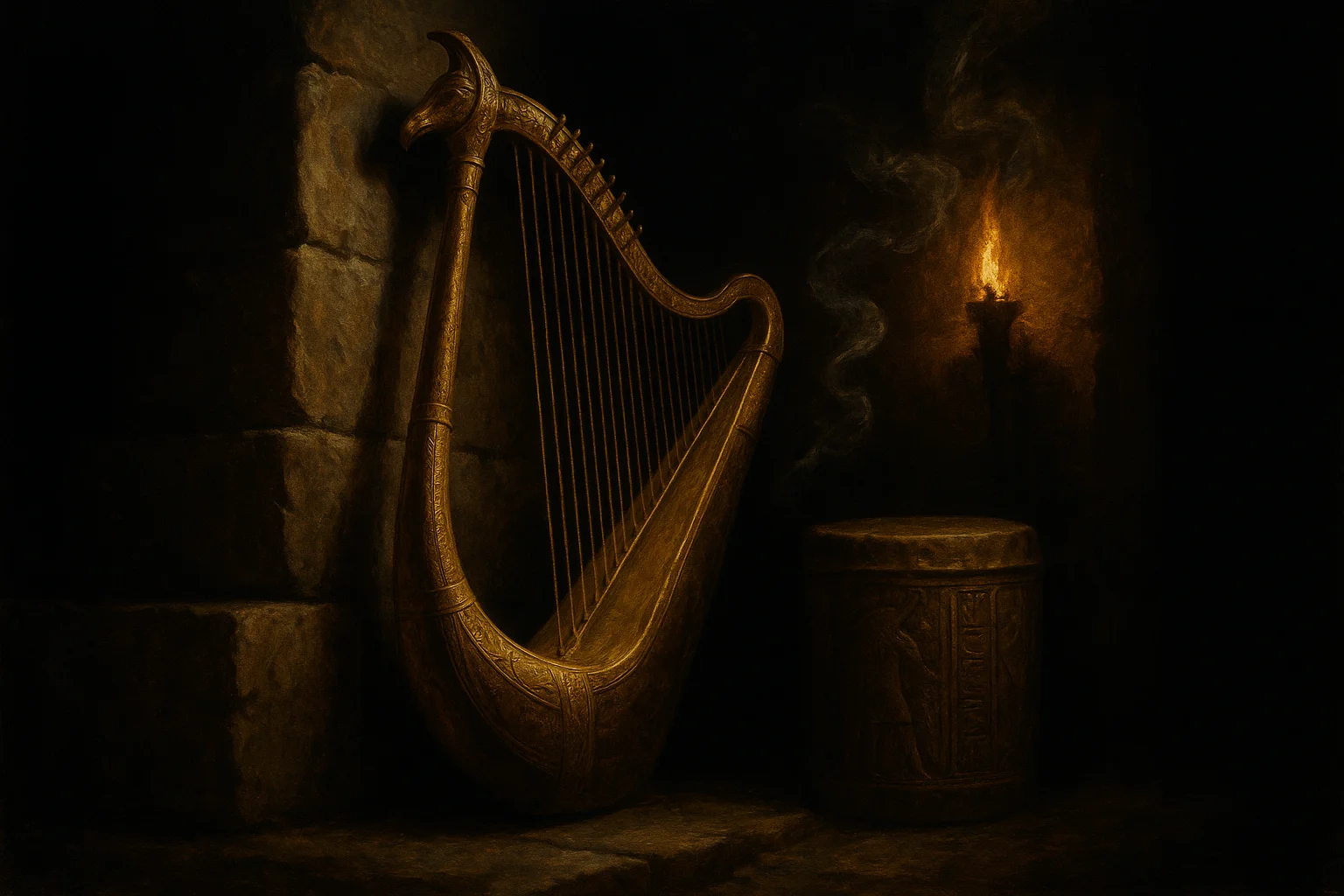
Stringed instruments appear in Egyptian contexts from the Old Kingdom onward. The arched harp, often taller than the musician, features prominently in tomb paintings showing banquet scenes, but temple reliefs reveal its liturgical use. The Stela of Intef II, an Eleventh Dynasty monument, depicts the pharaoh accompanied by a harpist in a ritual context, not a feast.
The lute, introduced during the New Kingdom possibly through Asiatic contact, appears in temple scenes at Karnak. Its association with Akhenaten's religious reforms suggests it may have carried theological significance tied to solar worship. The Great Hymn to the Aten, composed during Akhenaten's reign, describes the god's voice as "sweet," a term also applied to lute music in contemporary texts.
Harps and lutes accompanied hymns. The Book of the Dead, Spell 125, describes the deceased reciting the Negative Confession before the divine tribunal, and tomb paintings show musicians present during this imagined scene. Whether the instruments represented the gods' voices or provided accompaniment for human speech remains debated, but their presence in both funerary and temple contexts indicates they were not optional decoration.
Percussion and the Marking of Sacred Time
Drums, clappers, and tambourines regulated ritual tempo. The tomb of Nakht at Thebes (TT52) shows a percussion ensemble of three women playing during a banquet, but similar groupings appear in temple procession scenes. Papyrus Anastasi IV, an administrative text, lists "drummers of the temple" as a distinct occupational category with ration allocations.
Percussion marked transitions within ceremonies. The clapper, two curved pieces of wood or ivory struck together, appears in scenes of funerary practices and temple offerings. Its sharp, percussive sound likely signaled specific moments: the opening of shrine doors, the presentation of offerings, the conclusion of hymns. Modern reconstructions based on tomb reliefs suggest these instruments were loud enough to be heard across large temple courtyards.
Temple Musicians and the Priesthood of Sound
Temple musicians held priestly rank. The title "shemayet," female musician-priestess, appears in administrative documents alongside "hem-netjer," standard priestly designations. Male musicians, called "hesy," received similar status. Both groups underwent training documented in texts describing the education of priests, which included memorization of hymns, proper handling of sacred symbols, and performance protocols.
Payment records survive. Papyrus Harris I details grain, beer, and cloth allocations to temple musicians at Thebes, Memphis, and Heliopolis. The quantities match those given to other mid-ranking priests, suggesting musicians occupied neither the highest nor lowest rungs of temple hierarchy. Their work was specialized but not exceptional in status terms.
Temple Musicians
Held priestly titles, received temple salaries, underwent formal training, performed scheduled rituals tied to liturgical calendars, and were bound by purity regulations.
Secular Musicians
Performed at banquets and festivals, received payment from private patrons, learned through apprenticeship rather than temple schools, and faced no ritual purity requirements.
Gender roles were specific. Women dominated sistrum performance, particularly in Hathor worship. Men more commonly played harps and lutes, though exceptions appear. The tomb of Nakht shows female musicians playing lute, harp, and percussion together, suggesting that while gender patterns existed, they were not absolute prohibitions. Costume and status markers in these scenes indicate the women were not slaves but free professionals.
Music in Funerary Ritual
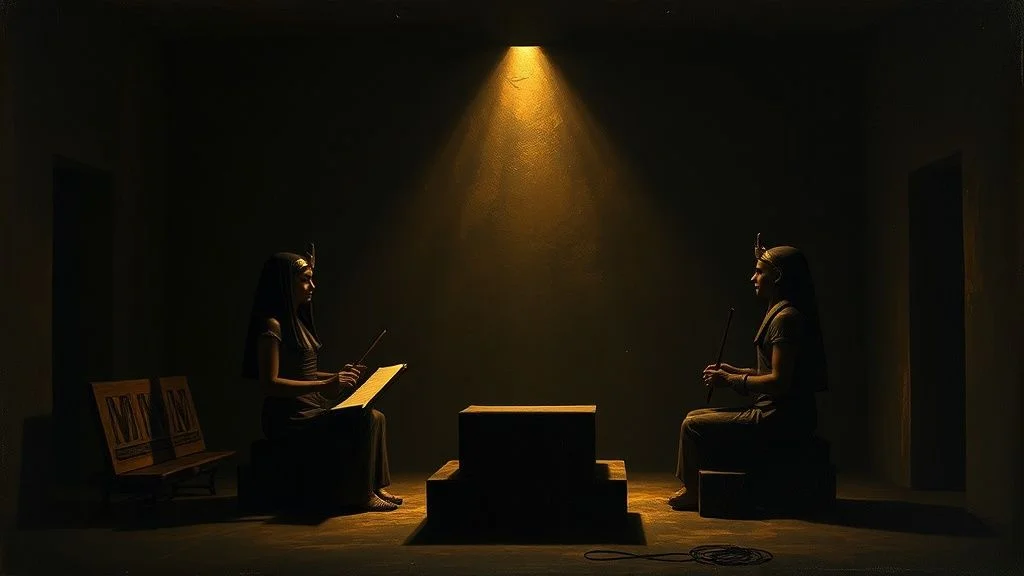
The deceased required music. Tomb paintings from the New Kingdom onward depict musicians performing during funeral processions and at the tomb entrance. The Book of the Dead describes the journey through the underworld as accompanied by "the sound of jubilation," a phrase that appears in contexts suggesting actual performance, not metaphor.
"The sistrum is shaken for thee, the rattle is played for thee, that thou mayest enter into the horizon with Ra." Book of the Dead, Spell 125
Funerary music served multiple functions. It guided the deceased's spirit, appeased the gods who judged the dead, and provided comfort to mourners. The tomb of Nakht shows a blind harpist performing at a banquet, a scene often interpreted as funerary because blindness was associated with the underworld and memory of the dead. The harpist's song, partially preserved in hieroglyphic transcription, advises enjoying life because death is inevitable, a sentiment that appears in multiple tomb contexts.
Instruments were sometimes buried with the dead. Archaeological excavations have recovered clappers, small harps, and percussion instruments from tombs, though their condition suggests they were often symbolic rather than functional. The presence of sacred animals in funerary contexts parallels this practice: both sound and animal companions equipped the deceased for the afterlife journey.
What We Know and What We Do Not
No musical notation survived from ancient Egypt. The melodies, rhythms, and harmonic structures that filled temples and tombs are lost. What remains are the instruments themselves, tomb paintings showing hand positions and ensemble configurations, and texts describing music's effects without recording its sound.
Modern reconstructions rely on organology, the study of instrument construction and playing technique. Surviving harps and lutes reveal string counts, scale lengths, and tuning peg placements. Experimental archaeology has produced playable replicas that demonstrate the instruments' tonal ranges and volume capacities. But the specific melodies remain speculation.
Some scholars have attempted reconstruction by analyzing the mathematical ratios evident in temple architecture and comparing them to known musical intervals from later Greek theory. These efforts produce plausible ancient Egyptian scales, but no direct evidence confirms them. The Egyptians left detailed records of temple construction, medical procedures, and administrative protocols. They did not, for reasons unknown, develop a system for writing music.
Vocal music presents similar challenges. Hymn texts survive in abundance, inscribed on temple walls and papyri. The words are clear. The melodies are not. Whether Egyptian hymns were chanted on a single pitch, sung with melodic variation, or performed in some now-lost style remains unknown. Comparative evidence from other ancient Near Eastern cultures suggests melodic hymn singing was common, but Egypt's specific practices died with the last temple musicians.
Music Beyond the Temple: Banquets, Labour, and War
Not all Egyptian music served the gods. Secular contexts abound in the archaeological record, though even these often carried religious overtones. Banquet scenes in private tombs show musicians entertaining guests with harps, lutes, and percussion. The tomb of Nakht's banquet scene, mentioned earlier, depicts three female musicians and a dancer, suggesting ensemble performance was standard at elite gatherings.
Work songs coordinated labour. Tomb paintings show agricultural workers harvesting grain while a figure claps rhythm. Papyrus Anastasi IV preserves a fragment describing singers accompanying construction work, their songs presumably timing the collective effort required to move heavy stones. Military contexts also featured music: trumpets signaled troop movements, and drums maintained marching cadence.
- Banquet music used harps, lutes, and percussion in ensemble configurations
- Agricultural work songs coordinated harvesting and threshing rhythms
- Construction crews sang while moving stones and building monuments
- Military trumpets and drums signaled commands and maintained march tempo
- Festival processions combined temple and secular musicians in public spaces
The boundary between sacred and secular was porous. Festival processions brought temple musicians into public streets, where they performed alongside secular entertainers. The Opet Festival at Thebes, documented in temple reliefs, shows both groups participating. The gods' statues traveled through the city accompanied by music that served both liturgical and entertainment functions simultaneously.
Frequently asked questions
What instruments did ancient Egyptians use in religious rituals?
Ancient Egyptians used sistra (metal rattles), harps, lutes, drums, clappers, and tambourines in religious rituals, each instrument serving specific liturgical functions documented in temple reliefs and administrative texts. The sistrum, particularly associated with Hathor worship, was shaken by priestesses to appease the goddess and drive away malevolent forces. Harps and lutes accompanied hymns and marked divine presence, while percussion instruments regulated ritual tempo and signaled ceremonial transitions. Temple inventories like Papyrus Harris I list these instruments alongside their assigned deities and performance schedules.
How did music function in Egyptian temple ceremonies?
Music in Egyptian temple ceremonies functioned as operational technology for maintaining cosmic order (ma'at), appeasing deities, and facilitating divine-human communication, not as atmospheric decoration. Temple musicians performed scheduled rituals tied to astronomical cycles, with specific instruments assigned to particular gods and ceremonial moments. The Pyramid Texts and Dendera Temple inscriptions describe musical performance as necessary for satisfying divine requirements, with sistrum sounds explicitly said to "drive away the evil one" and "gladden the heart of the goddess." Acoustic properties of temple architecture suggest spaces were designed to distribute sound evenly across ritual areas.
Do we know what ancient Egyptian music actually sounded like?
No musical notation survived from ancient Egypt, so the actual melodies, rhythms, and harmonic structures remain unknown despite extensive textual and archaeological evidence for musical practice. Modern reconstructions based on surviving instruments reveal tonal ranges and playing techniques, and experimental archaeology has produced playable replicas, but specific melodies are speculation. Hymn texts survive in abundance on temple walls and papyri, preserving the words but not the tunes. Some scholars have attempted scale reconstruction using mathematical ratios from temple architecture, but no direct evidence confirms these theories.
Who were the musicians in Egyptian temples?
Temple musicians held priestly rank with titles like "shemayet" for female musician-priestesses and "hesy" for male musicians, receiving salaries in grain, beer, and cloth documented in administrative papyri. They underwent formal training in hymn memorization, proper instrument handling, and performance protocols as part of priestly education. Women dominated sistrum performance, particularly in Hathor worship, while men more commonly played harps and lutes, though these patterns were not absolute. Payment records in Papyrus Harris I show their salaries matched those of other mid-ranking priests, indicating specialized but not exceptional status.
Was music used in Egyptian funerals?
Music was essential in Egyptian funerary rituals, with tomb paintings depicting musicians performing during funeral processions and at tomb entrances to guide the deceased's spirit through the underworld. The Book of the Dead describes the afterlife journey as accompanied by "the sound of jubilation," and Spell 125 states "the sistrum is shaken for thee" to enable entry into the horizon with Ra. Instruments including clappers, small harps, and percussion were sometimes buried with the dead, and blind harpists appear in tomb scenes performing songs that advised enjoying life before death's inevitability. These performances served to guide spirits, appease judging gods, and comfort mourners simultaneously.
What role did the sistrum play in Egyptian worship?
The sistrum, a metal rattle with loose rods producing frequencies between 4,000 and 6,000 Hz, served as the primary instrument for appeasing Hathor and calming Sekhmet's destructive rage in daily temple rituals. Temple inscriptions at Dendera explicitly state the sistrum's sound "gladdens the heart of the goddess" and "drives away the rage of the Eye of Ra," referencing the myth where Sekhmet nearly destroyed humanity before being calmed through intoxication and music. Priestesses called "shemayet" performed this function as occupational duty with documented salaries, ritualizing divine appeasement as scheduled maintenance rather than spontaneous worship. Two types existed: the naos sistrum shaped like a temple shrine and the simpler loop sistrum.
Further reading on Mythologis
Free 25-page sample
Want the whole story?
Take the first 25 pages free. If it pulls you in, the full edition is yours as an instant PDF download, with a paperback on Amazon for selected titles.
Egyptian
The Egyptian Mythology Book: Ra, Osiris, Isis, Anubis, and the Sacred Stories of the Pharaohs
Ra, Osiris, Isis, Anubis, and the Sacred Stories of the Pharaohs
Three thousand years of Egyptian sacred stories. The Duat, the weighing of the heart, the cult of Osiris, and the daily voyage of the sun.
More from Egyptian
All articles
Egyptian
The Book of the Dead: Egypt's Guide to Eternity
Ancient Egypt's most sacred funerary text was not a single book but a living archive of spells, maps, and prayers that guided the dead through the perils between death and eternal life.
Egyptian
Eye of Horus: The Protective Amulet That Watched Over the Living and the Dead
Worn by pharaohs and fishermen alike, the Eye of Horus is one of antiquity's most potent protective symbols, carrying the weight of cosmic battle, divine healing, and eternal vigilance.

Egyptian
Ra the Sun God: Egypt's Supreme Ruler of Light and Creation
Ra, the ancient Egyptian sun god, blazed at the very heart of a civilization that worshipped light as the pulse of creation itself. Discover his origins, his many forms, and the sacred journey he took across the sky and through the underworld every single day.
Egyptian
The Ankh: Egypt's Eternal Symbol of Life
The ankh is ancient Egypt's most recognizable hieroglyph, a looped cross carried by gods and pharaohs alike as the very key to immortal life. Discover its origins, meanings, and sacred legacy.