
Animals in Ancient Egypt
Cats, crocodiles, cattle, and ibises shaped Egyptian religion and daily life. Why some were mummified, others feared, and all taken seriously.
Contents
Animals in Ancient Egypt served as food sources, labor, raw materials, and living embodiments of divine forces, integrated into every layer of society from Nile Delta farms to temple sanctuaries where priests fed sacred crocodiles and mummified millions of ibises as votive offerings. Tomb paintings, temple reliefs, and Greek accounts all confirm that Egyptians saw certain species as manifestations of Egyptian gods, while others remained purely economic assets. The system was theological and practical in equal measure, never reducible to simple worship or superstition.
What looks like zoological obsession to modern eyes was in fact a coherent framework linking the natural world to cosmic order. The Nile's annual flood brought fish, waterfowl, and fertile silt; the desert beyond harbored lions and serpents that symbolized chaos. Animals occupied every register of Egyptian thought, from the Egyptian symbols carved into temple walls to the cat sleeping in a granary, and understanding their roles requires looking past the mummies to the economic and ritual logic beneath.
Why animals mattered: theology, economy, and the Nile
Egypt's agricultural surplus depended on domesticated animals and the predictable rhythm of the Nile flood. Cattle pulled plows through black silt, geese fattened in pens for temple feasts, and donkeys hauled grain to royal granaries. The economy ran on animal labor and animal products: leather for sandals and chariots, tallow for lamps, bone for tools. Temple estates maintained vast herds; the Stela of Intef II records donations of cattle to Karnak numbered in the thousands.
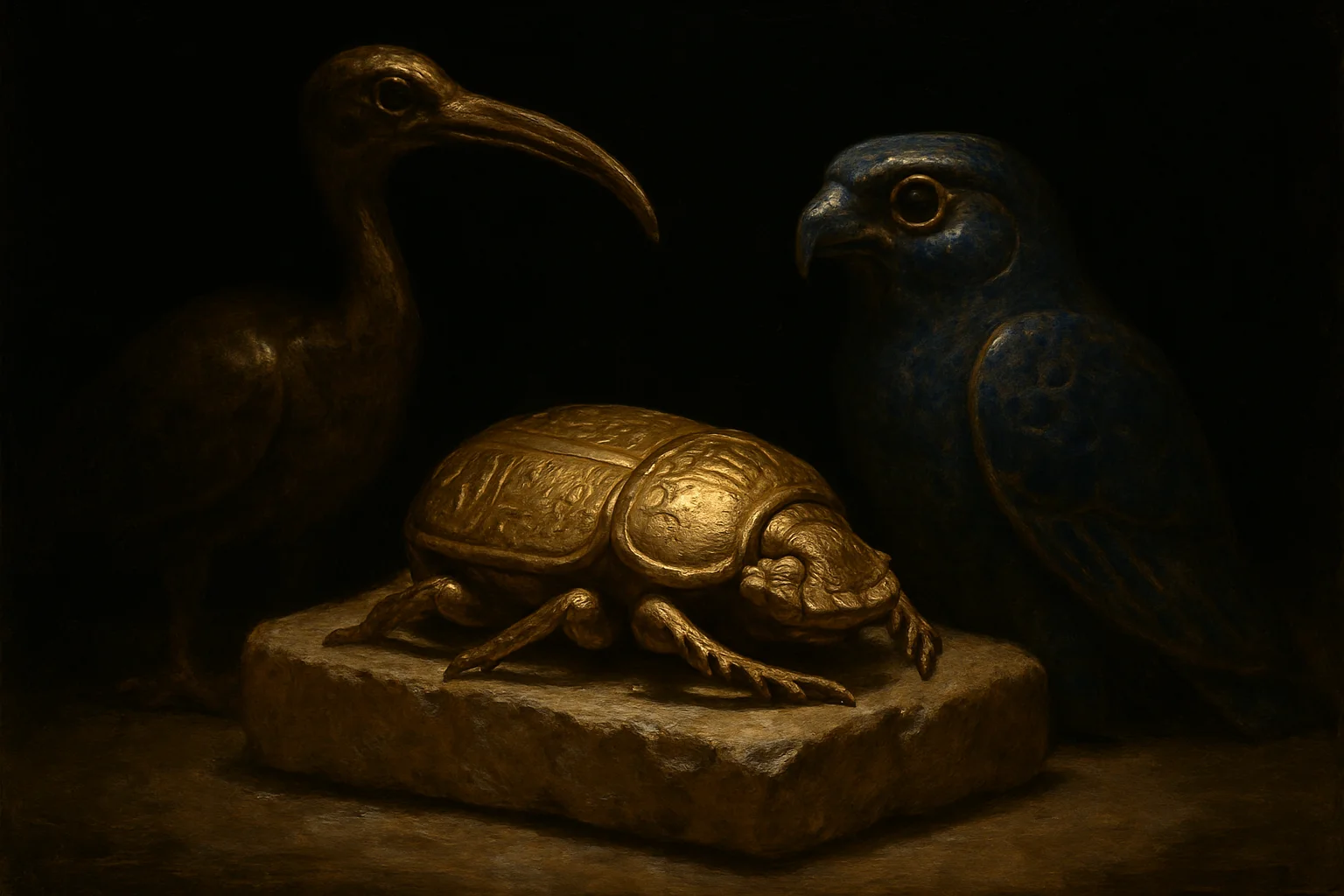
Theology and ecology overlapped. The flood brought life, and so did the creatures it sustained. Herons and ibises returned each inundation season, a visible sign of cosmic order restored. When a species appeared or disappeared in rhythm with the agricultural calendar, it became easy to see divine intention. The scarab beetle rolling dung across the sand mirrored the sun's journey across the sky, and so the beetle became Khepri, the morning aspect of Ra.
Not every animal was sacred. Most were food or tools. But certain species, by behavior or habitat, became vessels for divine presence. The line between the two categories was stable across centuries and well understood by those who worked the land.
Domesticated animals: cattle, sheep, goats, pigs, and geese
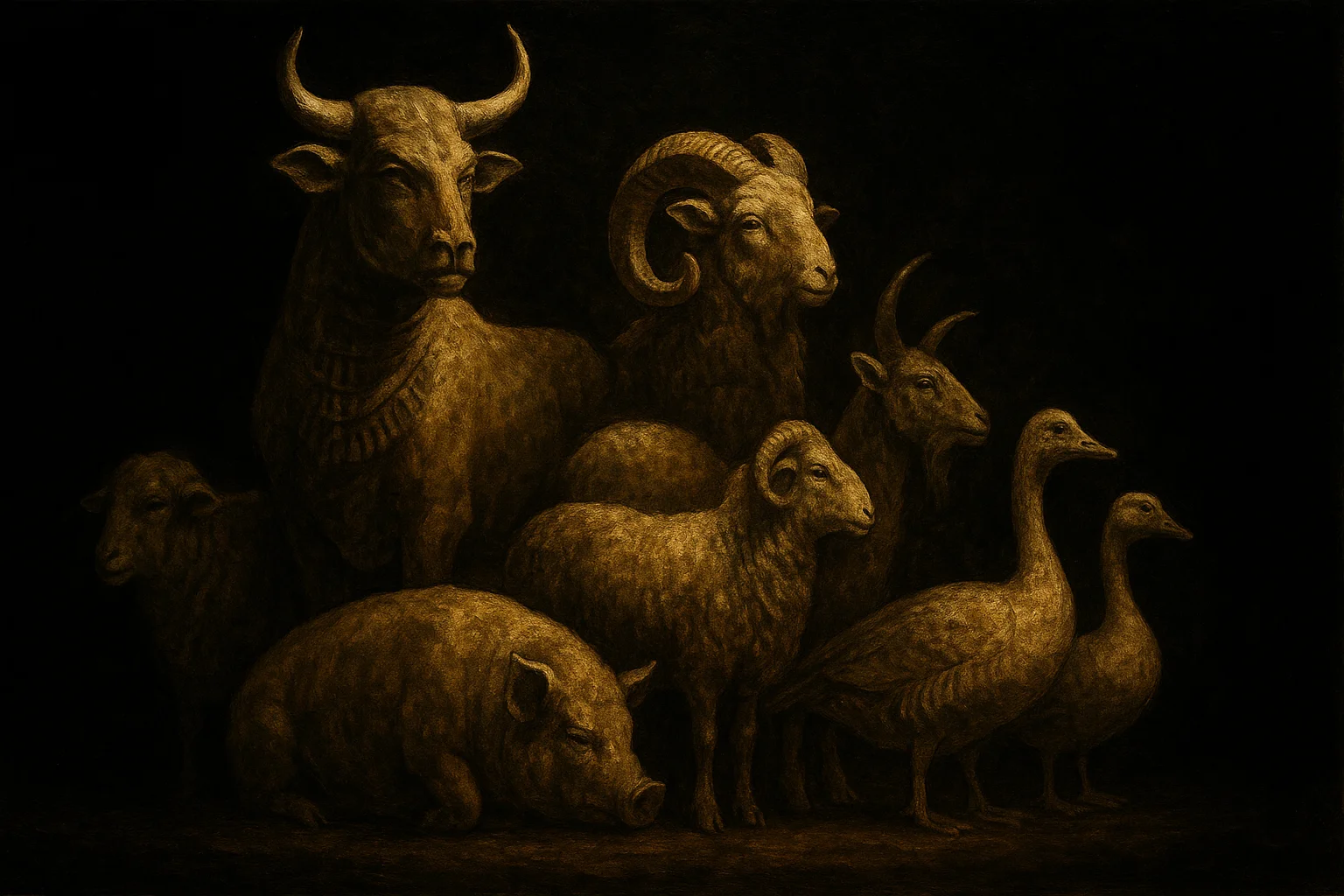
Domesticated herds formed the backbone of Egyptian wealth. Tomb paintings from the Old Kingdom onward show scribes counting cattle, butchers slaughtering oxen, and shepherds driving flocks to pasture. Sheep and goats provided wool, milk, and meat. Geese were force-fed for temple banquets and funerary feasts. The animals were economic units first, though some species carried secondary religious significance.
Cattle and the goddess Hathor
Hathor, mistress of joy and fertility, took the form of a cow or appeared with bovine ears and horns. Her cult centered at Dendera, where temple reliefs show her nursing the pharaoh. Live cows were kept in temple precincts as her avatars, fed offerings of grain and beer. The Pyramid Texts describe the king drinking milk from Hathor's udder to gain divine sustenance. Cattle were slaughtered for meat, but certain cows, marked by specific coloring or chosen by priests, lived out their lives as sacred animals and received burial rites upon death.
Bulls also carried divine associations. The Apis bull at Memphis, identified by precise markings, was considered the living soul of Ptah. When an Apis died, the entire country mourned, and the carcass was mummified and interred in the Serapeum at Saqqara. Herodotus describes the selection process in Histories 2.38, noting the calf had to be black with a white triangle on its forehead and other specific marks.
Pigs: useful but ritually suspect
Pigs occupied an odd position. Farmers raised them for meat, and archaeological evidence from workers' villages confirms pork consumption. Yet pigs rarely appear in tomb art, and temple personnel avoided them. Herodotus claims Egyptians considered pigs unclean and that swineherds formed a separate caste forbidden to enter temples. Plutarch, in On Isis and Osiris 8, suggests the taboo stemmed from the pig's association with Seth, who took boar form in some myths.
The reality was more textured. Pigs thrived in Delta marshes and required little care, making them valuable to poorer households. The priestly class, however, maintained strict purity codes, and pork fell outside acceptable temple fare. The animal was economically useful and ritually marginal, a distinction that held across Egyptian history.
The cat: from mouser to Bastet's avatar
Cats entered Egyptian households as pest control. Granaries attracted rodents, and cats solved the problem. Early evidence comes from Middle Kingdom tomb paintings showing cats beneath chairs or hunting birds in marshes. By the New Kingdom, the cat had become a common pet, and by the Late Period it was inseparable from the goddess Bastet.
Bastet's cult centered at Bubastis in the Delta. Originally a lioness goddess of war, she softened over time into a protector of the home, depicted with a cat's head or as a seated cat. Herodotus describes her festival as the most popular in Egypt, drawing hundreds of thousands of pilgrims who arrived by boat, singing and drinking. The temple at Bubastis maintained a cattery, and pilgrims purchased mummified kittens as votive offerings.
Killing a cat, even accidentally, carried severe penalties. Diodorus Siculus recounts in Bibliotheca historica 1.83 that a Roman soldier who killed a cat in Alexandria was lynched by a mob, despite diplomatic efforts to save him. The story may be exaggerated, but it reflects the intensity of local sentiment. Cats were buried with care; the necropolis at Bubastis alone has yielded tens of thousands of cat mummies.
Sacred species and their divine patrons
Certain animals were not merely associated with gods but understood as living manifestations. Temples kept these creatures in pools, aviaries, or enclosures, where they received daily offerings and ritual care. The species chosen reflected the god's domain: waterbirds for lunar deities, predators for solar ones, creatures of the liminal spaces for gods who mediated between worlds.
The ibis and Thoth
Thoth, god of writing, measurement, and the moon, appeared as an ibis or a baboon. The ibis, with its curved beak and methodical feeding habits, suggested precision and patience. Thoth's cult center at Hermopolis maintained flocks of sacred ibises, and when they died, priests mummified them and placed them in underground galleries. The Saqqara animal necropolis contains an estimated four million ibis mummies, stacked in ceramic jars and niches carved into bedrock.
Pilgrims purchased these mummies as offerings, a practice that turned animal mummification into a major temple industry. Inscriptions on jar labels record the donor's name and prayer, treating the mummified bird as an intermediary between human and divine.
Crocodiles and Sobek
Sobek, the crocodile god, ruled the marshes and riverbanks where crocodiles basked. His temples at Kom Ombo and Crocodilopolis kept live crocodiles in sacred pools, fed on roasted meat and honey cakes. Strabo describes priests adorning a crocodile with gold earrings and bracelets, a practice that sounds absurd until one considers the animal as a living statue, a body the god could inhabit.
Crocodiles were dangerous, and Sobek's worship acknowledged that danger. Fishermen and farmers who worked near crocodile-infested waters sought his favor. When a sacred crocodile died, it received full funerary practices: evisceration, natron treatment, linen wrapping, and burial in a dedicated cemetery. Thousands of crocodile mummies have been recovered from sites across Egypt.
Falcons and Horus
Horus, the sky god and divine prototype of kingship, took falcon form. His eyes were the sun and moon; his wings spanned the heavens. Temples across Egypt kept sacred falcons, and the Eye of Horus became one of the most widespread protective symbols. Falcon mummies, like those of ibises, were produced in industrial quantities. The necropolis at Saqqara holds hundreds of thousands.
The Book of the Dead, Spell 77, allows the deceased to transform into a falcon, gaining the speed and vision to navigate the afterlife. The identification between king and falcon was so complete that the pharaoh's Horus name, one of his five official titles, placed him directly in the god's lineage.
The scarab beetle
The scarab, though not kept in temples like ibises or crocodiles, carried profound symbolic weight. Khepri, the god of sunrise and transformation, appeared as a scarab pushing the sun disk across the sky, just as the beetle rolled dung balls across the sand. The insect's life cycle, emerging from the ball as if from nothing, suggested self-creation and rebirth.
Scarab amulets were ubiquitous, carved from stone and placed over the heart of the mummified dead. The Pyramid Texts, Utterance 273, describe the deceased as a scarab, reborn each morning. The beetle was not worshipped in the sense of receiving offerings, but it functioned as a living hieroglyph, a piece of the natural world that encoded theological truth.
Sacred animals in Egypt
Specific species chosen for observable traits, kept in temple precincts, mummified upon death, and treated as divine avatars requiring daily care and offerings from priests.
Totemic animals in other cultures
Often clan or lineage symbols, representing descent or spiritual kinship, but not typically housed, fed, or mummified as individuals embodying a god's presence on earth.
Animal mummies: votive offerings and temple economies
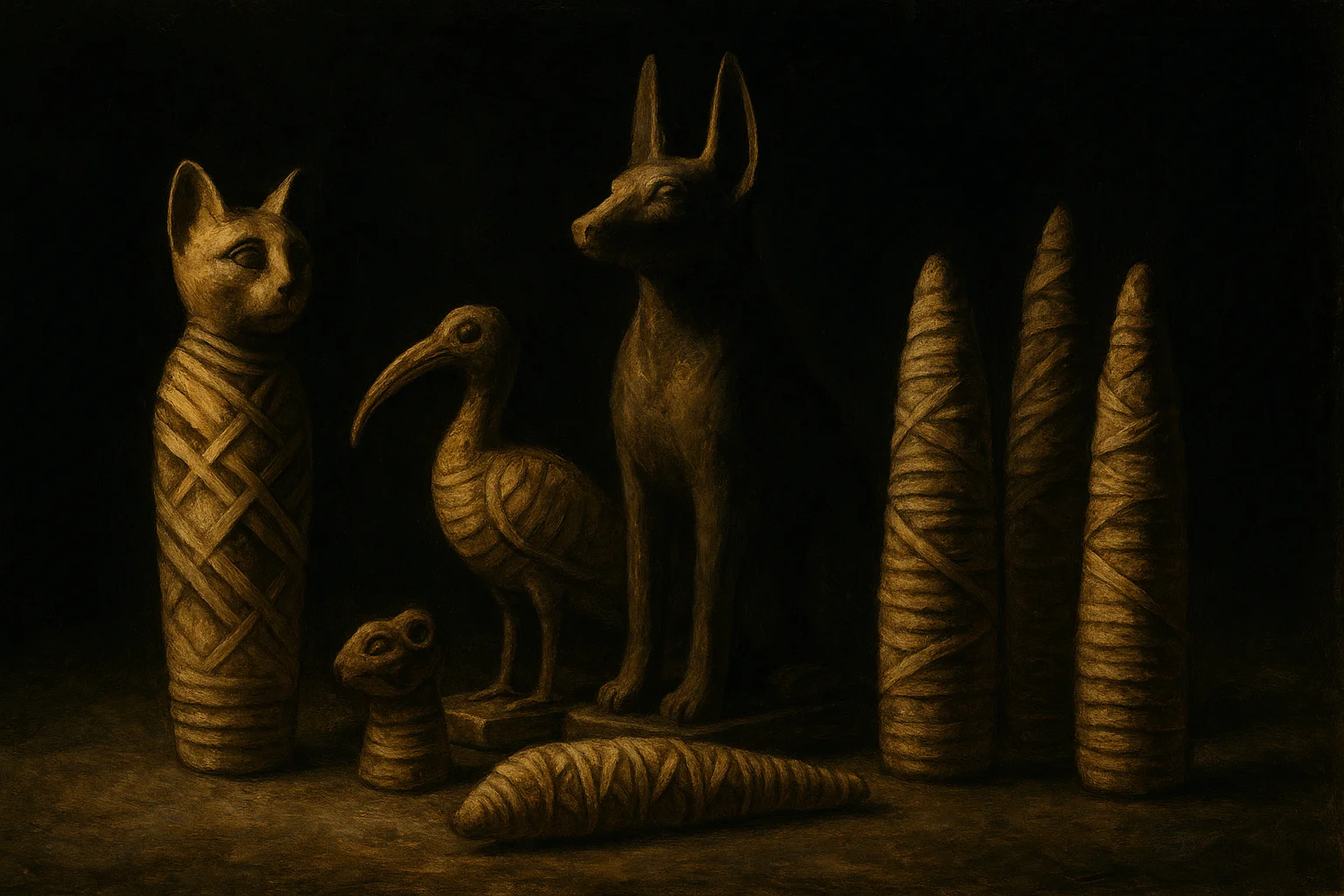
The scale of animal mummification in Egypt is staggering. Millions of birds, cats, dogs, crocodiles, snakes, and fish were preserved and interred, mostly during the Late and Ptolemaic periods. These were not pets. They were votive offerings, purchased by pilgrims who sought divine favor or wished to honor a god.
Temples operated breeding programs and mummification workshops. Priests raised ibises, hawks, and cats specifically for this purpose. When a pilgrim arrived, they bought a mummy, often pre-made, and deposited it in a temple gallery or necropolis. The animal served as a messenger, carrying the pilgrim's prayer to the god. The system generated enormous revenue for temples, which controlled both the supply of animals and the infrastructure for their preservation.
Not all mummies were created equal. High-quality examples show careful evisceration, resin treatment, and linen wrapping. Cheaper versions contain scraps of bone or are simply shaped bundles of reeds and feathers. The industry adapted to different price points, much like any other market.
"They mourn for them and bury them in sacred tombs, embalming them with cedar oil and such spices as have the quality of imparting a pleasant odor and of preserving the body for a long time." Diodorus Siculus, Bibliotheca historica 1.83
Wild animals: hunted, feared, and symbolically charged
Wild animals occupied the desert and the margins of the cultivated land. They were not domesticated, rarely kept in temples, but they carried potent symbolic meaning. Lions, hippos, serpents, and crocodiles represented forces that had to be controlled or appeased. Hunting scenes in tombs depict the deceased mastering chaos by killing dangerous game, a metaphor for the pharaoh's role in maintaining cosmic order.
Hippopotami and chaos
Hippos were common in the Nile until the New Kingdom and remained a symbol of danger and disorder. The goddess Taweret, protector of childbirth, took hippo form, but male hippos were linked to Seth, the god of storms and violence. Tomb reliefs show kings harpooning hippos, a ritual act that symbolized the defeat of chaos.
By the Late Period, hippos had largely disappeared from Lower Egypt, hunted to local extinction. Their symbolic role persisted in art and myth, even as the living animal vanished.
Lions and royal power
Lions roamed the desert fringes and were hunted by pharaohs as proof of martial prowess. The Sphinx at Giza, with its lion body and human head, embodied the fusion of animal strength and divine kingship. Sekhmet, the lioness goddess, represented solar fury and plague, her wrath capable of annihilating humanity until appeased with beer dyed red to resemble blood.
Lions were not kept as sacred animals in the manner of ibises or crocodiles, but they appeared frequently in royal iconography. The pharaoh's throne often featured lion legs and armrests, and lion hunts were recorded in temple inscriptions as acts of cosmic significance.
What Herodotus got right and wrong
Herodotus visited Egypt in the fifth century BCE and devoted much of Book Two of his Histories to Egyptian customs, including animal worship. He describes the reverence for cats, the sacred crocodiles of Crocodilopolis, and the selection of the Apis bull. Some of his observations are accurate; others reflect misunderstanding or exaggeration.
He claims, for instance, that all Egyptians shave their heads when a cat dies and that killing any sacred animal results in death. The first is unlikely; the second conflates local practice with universal law. He also reports that Egyptians worship all animals, which is false. Most animals were food or labor, and only specific species within certain temple contexts received veneration.
Where Herodotus excels is in capturing the intensity of Egyptian religious life. His account of the Bastet festival at Bubastis, with its crowds, music, and wine, matches archaeological evidence of large-scale pilgrimage. His description of animal mummies, though he misunderstands their function, confirms that the practice was already widespread in his time.
Plutarch, writing five centuries later in On Isis and Osiris, offers a more philosophical interpretation, suggesting Egyptians saw animals as symbols rather than gods themselves. This is closer to the theological reality, though it smooths over the lived experience of priests feeding sacred crocodiles or pilgrims purchasing mummified hawks.
- Herodotus accurately describes the Apis bull's markings and selection process
- He exaggerates the penalties for killing sacred animals
- His account of cat veneration matches archaeological findings
- He misses the economic dimension of animal mummification
- His observations on crocodile worship align with temple inscriptions
Frequently asked questions
Which animals were considered sacred in ancient Egypt?
Ibises, falcons, crocodiles, cats, and certain cattle were considered sacred in ancient Egypt, each associated with specific gods such as Thoth, Horus, Sobek, Bastet, and Hathor, and kept in temple precincts where they received daily offerings and were mummified upon death. Not all members of these species were sacred; only those selected by priests or marked by specific traits were treated as divine avatars. The scarab beetle, though not housed in temples, held profound symbolic importance as a manifestation of Khepri, the god of transformation and sunrise.
Why did Egyptians mummify animals?
Egyptians mummified animals primarily as votive offerings, purchased by pilgrims who deposited them in temple necropolises to honor gods or request divine favor, turning animal preservation into a major temple industry during the Late and Ptolemaic periods. Millions of ibises, cats, hawks, and other creatures were bred, mummified, and sold to worshippers, with temples operating workshops and breeding programs to meet demand. A smaller number of animals, such as sacred Apis bulls or temple crocodiles, were mummified because they were considered living embodiments of gods and received full funerary rites upon death.
What role did cats play in Egyptian religion?
Cats served initially as pest control in granaries and homes, protecting grain stores from rodents, but by the Late Period they became inseparable from the goddess Bastet, who evolved from a lioness war deity into a protector of the home and was worshipped at Bubastis in the Delta. Pilgrims purchased mummified cats as votive offerings, and killing a cat, even accidentally, could provoke severe punishment, as recorded by Diodorus Siculus. Cats were buried in dedicated cemeteries, with tens of thousands of mummies recovered from sites like Bubastis and Saqqara, reflecting both religious devotion and a profitable temple economy.
Were all animals in Egypt worshipped or only certain species?
Only certain species were worshipped in ancient Egypt, and even within those species, only specific individuals selected by priests or marked by particular traits were treated as sacred, while the vast majority of animals served as food, labor, or raw materials in the agricultural economy. Cattle, sheep, goats, pigs, and geese were raised for meat, milk, leather, and work, with no religious veneration attached to most individuals. The distinction between sacred and mundane was stable and well understood: a farmer could slaughter a cow for meat while priests at Dendera fed offerings to a sacred cow considered Hathor's living avatar.
How did domesticated animals support the Egyptian economy?
Domesticated animals formed the backbone of the Egyptian economy, with cattle pulling plows through Nile silt, donkeys hauling grain to royal granaries, and sheep and goats providing wool, milk, meat, and leather for sandals, chariots, and tools. Temple estates maintained vast herds, with inscriptions such as the Stela of Intef II recording donations of thousands of cattle to major temples like Karnak. Geese were force-fed for temple banquets and funerary feasts, while pigs, though ritually marginal, thrived in Delta marshes and provided affordable protein for poorer households, making them economically valuable despite priestly avoidance.
What did Herodotus say about Egyptian animal worship?
Herodotus, writing in the fifth century BCE, described Egyptians as uniquely devoted to animals, detailing the sacred Apis bull's selection by specific markings, the reverence for cats that led households to mourn their deaths, and the feeding of sacred crocodiles with roasted meat at Crocodilopolis, though he exaggerated some practices and misunderstood the economic function of animal mummification. His account of the Bastet festival at Bubastis, with hundreds of thousands of pilgrims arriving by boat, matches archaeological evidence of large-scale religious pilgrimage. While he sometimes conflated local custom with universal law and missed the distinction between sacred individuals and ordinary animals, his observations on the intensity of Egyptian religious life and the prevalence of animal mummies remain valuable primary sources.
Further reading on Mythologis
Free 25-page sample
Want the whole story?
Take the first 25 pages free. If it pulls you in, the full edition is yours as an instant PDF download, with a paperback on Amazon for selected titles.
Egyptian
The Egyptian Mythology Book: Ra, Osiris, Isis, Anubis, and the Sacred Stories of the Pharaohs
Ra, Osiris, Isis, Anubis, and the Sacred Stories of the Pharaohs
Three thousand years of Egyptian sacred stories. The Duat, the weighing of the heart, the cult of Osiris, and the daily voyage of the sun.
More from Egyptian
All articles
Egyptian
The Book of the Dead: Egypt's Guide to Eternity
Ancient Egypt's most sacred funerary text was not a single book but a living archive of spells, maps, and prayers that guided the dead through the perils between death and eternal life.
Egyptian
Eye of Horus: The Protective Amulet That Watched Over the Living and the Dead
Worn by pharaohs and fishermen alike, the Eye of Horus is one of antiquity's most potent protective symbols, carrying the weight of cosmic battle, divine healing, and eternal vigilance.
Egyptian
Ra the Sun God: Egypt's Supreme Ruler of Light and Creation
Ra, the ancient Egyptian sun god, blazed at the very heart of a civilization that worshipped light as the pulse of creation itself. Discover his origins, his many forms, and the sacred journey he took across the sky and through the underworld every single day.
Egyptian
The Ankh: Egypt's Eternal Symbol of Life
The ankh is ancient Egypt's most recognizable hieroglyph, a looped cross carried by gods and pharaohs alike as the very key to immortal life. Discover its origins, meanings, and sacred legacy.