
Ten Egyptian Mythology Stories from Primary Sources
Ten Egyptian myths drawn from temple walls, papyri, and coffin texts. Creation, murder, resurrection, and the daily journey of the sun.
Contents
The most important Egyptian mythology stories survive in temple inscriptions, funerary papyri, and royal tomb walls dating from the Old Kingdom through the Ptolemaic period. These narratives include the Heliopolitan creation, the murder and resurrection of Osiris, the contendings of Horus and Set, Ra's nightly voyage through the underworld, and several tales preserved on Middle and New Kingdom papyri that reveal how Egyptian gods interacted with mortals and one another.
Unlike Greek or Norse mythology, which come to us through continuous literary traditions, Egyptian myths exist as fragments scattered across three millennia of ritual texts, royal propaganda, and magical formulae. The stories below are drawn from primary sources, with attention to where the evidence sits and where it thins.
Why Egyptian myths survive in fragments
Egyptian religion had no canonical scripture. Myths appear embedded in ritual contexts: hymns carved on temple pylons, spells painted inside coffins, incantations recited during mummification. The Pyramid Texts, inscribed in Fifth and Sixth Dynasty royal tombs at Saqqara, are the oldest religious writings in the world. They contain allusions to myths but rarely tell a story start to finish.
The Coffin Texts of the Middle Kingdom and the Book of the Dead from the New Kingdom expand on these themes, but they remain spell collections, not narrative literature. A few literary papyri preserve complete tales. Most come from the Ramesside period, when scribes at Deir el-Medina copied stories for training or entertainment.
Regional variation matters. Heliopolis, Memphis, Hermopolis, and Thebes each developed distinct cosmogonies. Priests did not see these as contradictory. They were complementary lenses on the same divine reality.
1. The creation of the world at Heliopolis
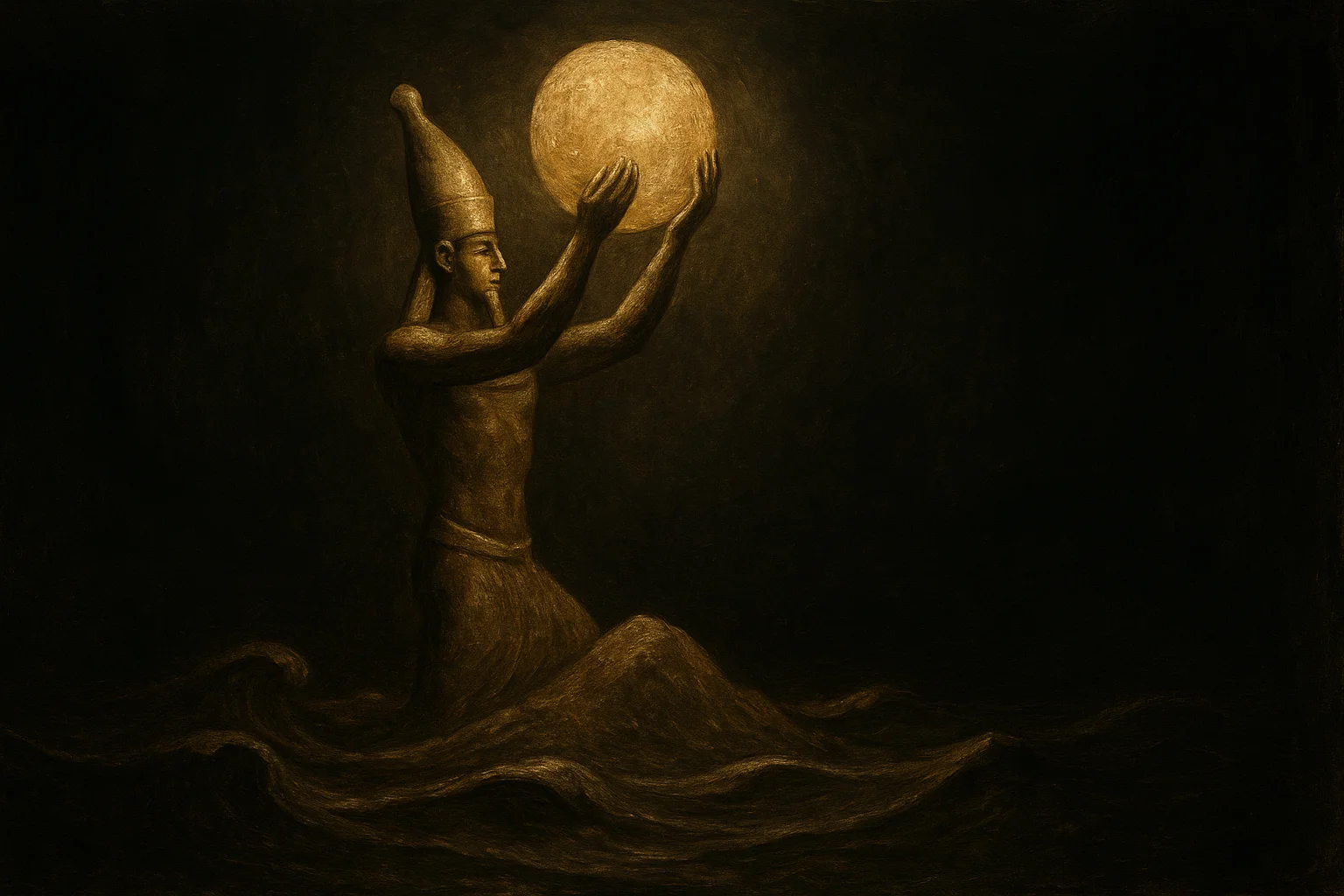
The Heliopolitan cosmogony, attested in the Pyramid Texts and later summarized in the Papyrus Bremner-Rhind, begins with Atum emerging from the primordial waters of Nun. Atum stands on the benben, the first mound of earth, and through an act of self-generation produces Shu, god of air, and Tefnut, goddess of moisture. Shu and Tefnut beget Geb, the earth, and Nut, the sky. Geb and Nut produce Osiris, Isis, Set, and Nephthys.
This sequence, known as the Ennead, establishes the divine genealogy that underpins kingship. The king is the living Horus, son of Osiris, descendant of Atum. Creation is not a single event but a daily renewal: each dawn, Ra-Atum rises from the waters of chaos and remakes the world.
The Memphite Theology, preserved on the Shabaka Stone, offers a rival account in which Ptah creates through thought and speech, a concept that influenced later theological speculation. Hermopolis posits an Ogdoad of eight primordial deities. These are not competing myths but regional theologies, each anchored to a cult center's political and economic power.
2. The murder and resurrection of Osiris
No single Egyptian text narrates the Osiris myth in full. The story must be reconstructed from allusions in the Pyramid Texts, the Coffin Texts, and Plutarch's De Iside et Osiride, written in Greek in the first century CE. Osiris, the good king, is murdered by his brother Set. The method varies: drowning, dismemberment, sealing in a coffin. Isis retrieves the body, and in some versions Set scatters the pieces across Egypt.
Isis reassembles Osiris with the help of Nephthys and Anubis. She uses magic to revive him long enough to conceive Horus. Osiris then descends to rule the Duat, the underworld, as judge of the dead. This myth anchors the Egyptian understanding of kingship and the afterlife: the dead king becomes Osiris, the living king becomes Horus.
The tale is central to funerary texts and the rituals of dying-and-rising gods studied comparatively across Mediterranean and Near Eastern traditions. Osiris does not return to the living world. His resurrection is a passage to another form of existence, not a reversal of death.
3. The contendings of Horus and Set
Papyrus Chester Beatty I, dating to the Twentieth Dynasty, preserves a full narrative of the legal contest between Horus and Set for the throne of Egypt. The gods convene a tribunal. Set argues that he is stronger and more experienced. Horus claims the throne as rightful heir to Osiris.
The story unfolds as a series of contests and tricks. Set and Horus transform into hippos and fight underwater. They race in stone boats. Set attempts to sexually dominate Horus to humiliate him; Horus turns the trick back on Set with Isis's help. The tone is bawdy and comic, far from the solemn theology of temple walls.
Eventually Ra and the Ennead rule in favor of Horus. Set is assigned dominion over storms and foreign lands. The myth legitimizes the king's rule and explains the persistence of chaos: Set is not destroyed but contained. The Eye of Horus, torn out during the fight and restored by Thoth, becomes a symbol of healing and completeness.
"Horus and Set were brought before the tribunal, and the Ennead said to Horus and Set: 'Speak concerning yourselves.' Then Set, great of strength, son of Nut, said: 'As for me, I am Set, greatest of strength among the Ennead.'" Papyrus Chester Beatty I
4. Ra's nightly journey through the Duat
The solar theology of the New Kingdom imagines Ra traveling through the Duat in a barque each night, passing through twelve hours represented as caverns or regions. This journey is mapped in the Amduat, the Book of Gates, and the Book of Caverns, all painted on royal tomb walls. Each hour presents dangers: serpents, demons, the apophis serpent who tries to swallow the sun.
Ra is rejuvenated in the depths of the night and emerges at dawn reborn. The king, identified with Ra, undertakes the same journey after death. The texts provide spells and knowledge needed to navigate the dangers. This is not allegory. The Duat is a real place, and the journey is literal.
The Amduat in the tomb of Thutmose III is the earliest complete version. Later kings elaborated the cycle. The journey structures temple ritual: priests reenact the solar voyage daily, ensuring cosmic order. The concept of underworld journeys appears across cultures, but Egypt's version is uniquely tied to the mechanics of kingship and the solar calendar.
5. The destruction of mankind
Inscribed on the walls of the tomb of Seti I and later royal tombs, the Destruction of Mankind tells of Ra's decision to punish humanity for plotting against him. He sends his Eye of Ra, manifested as the goddess Sekhmet or Hathor, to slaughter the rebels. She becomes drunk on bloodlust and threatens to exterminate the human race.
Ra relents. He orders beer mixed with red ochre to resemble blood and floods the fields with it. Sekhmet drinks, becomes intoxicated, and ceases the slaughter. Humanity survives, but Ra withdraws from the earth, ascending to the sky on the back of the celestial cow Nut. This marks the separation of gods and mortals.
The myth explains the distance between divine and human realms and the necessity of ritual to maintain ma'at, cosmic order. It also accounts for the dual nature of certain goddesses, who can be both nurturing and destructive. The story circulated widely in the Ramesside period and appears in multiple royal tombs with minor variations.
Destruction of Mankind
Ra punishes humanity but ultimately relents, preserving the human race while withdrawing to the heavens. The myth explains divine distance and the need for ritual mediation.
Greek Flood Myth
Zeus floods the earth to destroy the Bronze Age race, sparing only Deucalion and Pyrrha. Humanity is renewed through their offspring, but the gods remain present on Olympus.
6. Isis and the secret name of Ra
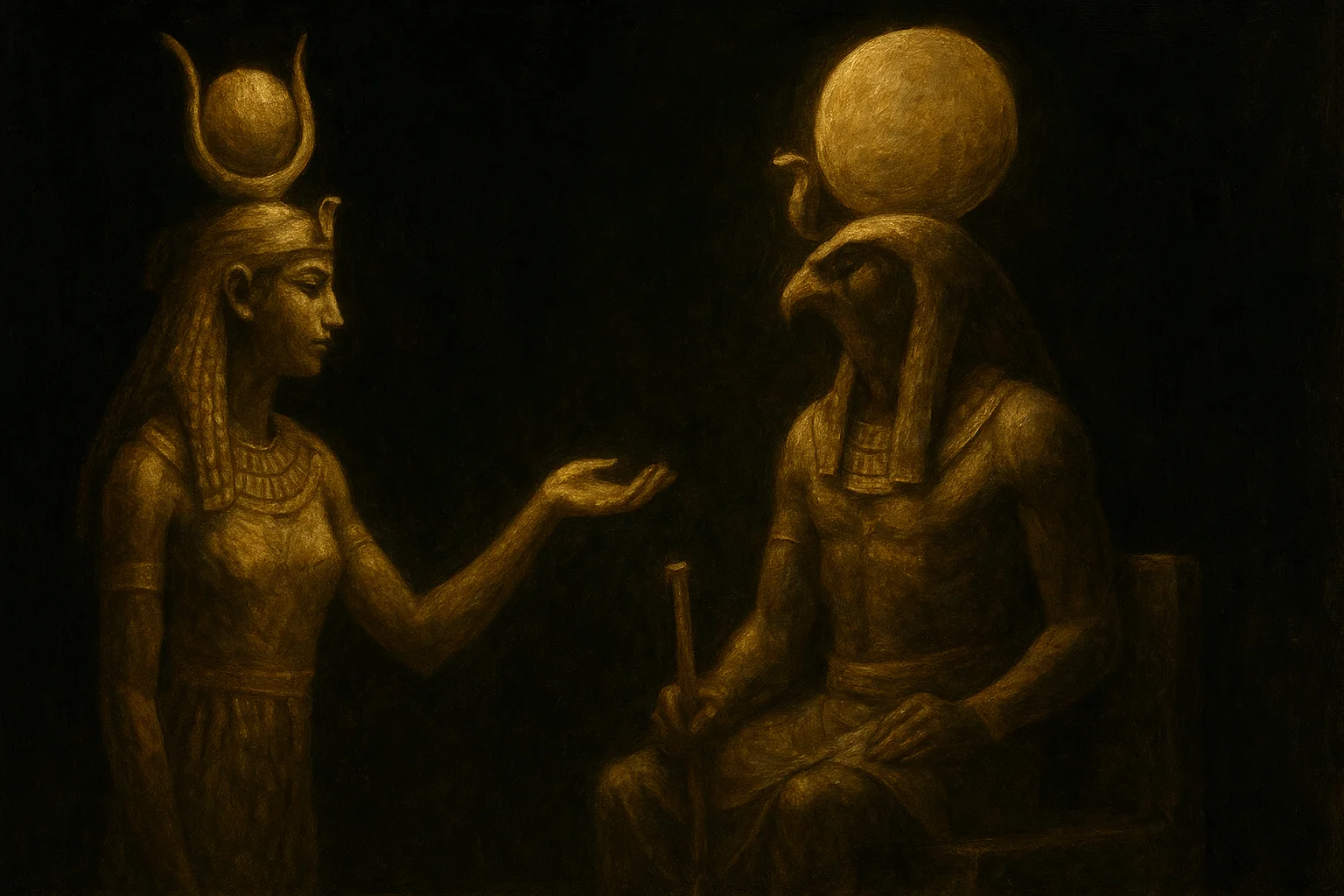
Papyrus Turin 1993 preserves a spell in which Isis seeks to gain power over Ra by learning his secret name, the source of his creative authority. She fashions a serpent from Ra's spittle and earth, which bites him. Ra suffers unbearable pain and calls on the gods for help. Isis offers to heal him if he reveals his true name.
Ra recites a list of epithets and titles, but Isis is not fooled. Finally, in desperation, he whispers his secret name into her ear. Isis uses this knowledge to heal him and gains magical supremacy. The myth was recited as a spell to cure snakebite, with the patient identified as Ra and the healer as Isis.
The story reveals the Egyptian understanding of names as vessels of power. To know a god's true name is to command that god. The myth also positions Isis as the archetypal magician, a role that persists into Greco-Roman religion and early Christian demonology.
7. The birth of the royal ka
Papyrus Westcar, a Middle Kingdom text, contains a cycle of tales told at the court of Khufu. The final story describes the birth of the first three kings of the Fifth Dynasty, triplets born to the wife of a priest of Ra. The god Ra himself fathers the children, and the goddesses Isis, Nephthys, Meskhenet, and Heket attend the birth disguised as musicians.
Each child is born with signs of kingship: a body of gold, hair of lapis lazuli. The goddesses prophesy that the boys will rule Egypt and build temples to Ra. The tale legitimizes the Fifth Dynasty's claim to the throne and establishes the doctrine of divine kingship: the king is the son of Ra, born with a royal ka, the divine life force.
This myth influenced later royal birth narratives, including those of Hatshepsut and Amenhotep III, carved on temple walls at Deir el-Bahari and Luxor. The motif of divine conception appears across Mediterranean cultures but is uniquely formalized in Egyptian royal ideology.
8. The shipwrecked sailor and the serpent lord
Papyrus Leningrad 1115, from the Middle Kingdom, tells the story of a sailor shipwrecked on a mysterious island. He encounters a giant serpent covered in gold and lapis lazuli, who rules the island as its sole inhabitant. The serpent listens to the sailor's tale of disaster and reassures him that he will be rescued and return home.
The serpent reveals that he once lived on the island with his family, seventy-five serpents in all, until a falling star destroyed them. He alone survived. When a ship arrives to rescue the sailor, the island vanishes. The sailor returns to Egypt with gifts from the serpent and tells his story to the king.
Scholars debate the tale's meaning. Some read it as a parable of survival and divine providence. Others see it as a frame narrative exploring the nature of storytelling itself. The serpent's island may represent the primordial mound of creation, a place outside ordinary time. The text is one of the few Egyptian literary works that approaches pure narrative fiction.
9. The blinding of Truth by Falsehood
Papyrus Chester Beatty II preserves a fragmentary tale in which two brothers, personifications of Truth and Falsehood, appear before a divine tribunal. Falsehood accuses Truth of losing a magical knife and demands that Truth's eyes be put out as compensation. The gods rule in favor of Falsehood, and Truth is blinded and made Falsehood's doorkeeper.
A woman sees the blind Truth and bears his son. The boy grows up strong and clever. When he learns his father's story, he brings Falsehood before the gods and tricks him into admitting his crime. Truth is vindicated, his sight restored, and Falsehood is punished.
The tale functions as a moral fable about justice delayed but ultimately fulfilled. It also reflects the Egyptian legal system's reliance on testimony and the dangers of false witness. The personification of abstract concepts as characters is rare in Egyptian literature, more common in Mesopotamian and later Greek traditions.
10. The taking of Joppa
Papyrus Harris 500 contains a fragmentary story set during the reign of Thutmose III. The general Djehuty besieges the Canaanite city of Joppa but cannot take it by force. He invites the prince of Joppa to a banquet, gets him drunk, and knocks him unconscious. Djehuty then hides two hundred soldiers in large baskets, which he sends into the city as tribute.
The soldiers emerge at night, open the gates, and the Egyptian army captures Joppa. The story echoes the Trojan Horse and may reflect a common Near Eastern narrative motif. It is one of the few Egyptian tales set in a historical military context, though the details are clearly legendary.
The text is incomplete, and the ending is lost. What survives shows how Egyptians adapted foreign narrative traditions and integrated them into their own literary corpus during the New Kingdom, when Egypt's empire extended deep into the Levant.
What these stories tell us about Egyptian religion
These ten narratives, drawn from temple walls, coffins, and papyri, reveal a religion grounded in ritual action rather than dogma. Egyptian myths are tools: they explain the origin of kingship, justify temple offerings, provide spells for protection, and map the geography of the afterlife. They are not scripture to be believed but knowledge to be used.
The gods are not distant. They intervene, quarrel, suffer, and scheme. They are immanent in the landscape, the Nile, the sun, the king's body. Myth and ritual are inseparable. To recite the words of Isis over a snakebite is to reenact her healing of Ra. To paint the Amduat on a tomb wall is to provide the king with a map.
Regional variation persists throughout Egyptian history. No central authority standardized the myths. Priests at Heliopolis, Memphis, and Thebes developed competing cosmogonies without conflict. This theological flexibility allowed Egyptian religion to absorb foreign gods and adapt to political change, surviving from the Early Dynastic period through the Ptolemaic era, a span of three thousand years.
The stories also show us what mattered to the Egyptians: order over chaos, the continuity of kingship, the mechanics of the afterlife, the power of words and names. Even the literary tales on papyrus, which seem to exist for entertainment, carry moral and theological weight. Truth triumphs, the gods reward the faithful, and Egypt endures.
Understanding these myths requires attention to their original contexts. A spell in the Book of the Dead is not a story but an incantation. A hymn on a temple wall is not theology but liturgy. The narratives are embedded in a ritual matrix, and to extract them is to change their meaning. The best we can do is read them in their fragments, cite the sources, and resist the urge to smooth them into a coherent mythology they never claimed to be.
For those interested in the broader framework of Egyptian religious life, the articles on Egyptian symbols and the radical theological shift under Akhenaten's religious revolution provide essential context. Comparative approaches, such as creation myths across cultures, help situate Egyptian cosmogonies within the wider ancient Near Eastern world.
Frequently asked questions
What is the most important Egyptian myth?
The Osiris myth, reconstructed from allusions in the Pyramid Texts, Coffin Texts, and Plutarch's later account, is the most important Egyptian myth because it explains the origin of kingship, the structure of the afterlife, and the rituals of mummification. Osiris, murdered by Set and resurrected by Isis, becomes lord of the Duat, while his son Horus claims the throne of the living. Every dead king becomes Osiris, every living king becomes Horus, making the myth the theological foundation of Egyptian monarchy for three millennia.
Where are Egyptian myths written down?
Egyptian myths appear in temple inscriptions, royal tomb walls, coffin interiors, and papyri, but not as continuous narratives. The Pyramid Texts in Fifth and Sixth Dynasty tombs at Saqqara are the oldest, followed by the Middle Kingdom Coffin Texts and the New Kingdom Book of the Dead. Literary papyri such as Papyrus Westcar, Papyrus Chester Beatty I, and Papyrus Leningrad 1115 preserve complete tales, mostly from the Ramesside period.
How did the Egyptians explain the creation of the world?
The Heliopolitan creation account, attested in the Pyramid Texts and Papyrus Bremner-Rhind, describes the god Atum emerging from the primordial waters of Nun and creating the first gods through self-generation. Atum produces Shu and Tefnut, who beget Geb and Nut, who in turn produce Osiris, Isis, Set, and Nephthys. Rival cosmogonies from Memphis, Hermopolis, and Thebes offer different mechanisms, but all begin with a primordial mound rising from chaos and the first act of divine speech or thought.
What is the story of Ra's journey through the underworld?
Ra travels through the Duat each night in a solar barque, passing through twelve hours represented as caverns or regions filled with demons, serpents, and the chaos serpent Apophis. The journey is mapped in the Amduat, the Book of Gates, and the Book of Caverns, painted on New Kingdom royal tomb walls. Ra is rejuvenated in the depths of the night and emerges at dawn reborn, a cycle that structures temple ritual and the king's own passage through death.
Why are Egyptian myths fragmentary?
Egyptian myths survive in fragments because they were embedded in ritual contexts rather than composed as continuous literary narratives. Myths appear as allusions in hymns, spells, and incantations, not as epic poems or sacred texts. The Pyramid Texts, Coffin Texts, and Book of the Dead are spell collections, not story anthologies. Only a few Middle and New Kingdom papyri preserve complete tales, and even these often serve didactic or magical purposes rather than pure storytelling.
What role did Isis play in Egyptian mythology?
Isis is the archetypal magician and mourner in Egyptian mythology, central to the Osiris cycle as the wife who resurrects her murdered husband and protects their son Horus. In the myth of Ra's secret name, preserved in Papyrus Turin 1993, Isis gains magical supremacy by tricking Ra into revealing his true name. She appears in birth narratives, healing spells, and funerary texts as a protective goddess whose knowledge of magic surpasses even that of the creator gods.
Further reading on Mythologis
Free 25-page sample
Want the whole story?
Take the first 25 pages free. If it pulls you in, the full edition is yours as an instant PDF download, with a paperback on Amazon for selected titles.
Egyptian
The Egyptian Mythology Book: Ra, Osiris, Isis, Anubis, and the Sacred Stories of the Pharaohs
Ra, Osiris, Isis, Anubis, and the Sacred Stories of the Pharaohs
Three thousand years of Egyptian sacred stories. The Duat, the weighing of the heart, the cult of Osiris, and the daily voyage of the sun.
More from Egyptian
All articles
Egyptian
The Book of the Dead: Egypt's Guide to Eternity
Ancient Egypt's most sacred funerary text was not a single book but a living archive of spells, maps, and prayers that guided the dead through the perils between death and eternal life.
Egyptian
Eye of Horus: The Protective Amulet That Watched Over the Living and the Dead
Worn by pharaohs and fishermen alike, the Eye of Horus is one of antiquity's most potent protective symbols, carrying the weight of cosmic battle, divine healing, and eternal vigilance.
Egyptian
Ra the Sun God: Egypt's Supreme Ruler of Light and Creation
Ra, the ancient Egyptian sun god, blazed at the very heart of a civilization that worshipped light as the pulse of creation itself. Discover his origins, his many forms, and the sacred journey he took across the sky and through the underworld every single day.
Egyptian
The Ankh: Egypt's Eternal Symbol of Life
The ankh is ancient Egypt's most recognizable hieroglyph, a looped cross carried by gods and pharaohs alike as the very key to immortal life. Discover its origins, meanings, and sacred legacy.