
Egyptian Scarab: Solar Symbol and Sacred Amulet
The scarab beetle embodied Khepri, the self-created sun god. Explore its role in funerary practice, royal seals, and the theology of rebirth.
Contents
The Egyptian scarab is a beetle-shaped amulet and symbol representing the dung beetle Scarabaeus sacer, which ancient Egyptians associated with the sun god Khepri, the self-created deity who rolled the solar disc across the sky each morning. Scarab amulets served multiple functions: administrative seals in the Old and Middle Kingdoms, heart scarabs inscribed with Book of the Dead spells to protect the deceased during judgment, and winged pectorals placed on royal mummies. The beetle's observed behaviour, pushing a ball of dung across the sand, mirrored the sun's daily journey and became a central metaphor in funerary practices and solar theology.
Most museum labels treat the scarab as decorative or vaguely symbolic of rebirth. The reality is more precise. The scarab was theology made portable, a piece of solar doctrine you could hold in your hand or place over a heart. Its meaning evolved across two millennia, from bureaucratic stamp to funerary safeguard, but the core association with Khepri and the rising sun remained constant.
The Beetle and the God
The connection between beetle and deity rests on observation. Scarabaeus sacer, the species native to the Nile valley, rolls balls of dung backward across the ground, buries them, and lays eggs inside. To the Egyptians, the beetle appeared to generate itself from the earth, emerging fully formed from the buried sphere. This self-creation mirrored the daily rebirth of the sun.
Khepri: The Self-Created One
Khepri appears in the Pyramid Texts as early as the Fifth Dynasty. Utterance 217 addresses the deceased king: "You are the one who came into being in the waters of Nun, who emerged from the primeval mound." The god's name derives from the Egyptian verb kheper, meaning "to come into being" or "to transform." He is not merely a sun god but the principle of transformation itself, the force that moves the sun from darkness into light.
In the Coffin Texts, Spell 335 allows the deceased to transform into Khepri: "I am Khepri in the morning, Ra at noon, Atum in the evening." The three forms represent the sun's journey: creation at dawn, zenith at midday, completion at dusk. Khepri is always the beginning, the moment of emergence. He appears in art as a man with a scarab for a head, or as the beetle itself pushing the solar disc.
Observing Scarabaeus sacer
The beetle's behaviour made the metaphor legible. It rolls dung into a sphere, pushes it backward using its hind legs, and buries it in the sand. The Egyptians saw the sun rolled across the sky in the same manner. The beetle's young emerge from the buried ball weeks later, apparently self-generated. No parent is visible. The parallel to the sun rising from the underworld each morning was exact enough to anchor an entire theological concept.
This was not poetic fancy. The Egyptians catalogued animals in ancient Egypt with precision, and the scarab's life cycle was well understood. The symbol worked because the natural history supported it.
Solar Theology and the Cycle of Rebirth
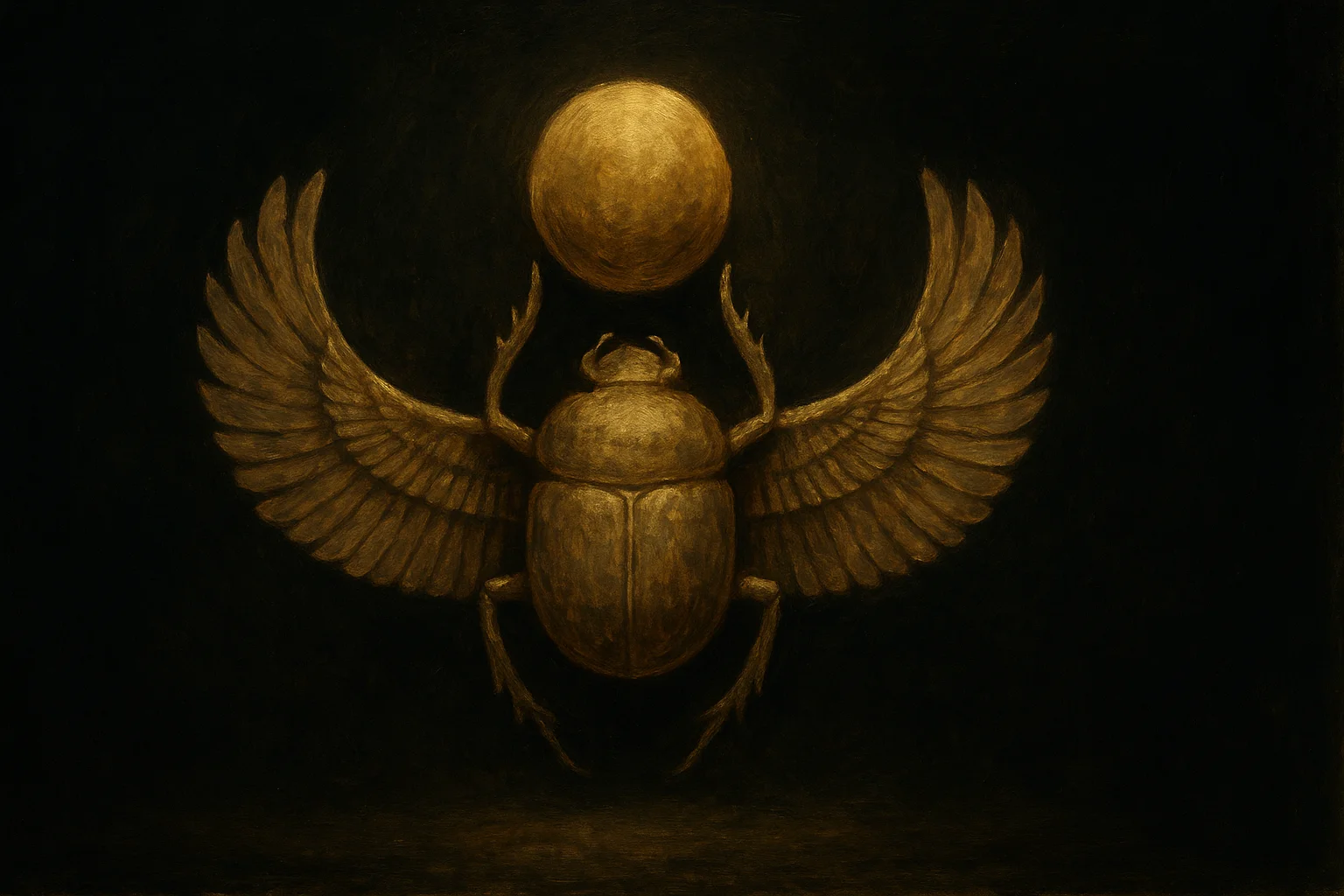
The scarab's role in solar theology extends beyond Khepri. The Amduat, a New Kingdom funerary text describing the sun's twelve-hour journey through the underworld, depicts the solar barque carrying the sun god through darkness. At the end of the twelfth hour, Khepri emerges from the serpent's coils, reborn. The scarab is the engine of that rebirth, the force that transforms death into dawn.
The Book of the Dead reinforces this. In the Papyrus of Ani, vignettes show the deceased adoring a scarab with outstretched wings. The accompanying text identifies the beetle as "the great god who comes into being of himself." The scarab is not a passive emblem but an active agent of transformation, the mechanism by which the dead become the living.
This theology intersects with broader Egyptian concerns about cyclical time. The sun dies each evening and is reborn each morning. The Nile floods and recedes. Pharaohs die and are succeeded. The scarab encapsulates the pattern: death is not an end but a transition, a burial from which new life emerges. The beetle made that abstract doctrine tangible.
Scarab Amulets: Form and Function
Scarab amulets appear in multiple forms, each with distinct purposes. The earliest examples date to the late Old Kingdom, around 2400 BCE. By the Middle Kingdom, production had become standardised. The New Kingdom saw the introduction of specialised types, particularly heart scarabs and winged pectorals.
Seal Scarabs and Administrative Use
The first scarabs were seals. The flat underside of the amulet bore carved designs: geometric patterns, hieroglyphic inscriptions, or the names of officials. Pressed into clay or wax, the scarab left an impression that authenticated documents and secured containers. This was bureaucratic technology, not primarily religious.
Seal scarabs circulated widely. They marked ownership, identified senders, and verified transactions. The beetle shape was practical: easy to grip, easy to roll. The religious symbolism was secondary at this stage, though the choice of form was not arbitrary. Even administrative tools carried solar associations.
Heart Scarabs and the Weighing of the Heart
Heart scarabs are larger, often measuring five to ten centimetres in length. They were placed on the chest of the mummy, over the heart, during mummification. The underside bore Spell 30B from the Book of the Dead, a formula instructing the heart not to testify against the deceased during judgment.
"O my heart of my mother, do not stand up as a witness against me, do not oppose me in the tribunal, do not be hostile to me in the presence of the Keeper of the Balance."
The spell addresses the heart directly, treating it as a potential betrayer. In Egyptian belief, the heart was the seat of thought and memory, the organ that knew every deed. During the Weighing of the Heart, the deceased's heart was placed on a scale opposite the feather of Ma'at, goddess of truth. If the heart was heavy with wrongdoing, the deceased would be devoured by Ammit. The heart scarab was insurance, a magical intervention to silence the heart's testimony.
The inscription on the heart scarab of Hatnefer, mother of Senenmut, architect under Hatshepsut, reads: "May my name endure in the House of Eternity, may my heart remain with me in the Hall of Judgment." The scarab was not decorative. It was a legal document for the afterlife.
Winged Scarabs and Royal Funerals
Winged scarabs appear on royal mummies from the 18th Dynasty onward. These pectorals, often made of gold and inlaid with semi-precious stones, depict the scarab with outstretched falcon wings. The most famous example comes from the tomb of Tutankhamun, where multiple winged scarabs were layered over the mummy's chest.
The wings identify the scarab with the sun's flight across the sky. The combination of beetle and bird merges two modes of solar movement: the rolling of the disc and the soaring of the celestial barque. These pectorals were exclusive to royalty and high officials, a mark of status as much as spiritual protection.
Inscriptions and Spells
The texts inscribed on scarabs vary by type and period. Seal scarabs bore names, titles, and occasionally royal cartouches. Heart scarabs carried Spell 30B almost without exception. Commemorative scarabs, issued by kings to mark events, bore longer narratives.
Amenhotep III issued a series of large commemorative scarabs recording his marriage to Queen Tiye, his lion hunts, and the construction of a pleasure lake. These were propaganda, not amulets. They were distributed across the empire, a form of royal messaging. The scarab's shape lent authority: the king's deeds were aligned with the sun's eternal cycle.
The language of scarab inscriptions is formulaic. Phrases like "given life like Ra" and "enduring of existence" recur. The goal was not literary originality but ritual efficacy. The words had to be correct, not creative. A single error could void the spell's power.
Heart Scarab
Large, placed on mummy's chest, inscribed with Spell 30B to prevent the heart from testifying against the deceased during judgment. Functional protection in the afterlife.
Seal Scarab
Small, worn as jewellery or used to stamp documents, inscribed with names or titles. Administrative tool with secondary religious symbolism.
Materials and Manufacture
Scarabs were made from a range of materials, each with different symbolic and practical properties. Steatite, a soft stone that hardens when fired, was the most common. It could be carved easily and glazed in blue or green to imitate turquoise or lapis lazuli. Faience, a ceramic material with a glossy blue-green finish, was also widespread.
Wealthier patrons commissioned scarabs in harder stones: carnelian, jasper, amethyst. Royal scarabs used gold, lapis lazuli, and obsidian. The choice of material mattered. Blue and green evoked the life-giving waters of the Nile and the regenerative power of vegetation. Gold was the flesh of the gods, incorruptible and eternal.
Manufacture was specialised. Workshops in Thebes, Memphis, and other urban centres produced scarabs in large quantities. Moulds allowed for mass production of standard forms, but finer pieces were hand-carved. The underside was inscribed using copper or bronze tools, sometimes with the aid of a bow drill. The final step was glazing or polishing, depending on the material.
The Scarab Across Dynasties
Scarab symbolism remained stable across Egyptian history, but usage evolved. In the Old Kingdom, scarabs were primarily seals. The Middle Kingdom saw the rise of personal amulets, worn for protection during life. The New Kingdom introduced heart scarabs and winged pectorals, tying the symbol more closely to funerary contexts.
The Third Intermediate Period and Late Period saw a decline in quality but an increase in quantity. Scarabs became cheaper, more accessible, and more varied in design. Foreign motifs appeared: Phoenician, Greek, Persian. The symbol was exported across the Mediterranean, adopted by cultures with no direct connection to Khepri or Egyptian solar theology.
By the Ptolemaic Period, scarabs were as much souvenirs as sacred objects. They were sold to pilgrims, traded as curiosities, and worn by people who did not know the original meaning. The form persisted, but the theology behind it had become optional.
Legacy and Modern Interpretation
The scarab entered European consciousness through classical authors. Plutarch, in his essay On Isis and Osiris, describes the beetle as a symbol of the sun and self-generation. Renaissance collectors prized scarabs as antiquities, though they often misunderstood their function. The 19th-century excavation of royal tombs brought thousands of scarabs into museum collections, where they were catalogued as jewellery or seals, rarely as theological instruments.
Modern scholarship has restored some of that context. The work of Egyptologists like Erik Hornung and Jan Assmann has clarified the scarab's role in solar theology and funerary practice. The beetle is no longer just a decorative motif but a key to understanding how Egyptians thought about time, death, and transformation.
The scarab also appears in comparative studies of dying-and-rising gods and cyclical cosmologies. Its symbolism parallels the ouroboros, the serpent eating its tail, and the ankh, the cross of life. All three are Egyptian symbols that encode ideas about continuity and renewal. The scarab is perhaps the most concrete: a living creature whose behaviour made the abstract doctrine of rebirth visible.
Today, the scarab remains one of the most recognisable symbols of ancient Egypt, alongside the Eye of Horus and the pyramids. It appears in jewellery, tattoos, and popular culture, often stripped of its original meaning. But the primary sources are still there, and they tell a precise story: the scarab was not a good-luck charm but a piece of solar theology, a tool for navigating the underworld journeys that awaited every Egyptian after death.
Frequently asked questions
Why did ancient Egyptians associate the scarab beetle with the sun god?
Ancient Egyptians observed the dung beetle Scarabaeus sacer rolling a ball of dung backward across the sand and burying it, from which young beetles later emerged, appearing to generate themselves without visible parents. This behaviour mirrored the sun god Khepri rolling the solar disc across the sky each morning and the sun's daily rebirth from the underworld. The beetle's name in Egyptian, kheper, means "to come into being" or "to transform," linking the insect directly to the principle of self-creation and the dawn. The Pyramid Texts and Coffin Texts explicitly identify Khepri as the morning form of the sun, making the scarab a theological symbol grounded in observed natural history.
What is a heart scarab and what spell was inscribed on it?
A heart scarab is a large beetle-shaped amulet placed on the chest of a mummy during mummification, inscribed with Spell 30B from the Book of the Dead. The spell instructs the heart not to testify against the deceased during the Weighing of the Heart, a judgment ritual in which the heart was weighed against the feather of Ma'at. The text reads, "O my heart of my mother, do not stand up as a witness against me, do not oppose me in the tribunal," treating the heart as a potential betrayer that must be magically silenced. Heart scarabs were typically five to ten centimetres long and made from materials like green stone, faience, or gold.
How were scarab amulets used in funerary rituals?
Scarab amulets served multiple roles in Egyptian funerary rituals, most importantly as heart scarabs placed over the mummy's chest to protect the deceased during judgment in the afterlife. Winged scarabs, often made of gold and inlaid with semi-precious stones, were layered over royal mummies to invoke the sun's flight across the sky and ensure the king's transformation into Khepri. Smaller scarabs were included in burial assemblages as general protective amulets, sometimes sewn into the mummy's wrappings or placed in the coffin. The Papyrus of Ani and other funerary texts depict the deceased adoring scarabs with outstretched wings, identifying the beetle as an active agent of rebirth rather than a passive symbol.
What materials were scarabs made from?
Scarabs were made from a wide range of materials depending on their purpose and the wealth of the owner. Steatite, a soft stone that hardens when fired, was the most common material and could be glazed in blue or green to imitate turquoise or lapis lazuli. Faience, a glazed ceramic, was also widespread, particularly for amulets intended for burial. Wealthier individuals commissioned scarabs in harder stones such as carnelian, jasper, amethyst, and obsidian. Royal scarabs used gold, lapis lazuli, and other precious materials. The choice of material carried symbolic weight: blue and green evoked the Nile and regeneration, while gold represented the incorruptible flesh of the Egyptian gods.
Did scarab symbolism change over the course of Egyptian history?
Scarab symbolism remained centred on Khepri and solar rebirth throughout Egyptian history, but the forms and uses of scarab amulets evolved significantly. In the Old Kingdom, scarabs functioned primarily as administrative seals. The Middle Kingdom saw the rise of personal amulets worn for protection during life. The New Kingdom introduced specialised forms such as heart scarabs inscribed with Book of the Dead spells and winged pectorals for royal funerals. During the Third Intermediate and Late Periods, scarab production became more widespread and less standardised, with foreign motifs appearing as the symbol was exported across the Mediterranean. By the Ptolemaic Period, scarabs were often produced as souvenirs or trade goods, with the original theological meaning becoming secondary to the form itself.
How do we know what the scarab meant to the Egyptians themselves?
We know the scarab's meaning from primary textual sources including the Pyramid Texts, Coffin Texts, and Book of the Dead, which explicitly identify the beetle with Khepri and describe its role in solar theology and funerary protection. Spell 30B, inscribed on heart scarabs, provides direct evidence of the amulet's function in preventing the heart from testifying during judgment. The Amduat and other underworld books depict Khepri's role in the sun's nightly journey through the underworld. Inscriptions on individual scarabs, such as the heart scarab of Hatnefer, record personal prayers and invocations. Archaeological context, including the placement of scarabs on mummies and in burial assemblages, confirms the textual evidence. These sources converge to show that the scarab was not decorative but a precise theological instrument.
Further reading on Mythologis
Free 25-page sample
Want the whole story?
Take the first 25 pages free. If it pulls you in, the full edition is yours as an instant PDF download, with a paperback on Amazon for selected titles.
Egyptian
The Egyptian Mythology Book: Ra, Osiris, Isis, Anubis, and the Sacred Stories of the Pharaohs
Ra, Osiris, Isis, Anubis, and the Sacred Stories of the Pharaohs
Three thousand years of Egyptian sacred stories. The Duat, the weighing of the heart, the cult of Osiris, and the daily voyage of the sun.
More from Egyptian
All articles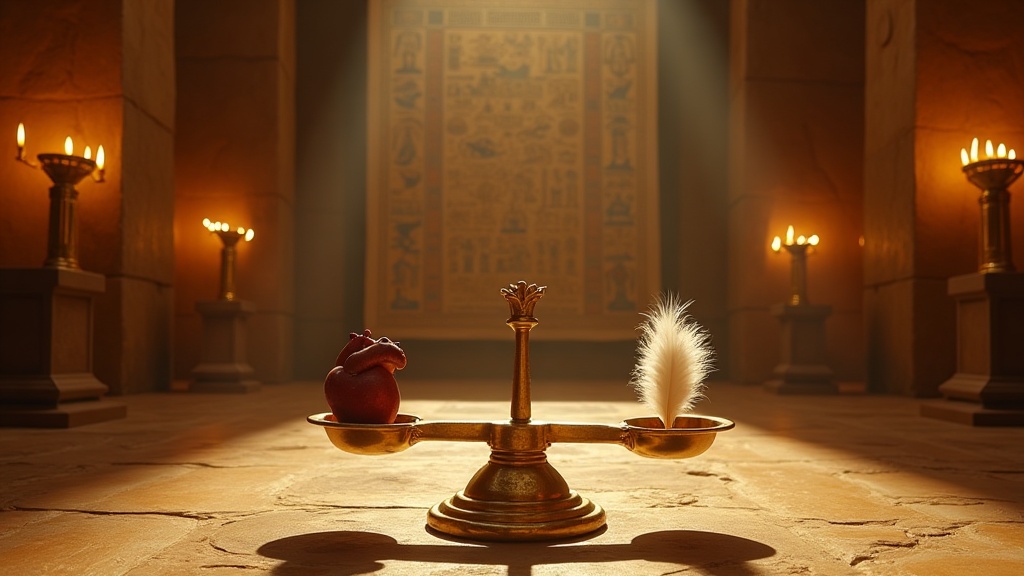
Egyptian
The Book of the Dead: Egypt's Guide to Eternity
Ancient Egypt's most sacred funerary text was not a single book but a living archive of spells, maps, and prayers that guided the dead through the perils between death and eternal life.
Egyptian
Eye of Horus: The Protective Amulet That Watched Over the Living and the Dead
Worn by pharaohs and fishermen alike, the Eye of Horus is one of antiquity's most potent protective symbols, carrying the weight of cosmic battle, divine healing, and eternal vigilance.
Egyptian
Ra the Sun God: Egypt's Supreme Ruler of Light and Creation
Ra, the ancient Egyptian sun god, blazed at the very heart of a civilization that worshipped light as the pulse of creation itself. Discover his origins, his many forms, and the sacred journey he took across the sky and through the underworld every single day.
Egyptian
The Ankh: Egypt's Eternal Symbol of Life
The ankh is ancient Egypt's most recognizable hieroglyph, a looped cross carried by gods and pharaohs alike as the very key to immortal life. Discover its origins, meanings, and sacred legacy.