
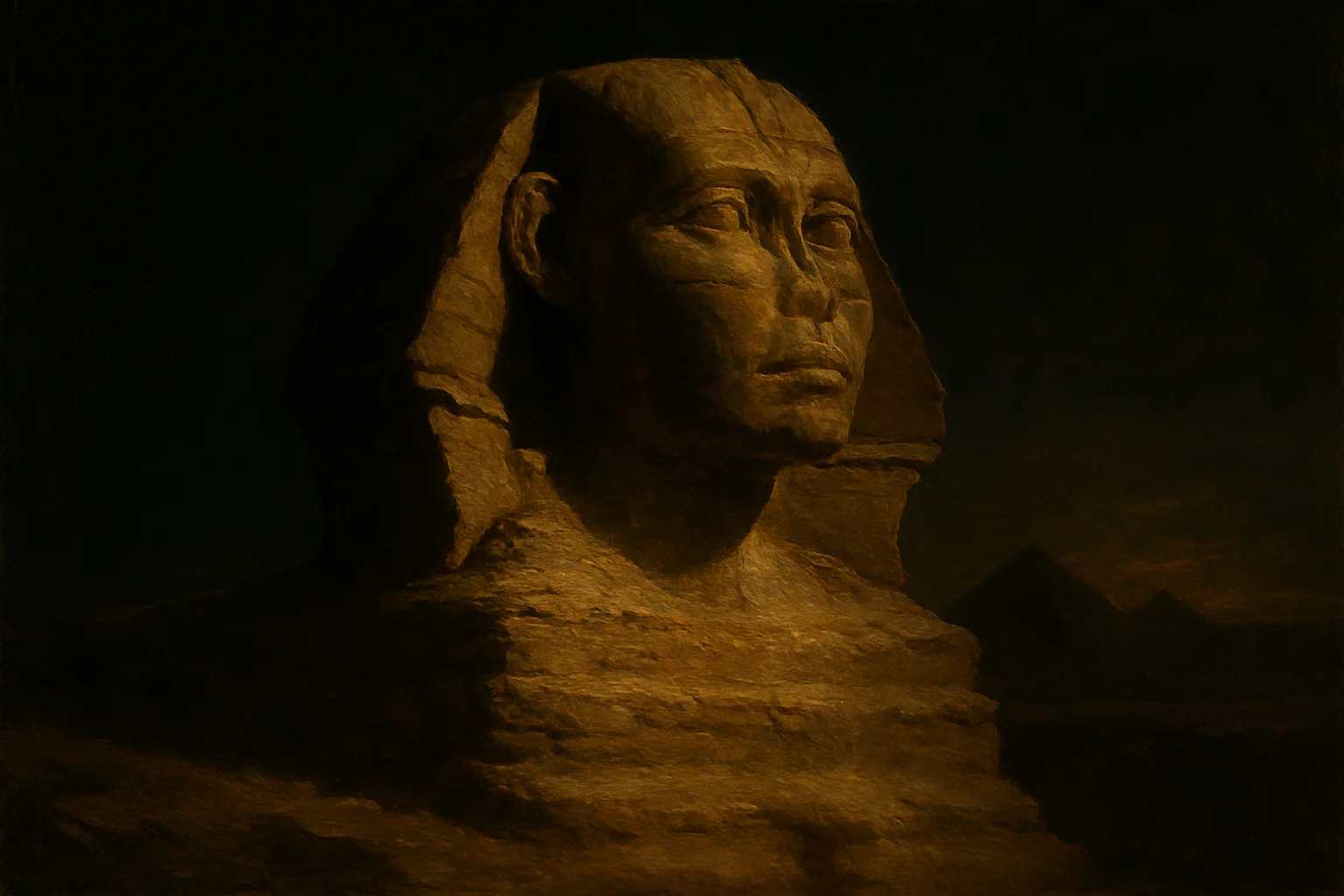
The Great Sphinx of Giza
The Great Sphinx of Giza carved from bedrock limestone during the Old Kingdom. Explore its construction, royal theology, and restoration history.
Contents
The Great Sphinx of Giza is a colossal limestone monument carved during Egypt's Fourth Dynasty, around 2500 BCE, depicting a lion's body with a human head, most likely representing Pharaoh Khafre. The statue measures approximately 73 meters long and 20 meters high, carved directly from the bedrock of the Giza plateau during construction of the Pyramids of Giza. It stands as the oldest known monumental sculpture in Egypt, embodying the fusion of royal power and divine solar authority that defined Old Kingdom theology.
The monument has spent most of its 4,500-year existence buried to the neck in sand. What survives today is a weathered giant, its nose gone, its beard fragments scattered, its surface scarred by millennia of wind, water, and misguided restoration. Yet the theological statement remains legible. This is not a riddle in stone. It is a guardian, a solar symbol, and a portrait of kingship rendered at a scale that still commands the horizon.
Carved from the Quarry: Construction and Material
The Sphinx was not built. It was excavated. Workers of the Fourth Dynasty cut down into a natural limestone outcrop on the Giza plateau, shaping the bedrock itself into the monument's mass. The stone is Mokattam Formation limestone, a sedimentary rock laid down some 50 million years ago when the region lay beneath a shallow sea. The quality varies by layer: harder bands alternate with softer, more porous strata, a geological fact that would determine the monument's fate.
The body and head were carved in situ, but the forepaws were constructed from separate limestone blocks. A small temple once stood directly in front of the Sphinx, aligned on an east-west axis with a causeway leading to Khafre's valley temple. The layout suggests the Sphinx was integral to the pyramid complex, not an afterthought. Quarry marks and tool traces visible on the enclosure walls match those found at other Fourth Dynasty sites, confirming the date and technique.
The scale is deliberate. At 73 meters long and 20 meters high, the Sphinx dwarfs every human figure carved in Egypt up to that point. It faces due east, toward the rising sun, a solar alignment that would be echoed in temple architecture for the next three millennia.
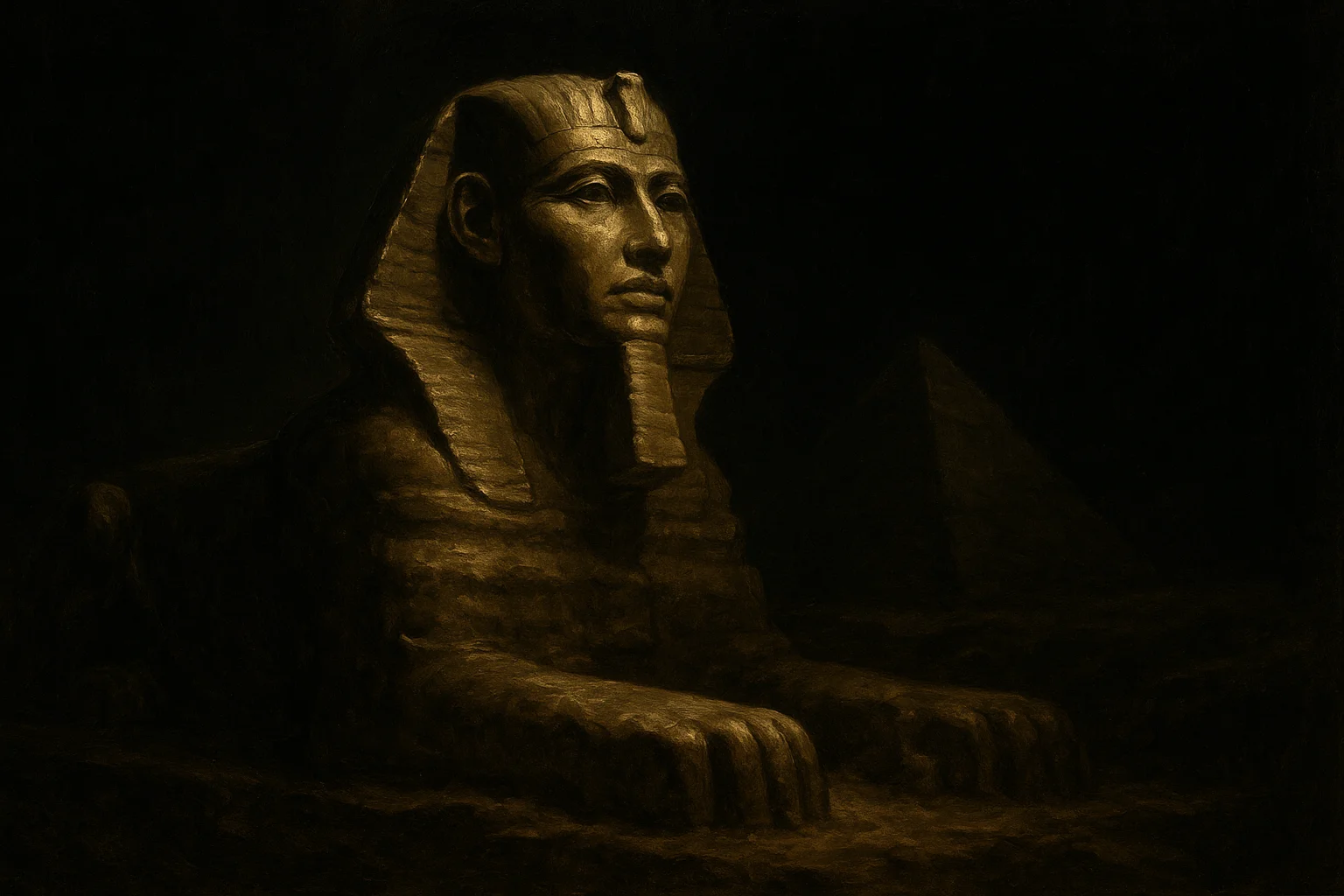
Dating and Attribution: The Fourth Dynasty Evidence
Most Egyptologists attribute the Great Sphinx to Pharaoh Khafre, builder of the second pyramid at Giza, based on stylistic, contextual, and geological evidence. The face of the Sphinx, though eroded, shares proportions with surviving statues of Khafre, particularly the diorite seated figure now in the Egyptian Museum. The Sphinx Temple and the Valley Temple of Khafre are built from the same core blocks quarried from the Sphinx enclosure, a clear construction sequence.
The so-called Inventory Stele, found at Giza in the nineteenth century, claims that Khufu, Khafre's predecessor, found the Sphinx already ancient and merely restored it. Scholars dismiss the stele as a later fabrication, likely from the Twenty-sixth Dynasty, when priests sought to anchor their temples to more distant, prestigious origins. The language, style, and theology all point to a date centuries after the Old Kingdom.
Herodotus, writing in the fifth century BCE, describes the pyramids in detail but never mentions the Sphinx. The omission is striking. By his time, the monument was likely buried to the neck, invisible to a Greek traveler walking the plateau. Pliny the Elder, writing five centuries later, notes the Sphinx briefly in his Natural History but offers no description, suggesting it remained largely hidden.
Form and Symbolism: Lion Body, Royal Head
The Sphinx combines two potent symbols: the lion and the king. In Egyptian royal ideology, the pharaoh is both. He is the living Horus, the son of Ra, the embodiment of divine order. The lion, meanwhile, appears throughout animals in ancient Egypt as a symbol of strength, ferocity, and solar power. The fusion is not metaphorical. It is literal.
The Lion in Egyptian Royal Ideology
Lions stalk the margins of Egyptian art from the Predynastic period onward. Kings are depicted as lions trampling enemies, or as human figures flanked by lions, or seated on thrones whose legs terminate in lion paws. The goddess Sekhmet, lioness-headed and fierce, embodies the sun's destructive heat. The pharaoh, as her earthly counterpart, channels that same force.
By the Fourth Dynasty, the lion had become shorthand for royal authority. Khafre's diorite statue shows him seated with a Horus falcon perched behind his head, but his throne is supported by lions. The Sphinx extends this logic to monumental scale. The king does not sit beside the lion. He is the lion, and the lion is him.
Solar Theology and Guardian Function
The Great Sphinx faces the rising sun, and its name in later periods reflects this orientation. New Kingdom texts call it Hor-em-akhet, "Horus of the Horizon," identifying the monument with the sun god at dawn. This is not a later reinterpretation. The alignment, the scale, and the placement all suggest that the Sphinx was conceived as a solar guardian from the outset.
The Egyptian gods do not dwell in distant heavens. They manifest in specific places, at specific times, through specific forms. The Sphinx, poised at the edge of the necropolis, watches the sun emerge from the eastern desert each morning. It does not symbolize the sun. It is the place where the sun becomes visible, where the divine enters the world of the living.
Guardian lions appear at temple gates and tomb entrances throughout Egyptian history. The Sphinx is the first and largest, a threshold figure that marks the boundary between the living world of the Nile valley and the eternal realm of the pyramids. Its gaze is not inward, toward the tombs, but outward, toward the river and the city beyond.
The Dream Stele of Thutmose IV
The most detailed ancient account of the Great Sphinx comes not from the Old Kingdom but from the Eighteenth Dynasty, a thousand years later. The Dream Stele, a granite slab erected between the Sphinx's paws by Pharaoh Thutmose IV around 1400 BCE, records a divine encounter. The young prince, not yet king, rests in the shadow of the Sphinx during a hunting expedition. The god speaks to him in a dream, promising the throne if Thutmose will clear away the sand.
"Behold me, look at me, my son Thutmose. I am your father, Harmakhis-Khepri-Ra-Atum. I will give you my kingdom on earth at the head of the living. The sand of this desert on which I stand has covered me. Promise me that you will do what is in my heart."
Thutmose clears the sand, restores the monument, and ascends to the throne. The stele presents the Sphinx as an active divine agent, capable of speech, of bestowing kingship, of demanding service. By the New Kingdom, the monument had acquired a name, a cult, and a voice. It was no longer simply a statue of Khafre. It was Hor-em-akhet, a god in stone.
The Dream Stele also reveals how quickly the Sphinx was forgotten and rediscovered. A thousand years after its carving, it was already buried, already in need of rescue. The pattern would repeat. Sand claimed it again under the Ptolemies, again under the Romans, again in the medieval period, again in the nineteenth century. Each generation that cleared the Sphinx believed itself to be the first.
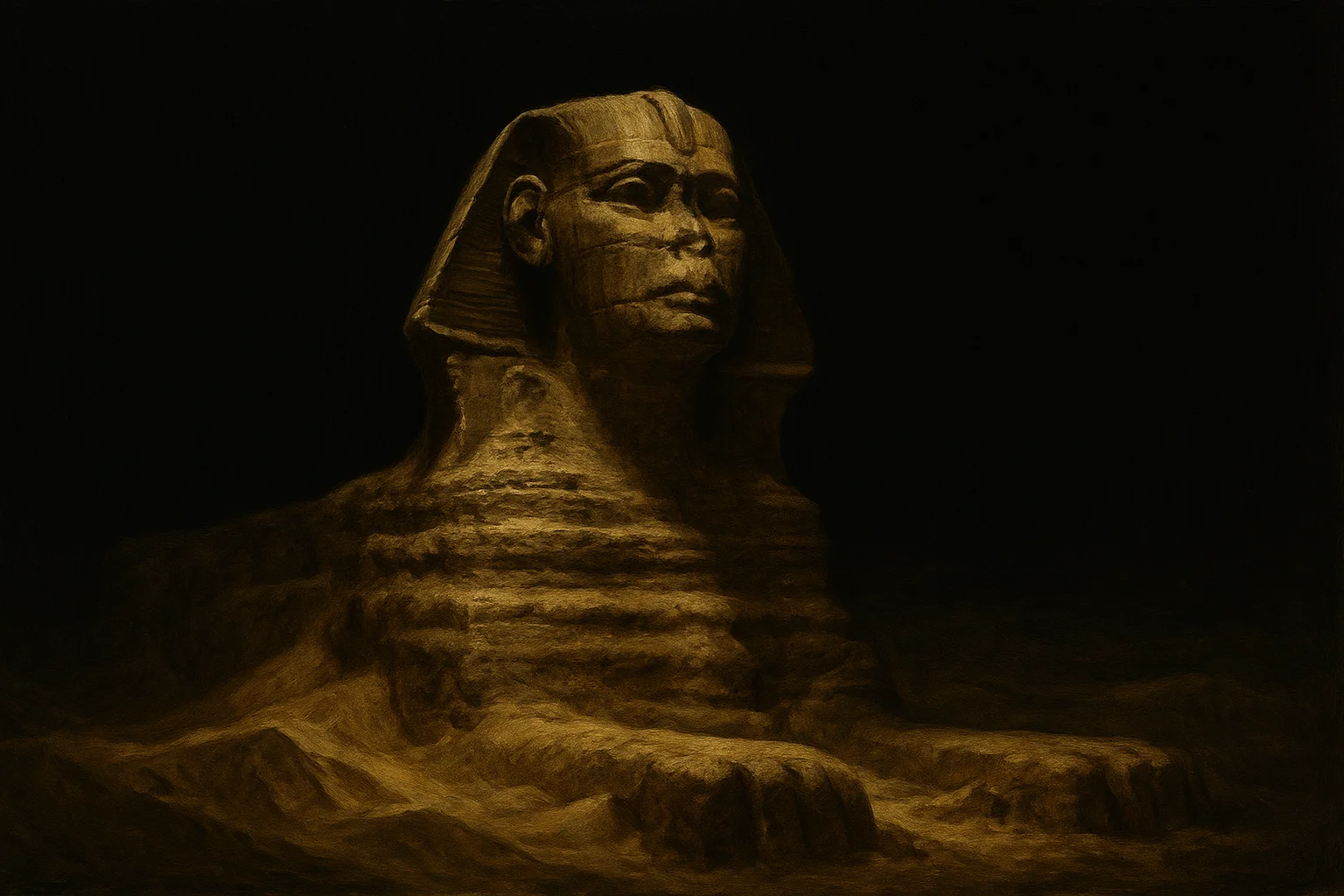
Erosion, Restoration, and the Sand
The Sphinx is dissolving. The soft limestone layers of its body erode faster than the harder bands, creating deep fissures and hollows. The head, carved from a more resistant stratum, survives in better condition, though the face is battered and the royal beard long since fallen. The body, by contrast, is a geological record of 4,500 years of weathering.
Debates over the cause and rate of erosion have generated more heat than light. Some argue that the vertical weathering patterns on the Sphinx enclosure walls suggest prolonged rainfall, pushing the monument's date back to a wetter climatic period before 10,000 BCE. Geologists and Egyptologists reject this claim. The erosion is consistent with wind-blown sand, periodic flooding, and the natural breakdown of layered limestone. The monument is exactly as old as the archaeological context suggests.
New Kingdom and Roman Repairs
Thutmose IV's restoration was not the last. Ramses II, that indefatigable builder, added his own repairs during the Nineteenth Dynasty. Roman-era inscriptions record further work, though the quality declined. By the time Pliny visited Egypt in the first century CE, the Sphinx was again half-buried, a curiosity rather than a cult center.
Medieval Arab writers describe the monument with a mix of awe and confusion. Some identify it as a talisman to control the Nile's flood. Others see it as a relic of a pre-Islamic past, powerful but inscrutable. The name "Sphinx" itself is Greek, borrowed from the sphinx as a mythical creature of Theban legend. The Egyptians never used it.
Modern Conservation Efforts
The first modern clearing of the Sphinx took place in 1817 under the Italian engineer Giovanni Battista Caviglia, who excavated the chest and forepaws. French archaeologist Émile Baraize completed the work in the 1920s, removing the last of the sand and exposing the full body for the first time in millennia. What he found was alarming: cracks, missing blocks, entire sections on the verge of collapse.
Restoration has been continuous ever since. Cement patches applied in the 1980s trapped moisture and accelerated decay, and had to be removed. Modern efforts focus on stabilizing the limestone with compatible materials, monitoring groundwater seepage, and controlling tourist access. The Sphinx is not a static monument. It is an ongoing negotiation between stone and time.
Ancient restorations
New Kingdom and Roman repairs used limestone blocks and mortar, matching the original material. These interventions are now part of the monument's history and are preserved where stable.
Modern restorations
Twentieth-century cement and polymer treatments proved incompatible with the limestone, trapping salts and moisture. Current work uses lime-based mortars and minimal intervention, prioritizing drainage and structural support.
The Sphinx in Later Egyptian Tradition
By the New Kingdom, the Great Sphinx had become a pilgrimage site. Stelae erected by private individuals cluster around the monument, recording prayers and offerings to Hor-em-akhet. The cult persisted into the Ptolemaic period, though by then the theology had shifted. Greek visitors conflated the Sphinx with their own riddle-posing monster, a misidentification that stuck.
The monument appears in hieroglyphics as a determinative for words related to divine images and sacred statues. It becomes a template: smaller sphinxes line temple avenues from Karnak to Luxor, each one a repetition of the Giza original. The form is endlessly copied, but the scale is never matched. The Great Sphinx remains singular.
Tutankhamun and other New Kingdom pharaohs commissioned their own sphinx statues, often with ram heads or falcon heads, blending the lion body with other divine forms. The grammar is established: lion body equals power, animal head equals specific divine identity. The Sphinx at Giza, with its human face, occupies a unique position. It is not a god wearing a lion's body. It is a king who has become one.
Visiting the Sphinx Today
The Sphinx sits at the eastern edge of the Giza plateau, a short walk from the pyramids. Visitors approach from the north, descending into the enclosure where the monument rests below the level of the surrounding bedrock. The scale is difficult to grasp from photographs. Up close, the body is massive, the head oddly small, the stone surface pitted and scarred.
The Dream Stele remains in place between the paws, though the inscriptions are worn. The Sphinx Temple, partially reconstructed, offers a sense of the monument's original ritual context. Tourists are no longer allowed to climb on the statue, and photography is restricted to certain angles. The site is crowded, especially at sunrise, when the alignment with the eastern horizon is most dramatic.
The view from the Sphinx back toward the pyramids is worth the visit. From this angle, the monuments align as they were meant to be seen: the Sphinx in the foreground, Khafre's pyramid rising behind, the entire complex oriented toward the sun. For a moment, the theology is legible. This is not a collection of tombs. It is a solar machine, a stone mechanism for transforming the dead king into the rising sun.
The site is managed by Egypt's Ministry of Antiquities, and access is included in the general Giza plateau ticket. Guided tours provide context, though the quality varies. The best time to visit is early morning or late afternoon, when the light is low and the crowds thinner. Bring water. The desert is unforgiving, and the Sphinx offers no shade.
Frequently asked questions
When was the Great Sphinx of Giza built and by whom?
The Great Sphinx of Giza was most likely carved during the reign of Pharaoh Khafre in the Fourth Dynasty, around 2500 BCE, as part of his pyramid complex on the Giza plateau. The monument was excavated directly from the limestone bedrock, and its stylistic features, including facial proportions and the alignment with Khafre's valley temple, support this attribution. Some later texts claim earlier origins, but these are considered unreliable by modern scholars.
What does the Sphinx symbolize in Egyptian royal theology?
The Sphinx embodies the fusion of royal and divine power, combining a lion's body, symbol of strength and solar ferocity, with a human head representing the pharaoh. In New Kingdom theology, it was identified as Hor-em-akhet, "Horus of the Horizon," linking the monument to the sun god at dawn. It functioned as a guardian figure, marking the threshold between the living world and the sacred necropolis, and as a manifestation of the king's divine authority rendered in monumental stone.
What is the Dream Stele and what does it tell us about the Sphinx?
The Dream Stele is a granite inscription erected by Pharaoh Thutmose IV around 1400 BCE, placed between the Sphinx's paws, recording a divine dream in which the Sphinx promised him the throne if he cleared away the encroaching sand. The stele reveals that by the New Kingdom, a thousand years after its carving, the Sphinx was already buried and had acquired a distinct divine identity as Hor-em-akhet. It also demonstrates the monument's role as an active cult site where pharaohs sought legitimacy through divine encounter.
Why has the Sphinx eroded so severely compared to nearby structures?
The Sphinx erodes more rapidly than the pyramids because it was carved from layered limestone bedrock with alternating hard and soft strata, rather than constructed from uniform blocks. The softer layers weather faster under wind, sand abrasion, and moisture infiltration, creating deep fissures and hollows in the body. The pyramids, built from harder Tura limestone casing blocks and Aswan granite, are more resistant. Additionally, the Sphinx spent millennia buried in sand, which both protected and, when wet, chemically attacked the stone.
How can visitors experience the Sphinx at Giza today?
Visitors can view the Great Sphinx from the enclosure at the eastern edge of the Giza plateau, included in the general site ticket, with the best light and smallest crowds at dawn or late afternoon. The Dream Stele remains visible between the paws, and the partially reconstructed Sphinx Temple offers context for the monument's original ritual function. Climbing on the statue is prohibited, and photography is restricted to certain angles to manage conservation and crowd flow.
Further reading on Mythologis
Free 25-page sample
Want the whole story?
Take the first 25 pages free. If it pulls you in, the full edition is yours as an instant PDF download, with a paperback on Amazon for selected titles.
Egyptian
The Egyptian Mythology Book: Ra, Osiris, Isis, Anubis, and the Sacred Stories of the Pharaohs
Ra, Osiris, Isis, Anubis, and the Sacred Stories of the Pharaohs
Three thousand years of Egyptian sacred stories. The Duat, the weighing of the heart, the cult of Osiris, and the daily voyage of the sun.
More from Egyptian
All articles
Egyptian
The Book of the Dead: Egypt's Guide to Eternity
Ancient Egypt's most sacred funerary text was not a single book but a living archive of spells, maps, and prayers that guided the dead through the perils between death and eternal life.
Egyptian
Eye of Horus: The Protective Amulet That Watched Over the Living and the Dead
Worn by pharaohs and fishermen alike, the Eye of Horus is one of antiquity's most potent protective symbols, carrying the weight of cosmic battle, divine healing, and eternal vigilance.
Egyptian
Ra the Sun God: Egypt's Supreme Ruler of Light and Creation
Ra, the ancient Egyptian sun god, blazed at the very heart of a civilization that worshipped light as the pulse of creation itself. Discover his origins, his many forms, and the sacred journey he took across the sky and through the underworld every single day.
Egyptian
The Ankh: Egypt's Eternal Symbol of Life
The ankh is ancient Egypt's most recognizable hieroglyph, a looped cross carried by gods and pharaohs alike as the very key to immortal life. Discover its origins, meanings, and sacred legacy.